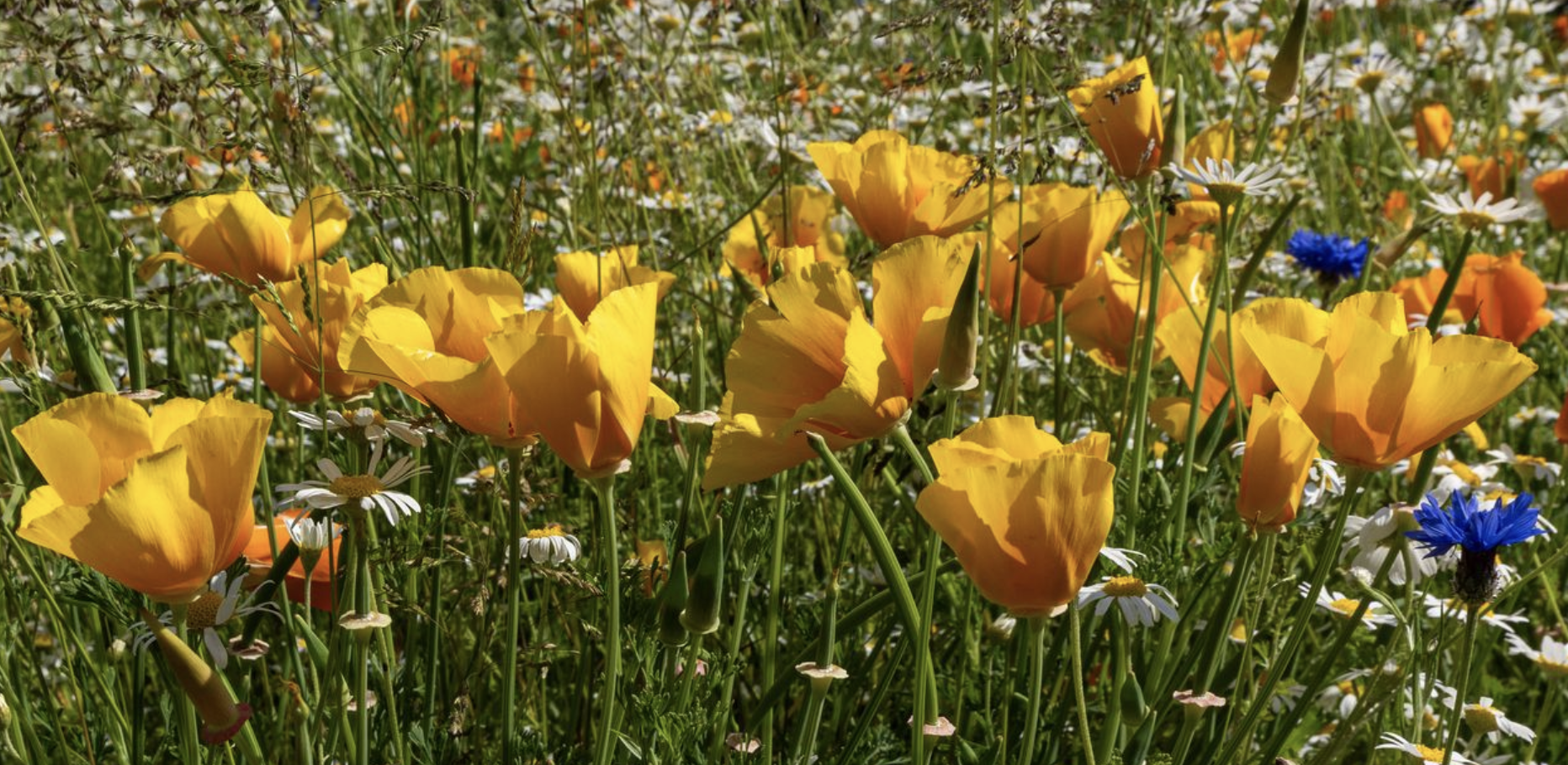
Eschscholzia californica – May 11th 2026 – California Poppy
California poppy Eschscholzia californica is a garden plant that came to Europe from California long ago. It ‘escaped’ from gardens and the first British record from the wild was in 1864. Its history is told by Alice Coats in her book Flowers and their Histories.
The species was ‘discovered’ in California by Archibold Menzies in 1792 and seeds were raised in Kew, but then the plant was ‘lost’. It was rediscovered in 1815 by Adelbert von Chamisso, poet and storyteller, employed as the botanist aboard the Russian ship Rurik. He named it after his fellow-voyager and naturalist Johann von Eschscholtz. Of him, the famous Victorian garden-writer James Shirley Hibberd wrote “Peace to his dust, honour to his memory, and may his name…be henceforth and for ever spelled correctly”. Even today, the spelling and pronunciation of ‘Eschscholzia’ is a challenge for english-speaking gardeners and botanists.

California poppy Eschscholzia californica. Image: Richard Milne
It is a striking plant, with orange petals and finely divided leaves (there are cultivars with whitish and reddish flowers). The pigments forming the colours include unique carotenoids (one is called eschscholtzxanthin). Flowers are visited by flying insects – bees, beetles, and flies –surprisingly, the flowers have rather little nectar but lots of pollen. They close at night and in dull weather (‘nyctinasty’).
As with most (perhaps all?) poppies, the plant contains a milky sap, but the milkiness is less well developed than in most others, often described as a thin, coloured latex rather than the thick, white sap found in other poppy species. The sap of poppies contains poisonous alkaloids used by the plant for protection against herbivores.
The plant is an annual, sometimes behaving as a perennial. After blooming (July to September) the plants form long seedpods that audibly crack as they split open to throw out the seeds, many of which are likely to germinate in the following year. In the dry conditions of California, the seeds may lie dormant in the dry soil for a few years until the right combination of moisture and temperature triggers germination, resulting in the rare botanical phenomenon called super-blooming whereby an unusually high volume of wildflower seeds germinate and bloom simultaneously. This event typically occurs in arid regions, such as the deserts and hills of Southern California, transforming dry, barren landscapes into vibrant carpets of orange, yellow, and red. People come from far and wide to witness the spectacle.

Walker Canyon, Riverside County, California – During the 2019 Poppy Super Bloom. Attribution: Bluesnote Own Work, creative Commons via Wikipedia.
There are no reports of superblooms in Britain – in our much more oceanic climate the soil is usually damp in the spring and so germination is never held back by a lack of water. In our urban flora project we have seen California poppy many times in towns and cities (including Banchory, Dumbarton, Rosyth, Edinburgh) often in parkland or on road verges. The BSBI’s Atlas 2020 gives the habitats as “pavements, roadsides and refuse tips, but sometimes naturalized in quarries, old gravel and ballast pits, on railway tracks and waste ground”. It can flourish in poor, sandy, or well-drained soils which often occur in urban environments.

California poppy in full flower. Image: Chris Jeffree.
In Britain it can be confused with the Welsh Poppy (Papaver cambricum) as both have yellow or orange flowers. However, P. cambricum begins flowering earlier, in May, and doesn’t have the finely divided leaves that help to define E. californica.

California poppy, detail of the finely divided leaves. Image: Chris Jeffree.
Culturally, Eschscholzia californica is rather ‘special’ to California’s identity. It was adopted as the state flower in 1903, symbolizing the beauty and resilience of the region. The plant is celebrated annually on April 6th as California Poppy Day, and entire landscapes are dedicated to its preservation and appreciation.
Historically, the California poppy has also been used for medicinal purposes. Indigenous peoples of California utilized the plant for its mild sedative and analgesic properties. Extracts from the plant were traditionally used to promote relaxation, alleviate pain, and aid sleep. Unlike its relative, the opium poppy (Papaver somniferum), Eschscholzia californica has few narcotic compounds, making it a safer alternative in herbal remedies. Modern herbalists still use California poppy extracts in tinctures and teas for anxiety relief and insomnia, though scientific research on its efficacy is not yet complete.

Eschscholzia californica – British and Irish distribution from BSBI/Maps
The plant may also be useful as a model species for research into the genetic control of flower development because of its simple flower structure and short life cycle. Annette Becker of the Hustus-Liebig-University in Germany calls it the “Papaveraceae golden girl model organism” and provides a useful account of the evolutionary relationships of the various subfamilies in the Papaveraceae. In Britain we do of course have plenty of red poppies (Papaver rhoeas and P. dubium) as well as the colourful Opium Poppy P. somniferum and the Welsh Poppy. These species have already been described in this series of blogs, here, here and here.
So, what’s not to like about California poppy? It is a widely distributed invasive plant in Chile, particularly within the Mediterranean region. Introduced over 100 years ago, it thrives in disturbed habitats and open grasslands, spreading between 30°S and 38°S latitude and from sea level to 2200 meters. Chilean populations have adapted to their new environment, sometimes producing more seeds than their native counterparts in California.
References consulted
Becker A, Yamada Y, Sato F. (2023). California poppy (Eschscholzia californica), the Papaveraceae golden girl model organism for evodevo and specialized metabolism. Frontiers of Plant Science 2023 Mar 2;14:1084358.
Bustamante RO et al. (2017). Genetic and phenotypic variation, dispersal limitation and reproductive success in the invasive herb Eschscholzia californica along an elevation gradient in central Chile. Plant Ecology & Diversity, 10, 419–429.
Cook SA. (1965). Population regulation of Eschscholzia californica by competition and edaphic conditions. The Journal of Ecology 53, 759-769.
Leger EA and Rice KL (2003). Invasive California poppies (Eschscholzia californica Cham.) grow larger than native individuals under reduced competition. Ecology letters 6, 257-264.
©John Grace