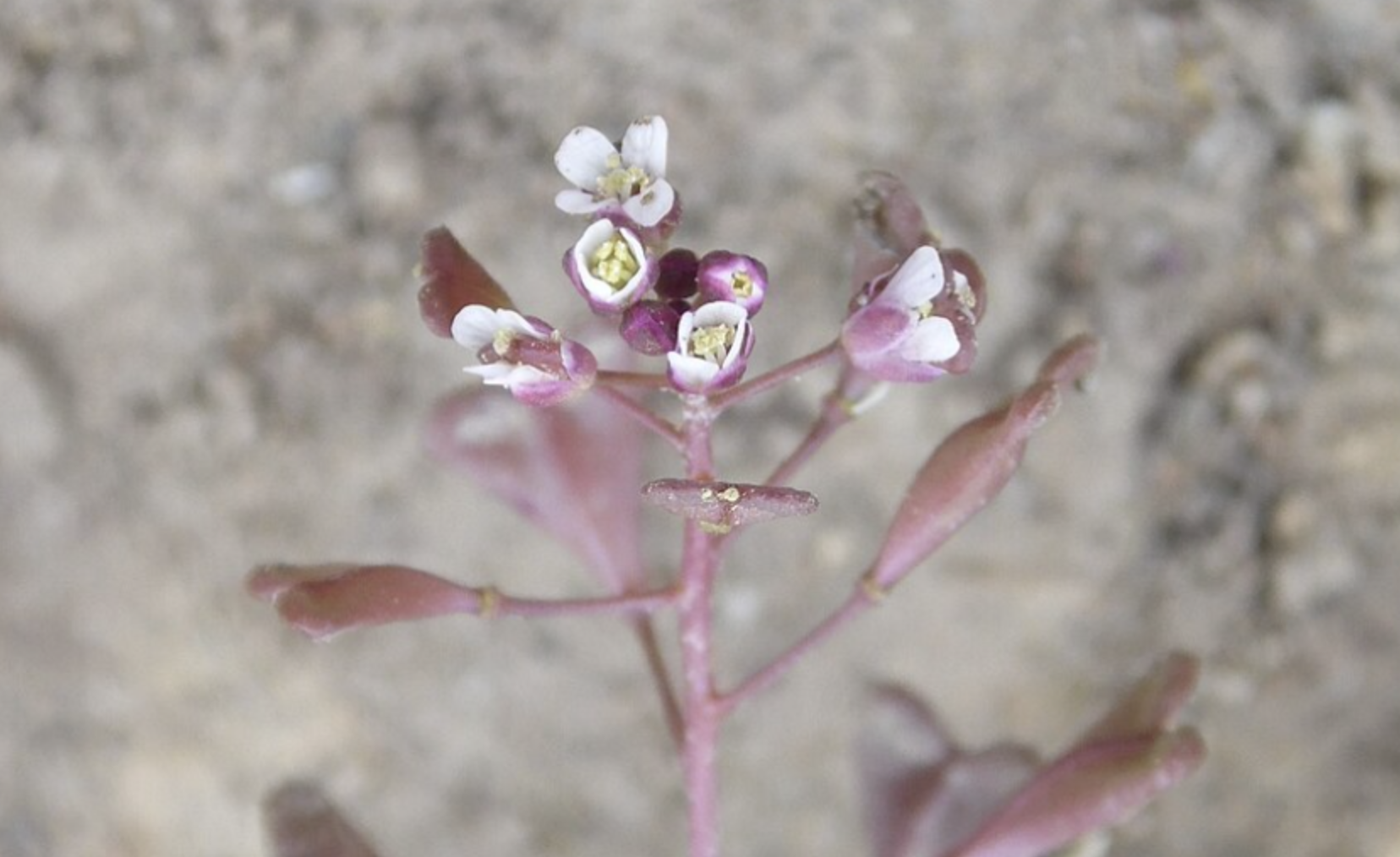
Capsella rubella – May 25th 2026 –Pink Shepherd’s-purse
Last week the BSBI Recorder for Midlothian, Sue Jury, emailed me to say she’d found Capsella rubella, the Pink Shepherd’s-purse. This plant is rare in Britain and very rare in Scotland. I’ve never seen it, and if I were to come across it, I might think it to be Capsella bursa-pastoris, the common Shepherd’s-purse, perhaps suffering from a mineral deficiency. It’s quite like the common Capsella but has smaller flowers, and a red tinge.
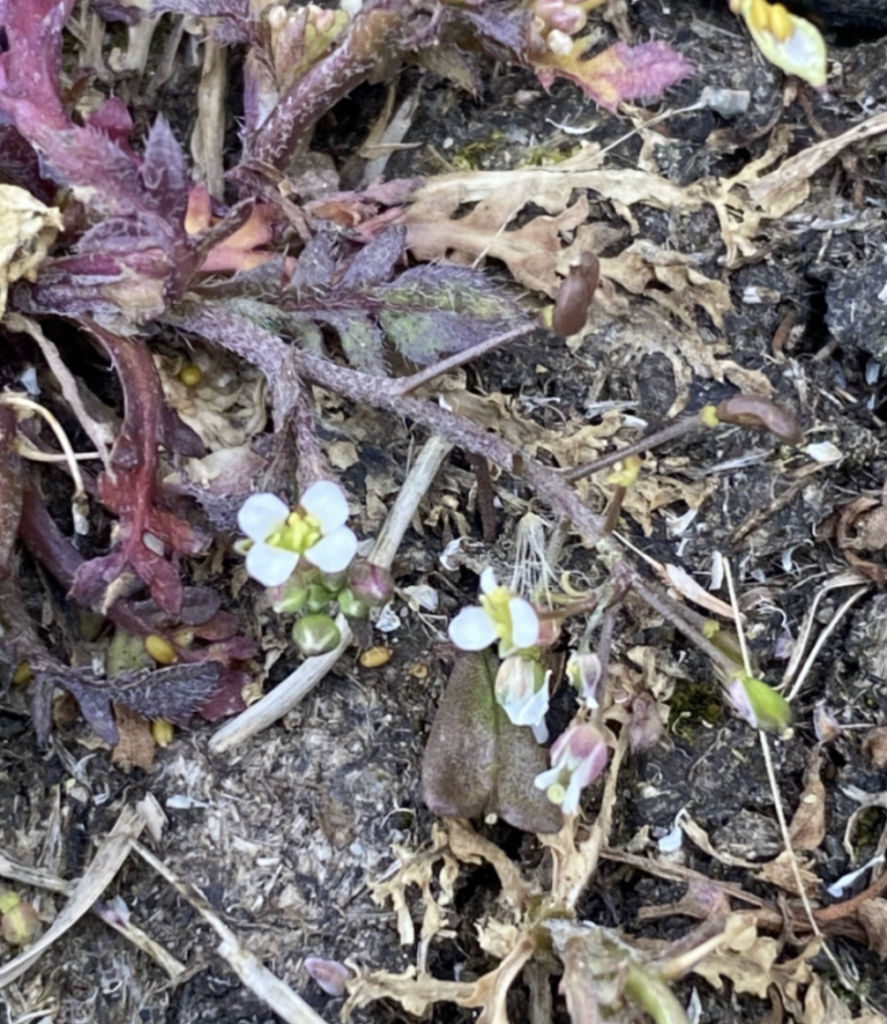
Here’s what Sue Jury spotted.
In Scotland, it appeared first in 1961/2 at the Tomatin Distillery. Thirty years elapsed before its next appearance which was at Loch Leven 1991/2. Then, in 2006 it was spotted in Glasgow. In 2023 it was recorded at a campsite in Ardrossan, and now (2026) it has been seen at Holyrood Park and Blackford Hill in Edinburgh. There appears to be no geographical pattern, and appearances are random and brief.

As seen through a hand-lens. Note red/purple tinge, small flowers. Image: Sue Jury
The plant is an annual belonging to the cabbage family Brassicaceae, and it comes from southern Europe; its seeds may have travelled on the boots of holidaymakers from sunnier climes (all the sites mentioned above are tourist attractions). Perhaps it’s too cold in Scotland, so it makes only a brief appearance before death. Another possibility is that it is not rare, but recorders have mistakenly written it down as Capsella bursa-pastoris, the common Shepherd’s-purse. Perhaps both hypotheses hold.

Showing arrangement of flowers and fruits on the stems, very similar to Capsella bursa-pastoris which we featured back in 2022. Image: Richard Milne.
It is more common in southern Britain and was first recorded in 1928 (in Surrey). For clues, I turned to the BSBI Atlas 2020. They say “its distribution has been increasing in recent years, becoming persistent in some areas. It was recently discovered as a frequent alien of disturbed turf in caravan and camping sites throughout southern England where it appears to have been introduced unintentionally by tourists from southern Europe”.
Despite its similarity to C. bursa-pastoris, there can be no doubt about its status as a true species. The chromosome count clinches it. C. bursa-pastoris is a tetraploid (4n = 32) whereas C. rubella is a diploid (2n = 16). Both are self-pollinated, and believed to have evolved from the outcrossing species C. grandiflora. Self-pollination (‘selfing’) is of course considered in evolutionary terms to be a ‘bad thing’ because of ‘inbreeding depression’ and the lack of variation in the offspring which limits adaptations to environmental change. On the other hand, over short time periods it can be successful, and may lead to the formation of enduring microspecies. Around 50 percent of all flowering plants are predominantly outcrossing whilst only 15 percent are self-fertilising (‘selfed’). The remaining 35 percent have a ‘mixed mating system’, often using the ‘selfing route’ when pollination fails (when insects are not around, for example).

Capsella rubella by Gilles San Martin, Creative Commons (CC BY-SA)
It is widely believed that Capsella rubella evolved from an outcrossing ancestor similar to Capsella grandiflora. During this evolution, the plant evidently underwent a transition from cross-pollination to self-fertilization. Now, molecular geneticists have adopted Capsella as a kind of ‘model species’ to study how outcrossing ancestors gave rise to today’s selfing species, and they think the transition occurred ‘recently’, in fact 30-50 thousand years ago (considered a short period in evolutionary time-scales).
Researchers have investigated floral scent. In the outbreeding ancestor C. grandiflora, benzaldehyde is a main compound of floral scent, but it is lacking or strongly reduced in the selfing species C. rubella.

Distribution of Capsella rubella in Britain and Ireland, from BSBI/Maps
Hybrids between C. rubella and C. grandiflora are sometimes recorded. They are sterile, with empty pollen and no seeds (Stace et al. 2016). But the fact that hybrids exist indicates that sometimes (rarely?) C. rubella can become sexual and either produce or received pollen.

Left: Global distribution of Capsella bursa-pastoris from GBIF and Right: from Plants of the World Online, showing native (green) and countries where the plant has been introduced (purple).
In the course of writing this, and browsing the literature, I have seen that Capsella rubella is one of the most informative plants in evolutionary genetics. The species demonstrates how even tiny plants can provide insights into evolution, adaptation, and heredity. Its small size, fast reproduction and similarity to Thale Cress (Arabidopsis thaliana) mean it is highly suited as a laboratory organism. By studying Capsella rubella, we may uncover important ecological principles about how plants survive, reproduce, and evolve in changing environments.
But unlike many members of the Brassicaceae, people do not eat it.
Attribution of image
The image at the top of this article is fromKrzysztof Ziarnek, Kenraiz, CC BY-SA 4.0 https://creativecommons.org/licenses/by-sa/4.0, via Wikimedia Commons
References consulted
Charlesworth D and Charlesworth B (1987). Inbreeding depression and its evolutionary consequences. Annual review of ecology and systematics, 237-268.
Guo YL et al. (2009). Recent speciation of Capsella rubella from Capsella grandiflora, associated with loss of self-incompatibility and an extreme bottleneck. Proceedings of the National Academy of Sciences, 106, 5246-5251.
Jantzen F et al. (2019). Retracing the molecular basis and evolutionary history of the loss of benzaldehyde emission in the genus Capsella. New Phytologist, 224(3), 1349-1360.
Mendoza SP, Lascoux M and Glémin S (2018) Competitive ability of Capsella species with different mating systems and ploidy levels, Annals of Botany, 121, 1257 1264.
Penin AA et al. (2024) Origin and diversity of Capsella bursa-pastoris from the genomic point of view. BMC Biol. 22, 52. doi: 10.1186/s12915-024-01832-1. PMID: 38439107; PMCID: PMC10913212.
Pope C and Stanley P (2018) Caravan touring sites – an overlooked habitat for introduced species. BSBI News 139, 53–55
Sicard A and Lenhard M (2018) Capsella. Current Biology, 28, R920-R921.
Stace C, Preston C and Pearman D (2015) Hybrid Flora of the British Isles. BSBI.
©John Grace