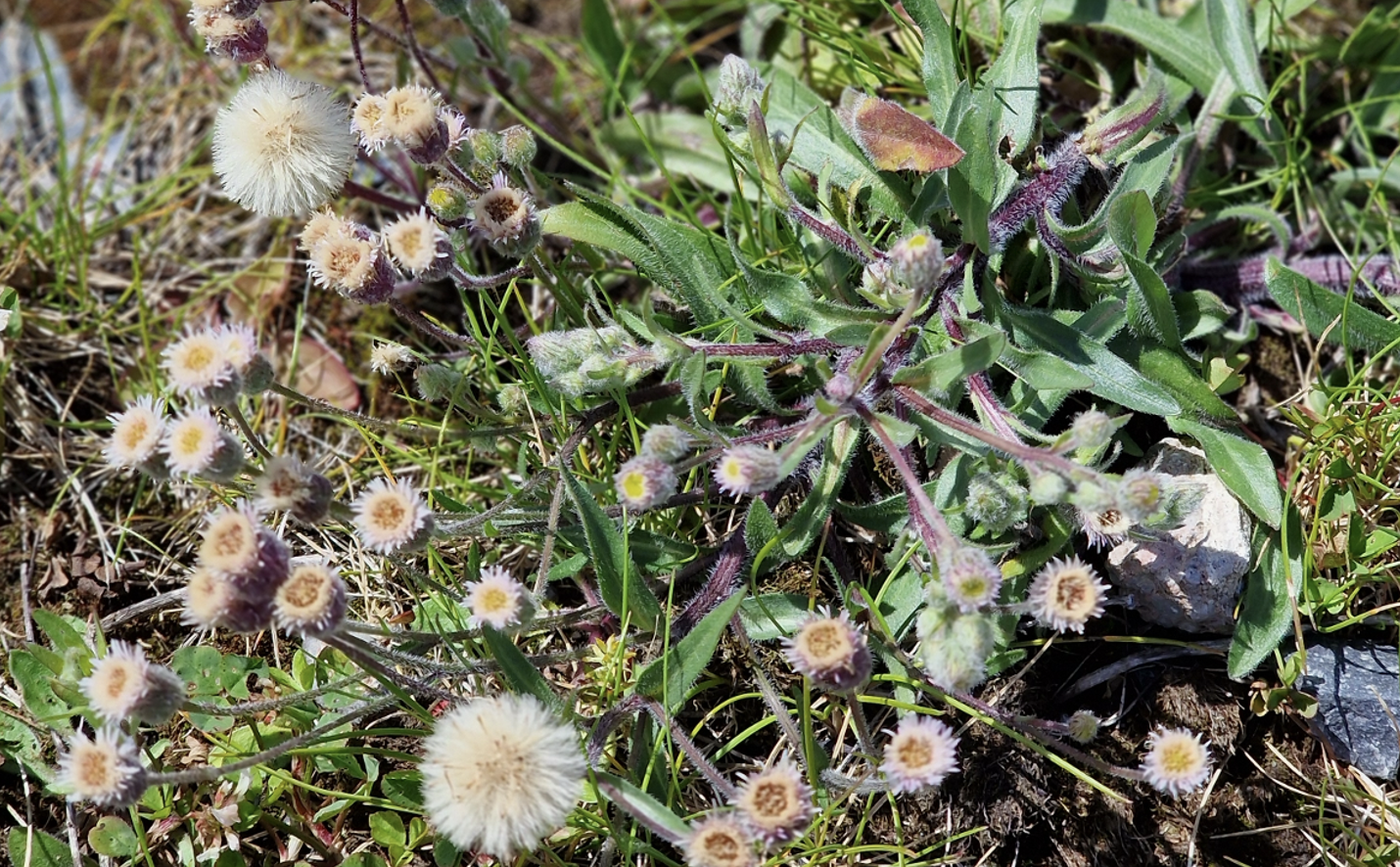
Erigeron acris – June 15th 2026 – Blue Fleabane
Back in 2016 I found the Blue Fleabane in Stranraer, a town in the southwest of Scotland. We were exploring a derelict car park at the disused ferry port, where vehicles would have queued in their hundreds to catch the ferry to Northern Ireland. But the ferry service was closed in 2011. The site was then abandoned, and the ferries began using the new £200 million port development at Cairnryan, several miles north, where the water was deeper and the route to Ireland somewhat shorter.

Part of the large derelict car park at Stranraer, abandoned since 2011, but home to many ruderal species capable of surviving frequent application of herbicide. Image: John Grace
The cracks between the concrete slabs of the old port had been colonised by the usual range of ruderal plants – thistles, ragweed, dandelions, willowherbs, poppies and grasses. The unusual one that caught my eye was the Blue Fleabane. It had been recorded only once before in that part of Scotland.
In the years that followed I looked for it again, but it wasn’t there. In some years, weedkiller was used and the ground looked awful, covered with dead and decomposing vegetation. A perimeter fence was installed with ‘keep out’ signs. Gulls swooped, evidently nesting nearby.

Blue Fleabane from Stranraer, showing a mature plant beginning to set seed. Image: John Grace
Last week I decided to look again. This time, I entered the site at a completely different place, via a hole in the fence near the adjoining railway station (trains to Glasgow are still operating, but with a reduced service). There were many Blue Fleabanes. This time the gulls attacked me as I cautiously wandered across the area where elongated letters spelling ‘COACHES’ could still be seen written on the eroded concrete.
Erigeron acris, the Blue Fleabane is a native species, much more common on the lime-rich parts of southern England than in Scotland1. In South Yorkshire and Derbyshire, Grime et al (1988) found it only on ‘skeletal soils’ by which they meant shallow soils consisting mostly of coarse rock fragments and gravel, as found in quarries and some derelict sites. The BSBI’s PlantAtlas2020 goes further in its habitat description, to include “sand dunes, sand- and gravel-pits, spoil and waste heaps from quarries, railway ballast, industrial waste and cinders. It also grows on rock outcrops, especially of chalk and limestone and on mortared walls”.

Blue Fleabane on top of the mortared brick wall between the train station and the derelict site at Stranraer. Other species growing on the wall include Plantago coronopus (Buck’s-horn Plantain) and Catapodium marinum (Sea Fern-grass). Image: John Grace
Mortared walls? Yes. At Stranraer it was not only on the concrete ground of the parking area, but also on the mortar of a brick wall of the railway station. There, the plants were quite small, and more exposed to wind and salt spray, less than 10 cm tall. Plants as tall as 60 cm can occur.
The plant appears to shy away from colder parts. Grime et al (1988) point out that it is ‘scarce’ on the upland carboniferous limestone of Derbyshire but ‘frequent’ on lowland limestone in South Yorkshire. The authors also saw it more often on south-facing than north-facing slopes. Moreover, according to the PlantAtlas2020,it is increasing in Britain, especially so in Ireland, perhaps aided by the climatic warming trend.

Blue Fleabane, showing lilac-coloured (‘blue’) ray florets, and general hairiness. Image: Chris Jeffree.
But in the world, Blue Fleabane has a circumboreal distribution, extending to some of the coldest northern regions into what has been called ‘Russian Lapland’, and into Greenland. It seems the species has numerous subspecies, with a wide range of environmental tolerances, some more able to survive the cold than others. Russian botanists have tried to ‘tidy up’ the confusion (Sennikov and Kozhin 2023), and Chinese records also suggest differences from what we in Britain call Erigeron acris. I was relieved to see we have just a single species, considered to be ‘native’ in most northern countries (Stace 2019).

Seed head and an individual seed with its parachute-like pappus of hairs, aiding dispersal by wind. Images: John Grace
In our Urban Flora project, we found Blue Fleabane several times in Glasgow (including the university campus at Gilmorehill) and also in Edinburgh (Granton, outside the National Museums Collection Centre). The BSBI database reveals many more Scottish records, often from quarries but also from a wind-farm (Pateshill, West Lothian) and from coastal areas (Tentsmuir, Belhaven Bay, Aberlady). It is not generally reckoned to be salt-tolerant, but it does seem to be disproportionately represented around the coast.
I was curious to see how Blue Fleabane fares in London, having just bought a copy of Mick Crawley’s 1223-page book, London’s Plants. He found it at the Arena Essex, on ‘disturbed ground by the speedway track’ with about 60 other species forming ‘an interesting community of small plants’. He muses ‘How many of these survive Google’s redevelopment of the site remains to be seen’.

Blue Fleabane, distribution in Britain and Ireland, with Stranraer encircled. From BSBI/Maps
Erigerons belong to the daisy Family, the Asteraceae. As with all daisies, the flower is a composite of many tiny florets bounded by green bracts called phyllaries. Unlike the common daisy (Bellis perennis) the ‘ligules’ of the outermost florets (appearing in daisies as the white ‘petals’) are short and purplish-mauve, so the flower is quite inconspicuous. Small flying insects may see these flowers better than we humans can, but there is a dearth of information about floral biology and pollination of this species. Abundant seeds are formed and evidently they are wind-dispersed.
Grime et al (1988) remark that this is “a species that required further study in field and laboratory”. But very little ‘further study’ seems to have occurred since they wrote this comment nearly 40 years ago. Other Erigerons better known and widely grown in gardens.
Lately, Erigeron karvinskianus (Mexican daisy) and Erigeron glaucus (Seaside fleabane) have become popular. But Blue fleabane remains the ‘Cinderella of the fleabanes’.
Meanwhile, I’ve been trying to find out more about the site at Stranraer. What will become of it? There has been a local battle between those who want to see ‘regeneration’ of the place (a seaside attraction?) and those, like the haulage giant Manfreight, who want a big lorry park2. My reading of the local papers suggests that the lorry park is winning.
Postscript
I revisited the site yesterday (13th June 2026) and found most of the plants were dead or dying. The gulls were silent this time. A week ago the plants were fine. What herbicide is being used? How is this allowed in a town that is part of the Galloway and Ayrshire Biosphere Reserve, and which borders Loch Ryan where oysters are harvested for human consumption?
Notes
1 On the BSBI data base, the earliest Scottish records are from the 1960s.
2 the haulage industry employs around 60 lorry drivers locally – generating more than £2.5m in wages and spending in the community, with hopes to double that workforce.
References consulted
Crawley MJ (2026) London’s Plants. UKBookPublishing.
Flora of China, Vol. 20-21 Page 645 (consulted online).
Grime JP, Hodgson JG and Hunt R (1988) Comparative Plant Ecology. Unwin.
Olader S and Tyler T (2017) Morphometrics and taxonomy of Erigeron acris sensu lato in Fennoscandia. New Journal of Botany 7, 39-50.
Sennikov AN and Kozhin MN (2023) Taxonomic revision of the Erigeron acris group (Asteraceae) in Murmansk Region, Russia, reveals a complex pattern of native and alien taxa. Phytokeys 235, 83-128. (this massive work is not for the faint-hearted, but it is open-access if you go here.
Stace C A (2019) New Flora of the British Isles. C&A Publishing.
©John Grace