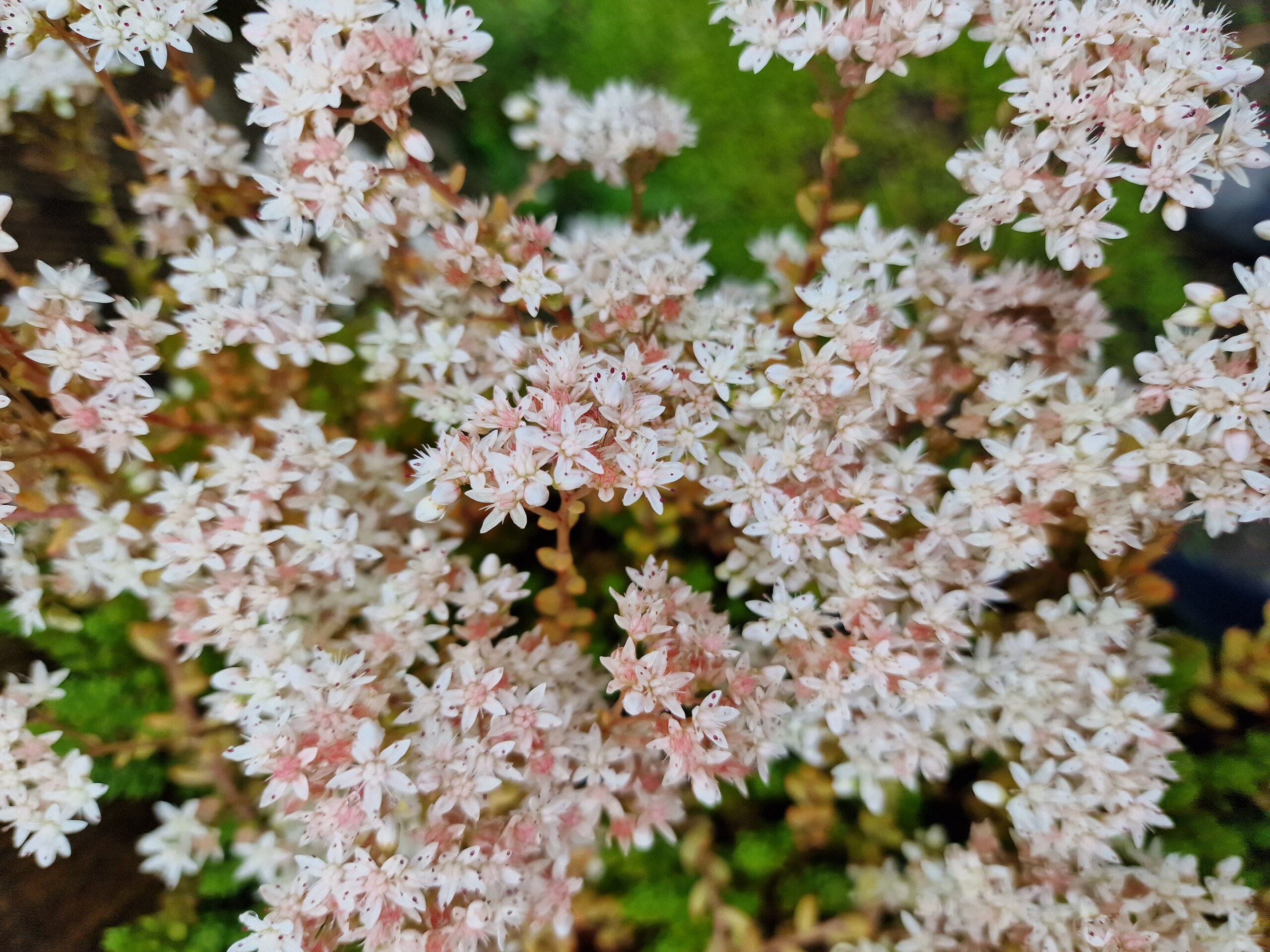
Sedum album – JuLY 6th 2026 – white stonecrop

Sedum album at derelict motor works, Granton, Edinburgh. Image: Chris Jeffree.
Sedums are succulent plants with star-like flowers and fleshy leaves belonging to the Family Crassulaceae, and known as Stonecrops because they thrive in gravelly and stoney places. The three most common in Britain are Sedum acre, S. anglicum and S. album. Sometimes they are found as weeds on roofs, where they can be hard to remove, but (ironically) they are now being used by architects to make ecologically friendly ‘green roofs’. The most famous of these is at the Rolls Royce factory in Goodwood (West Sussex, England). The quotation below is from a site which botanists rarely peruse, 1chauffeur.co.uk. A more fulsome story about this vast green roof is in the Guardian newspaper here.

Sedum album is one of the species often selected for green roofs. Its natural habitat in UK is described thus in the BSBI’s Online Plant Atlas 2020:
“..open, nutrient-poor and base-medium to rich dry sites, including limestone rocks, walls, roofs, the concrete of old airfield runways, maritime shingle, paths, pavements, waste ground, disused railways and sidings, old sand- and gravel-pits and churchyards and cemeteries where originally planted on graves”.

Sedum album, showing a single stem with an inflorescence made of over 20 flowers. Image: John Grace
Gravelly and sandy habitats are often dry, with high surface temperatures in sunny weather, and they are frequently disturbed and trampled. Sedum album doesn’t mind. Like most members of its Family, it can regenerate from fragments. More importantly, Sedums have the remarkable property of keeping their stomata closed in the heat of the day to conserve water, and opening them at night to take up their CO2 in a process called Crassulacean Acid Metabolism (‘CAM’)1.

Sedum album in bud (left) and in full flower (right). Note the large number of flowers per inflorescence. Images: John Grace.
Most plants can’t do CAM; they open their stomata in the day to take up CO2 in daylight by the classical process of photosynthesis which captures the carbon as the 3-carbon compound (‘C3 photosynthesis’). But Sedum album is extra-special: it can flexibly switch from CAM to C3 to suit conditions. When water is plentiful, it does C3 but when dry it goes into CAM mode.

Sedum album, at Granton derelict motor works, Edinburgh. Image: Chris Jeffree
It can be hard to tell the three Sedums apart, but the difference becomes apparent when they flower. Sedum acre has yellow flowers and tastes remarkably peppery2. Sedum anglicum has pink flowers with only 3-6 flowers per inflorescence, and Sedum album has pale pink or white flower with over 20 flowers per inflorescence.

Sedum anglicum at Bennane Head, South Ayrshire (left) and Sedum acre at a derelict car park in Stranraer (right). Images: John Grace.
These three are all tough little plants. A few weeks ago I visited a derelict carpark in Stranraer which had been treated with herbicide. Almost all vegetation was dead or dying, but bright yellow patches of Sedum acre stood out against the brown skeletons of all other species. I presume the resistance to herbicide is aided by the smooth waxy surface of the leaves, repelling water, and the closed stomata during the day when the spraying occurred.
There are many more Sedums in Britain (Stace’s New Flora of the British Isles list 19, many having been introduced as garden plants, but these are uncommon here in Scotland). In contrast to most, there are two native Sedums that grow in moist northern conditions: S. villosum (Hairy Stonecrop) and S. rosea (Roseroot). Mostly, they occupy hills and mountains.
Taxonomists have discovered the genus Sedum needs revision, as Recent DNA-evidence show these plants evolved from multiple different ancestors. For example, Sedum telephium becomes Hylotelephium telephium, Sedum rosea becomes Rhodiola rosea, and Sedum spurium becomes Phedimus spurius. However, the three Sedums we describe above remain Sedum.

Formerly Sedum spurium. It looks like Sedum but DNA says ‘no’ and now it is Phedimus spurius. Image: Chris Jeffree
Sedum album is thought to be an ancient introduction, although some authors suggest it is native to some parts of the south. The present distribution in the British Isles is markedly southern, reflecting the likely southern European native distribution, although it is recorded in Orkney and Shetland.

Distribution of Sedum album in Britain and Ireland, from BSBI/Maps.
Notes
1.Most plants open their stomata to capture CO2 by day to form a 3-carbon compound, phosphoglycerate (the process called ’C3 photosynthesis’). But there are variants of this. One of them is widespread in succulent plants, particularly those in the Families Crassulaceae and the Cactaceae. It is called Crassulacean Acid Metabolism (‘CAM’) and occurs in about 7% of plants. CAM is a remarkable adaptation to enable water conservation in arid regions. The stomata close in the day to avoid water loss and open at night when the air is humid and the potential for evaporation is low. At night, CO2 diffuses into the leaf tissues to be incorporated into malic acid (a C4 compound). At daybreak the stomata close and the malic acid is broken down to release CO2 inside the leaf which is then captured by the same series of enzyme reactions as occur by day in C3 plants.
2. See our article from June 2024 to learn more about S. acre.
References consulted
Braithwaite, M.E. 1994. Sedum villosum L. In: A. Stewart, D.A. Pearman & C.D. Preston (eds), Scarce Plants in Britain, p.377. Joint Nature Conservation Committee, Peterborough.
Castillo FJ (1996) Antioxidative protection in the inducible CAM plant Sedum album L. following the imposition of severe water stress and recovery Oecologia 10, 746–477.
Earnshaw MJ, Carver KA & Lee JA (1985). Changes in leaf water potential and CAM in Sempervivum montanum and Sedum album in response to water availability in the field. Oecologia, 67(4), 486-492.
Muratet A et al. (2024) Origins and drivers of roof plant assemblages: Designing green roofs for biodiversity conservation. Urban Forestry & Urban Greening 94 (2024): 128247
Winter K and Holtum JAM (2014) Facultative crassulacean acid metabolism (CAM) plants: powerful tools for unravelling the functional elements of CAM photosynthesis, Journal of Experimental Botany, 65, 3425–3441, https://doi.org/10.1093/jxb/eru063
©John Grace