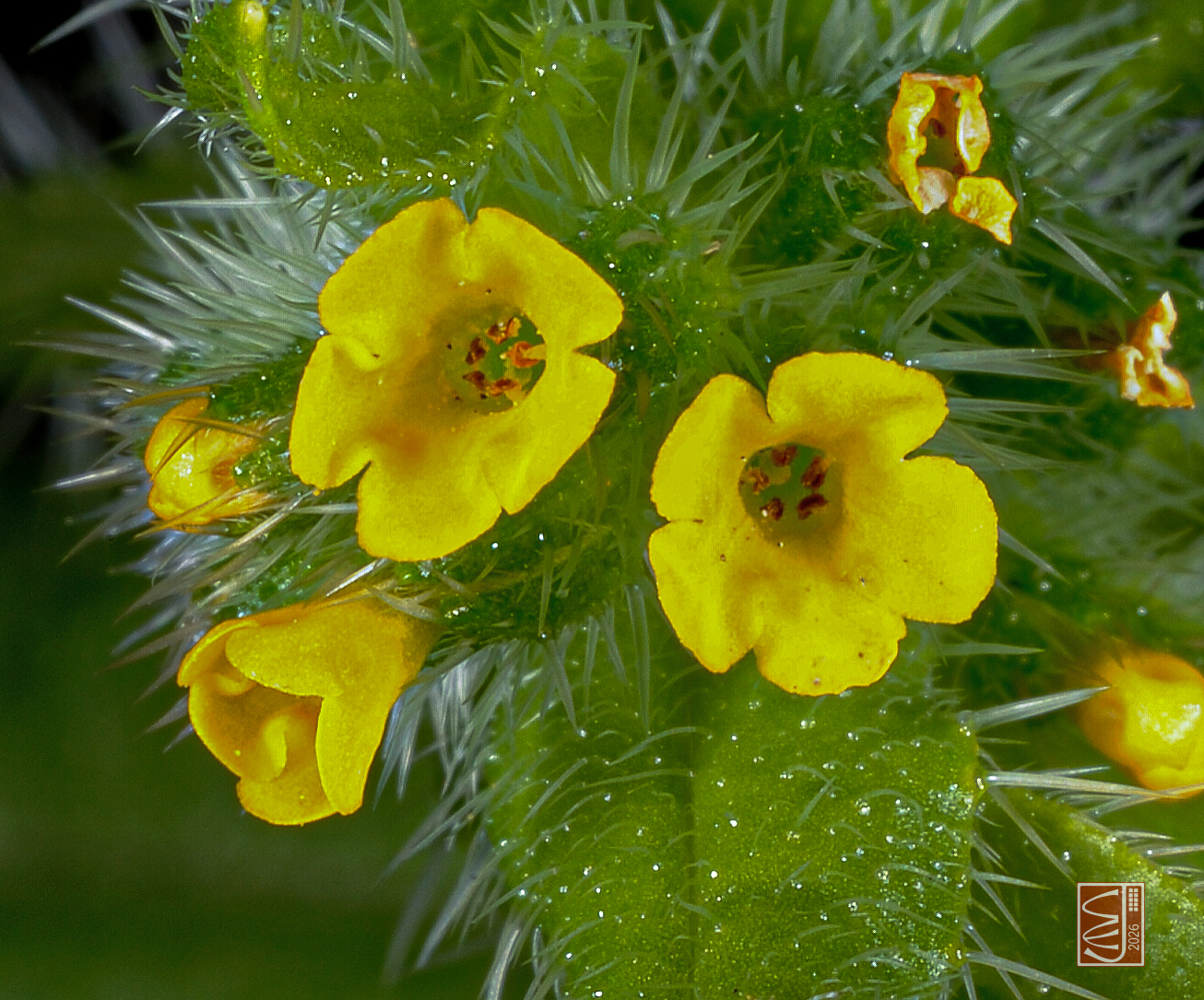
Amsinckia micrantha – September 27th 2026 – Common Fiddleneck
There are very few plants named after a musical instrument. The name “fiddleneck” comes from the distinct curl of the flower spike, which resembles the head of a violin or fiddle. It belongs to the Boraginaceae, the Family of borage, lungwort, comfrey and forget-me-not. Amsinkia is an unusual family-member in having flowers that are yellow; most of its relatives have blue. But it does have the stiff bristles so common in the Boraginaceae.

This image (courtesy of Richard Milne) shows the resemblance of the plant to the neck of a violin.
I’m trying to think of other family-members with curled flower-spikes: comfreys and Water Forget-me-not, but not to the same extent.
Fiddleneck likes the eastern half of the country more than the west. It thrives on light sandy soils, and these are more common in the east (East Anglia and East Scotland), where the drier lowland conditions are good for its spring growth and flowering cycle. It was introduced from western North America, probably via historical trade routes as a contaminant of agricultural seeds, grain, and perhaps wool and thus gained a strong foothold in the eastern arable farming areas. It was first recorded in the wild in 1888, but did not become widespread in Britain until the 1960s.

Close-up of flowers and bristles. See also the image at the top of the page. Image: Chris Jeffree.
Suitable sites occur quite often in towns and cities. In the Urban Flora project it has been recorded on waste ground, car parks and cemeteries, and at Ninewells hospital in Dundee. It was spotted at the Elgin Leisure Centre, Broughty Ferry (Dundee) and Blackford Bank (Edinburgh). To see it at its most vigorous, you may need to visit margins of farmer’s fields, for example at Inveresk (see the image below). Yes, it can be a serious weed.

The leaves are curiously undulating. Why? Can it be something to do with ‘inbreeding depression?’ Image: Chris Jeffree
In parts of Australia (e.g. Victoria) it is treated as a highly problematic invasive species. The plant is poisonous to cattle, containing the pyrrolizidine alkaloids that many members of the Boraginaceae contain (and sometimes honey becomes contaminated with these compounds). The entire plant—especially the seeds—contains pyrrolizidine alkaloids and high nitrates, which cause irreversible liver damage in cattle, horses, and pigs. As a weed in Britain, it forms invasive populations in the East Anglian fields of sugar beet, choking out the crop and thus requiring specialized herbicide treatments. In fields of cereals, aggressive growth allows it to rapidly dominate the spring crop.
The bristly, sharp hairs on the plant can cause mechanical skin irritation and rashes in humans. I think that’s because the sap contains coumarins, compounds that cause phyto-photo-dermatitis in people handling the (un-related) Giant Hogweed. Occasionally workers harvesting parsnips and celery receive these ‘burns’ when working in bright sunshine.

Common Fiddleneck dominating a field margin at Inveresk (East Lothian). Image: Chris Jeffree.
It is an annual species. Its success as a weed can be related to its rapid initial growth in the spring; the four seeds (‘nutlets’) from each flower are a substantial source of nutrients for fast growth, and once established in a field, the seed production is evidently high. As it grows, it is well defended against enemies by its bristles and toxic compounds. It doesn’t waste resources on flowers and fragrances; it is self-fertilized (99% self-fertile). Such a reproductive strategy does of course run the risk of ‘inbreeding depression’ which may have long-term repercussions, but for now it is ‘doing fine’.

Distribution of Common Fiddleneck in Britain and Ireland. Left: records up to 1999; right: records after 1999. From BSBI/Maps.
It is probably still increasing in Britain. The BSBI map shows a modest increase in extent since 1999, but such maps do not portray the local increase within each square. Fiddleneck has expanded its range in the north-east and we may say therefore that it doesn’t mind the cold. We read that it comes from western North America, but its native range seems to extend all the way from British Columbia to Mexico. We can’t say exactly where ‘our’ introductions came from so we know nothing much about its climatological history.
There is another fiddleneck with a more recent origin: Amsinckia lycopsoides. It is also North American, but this one came to the Farne Islands in 1922. It is rather rare and its (highly suitable) common name is Scarce Fiddleneck. Perhaps it still only exists on the Farne Islands as Stace’s New Flora of the British Isles says “over-recorded in the rest of England and Scotland, presence there very uncertain..”. Careful examination of the flower1 is necessary to tell the difference and so the two species may have been confused in the past.
The genus Amsinckia was named in honour of Wilhelm Amsinck (1752–1831), a prominent German statesman, scholar, and the first mayor (Bürgermeister) of the free imperial city of Hamburg. He was a significant benefactor and patron of botany who supported the development of the Hamburg Botanic Garden.The genus was officially named in his honor in 1831 by the German botanist Johann Georg Christian Lehmann.
Note
1Does the corolla tube have a ‘bearded throat’ seems to be a critical point.
References
Andreasen C and Stryhn H (2012). Increasing weed flora in Danish beet, pea and winter barley fields. Crop Protection, 36, 11-17.
Bitarafan Z et al. (2026). Contamination of Norwegian honey by pyrrolizidine alkaloids from plants and the active ingredient clopyralid in herbicides. Heliyon 12, e44985.
Charlesworth D, Willis JH.(2009) The genetics of inbreeding depression. Nature Reviews Genetics 10, 783-796.
Clement E (1999). Misconceptions about Amsinckia lycopsoides. BSBI News 80, 44-46.
Johnston MO and Schoen DJ (1996). Correlated evolution of self-fertilization and inbreeding depression: an experimental study of nine population of Amsinkia (Boraginaceae). Evolution 50, 1478-1491.
©John Grace