Buddleja davidii – 5th September 2022 – Butterfly Bush
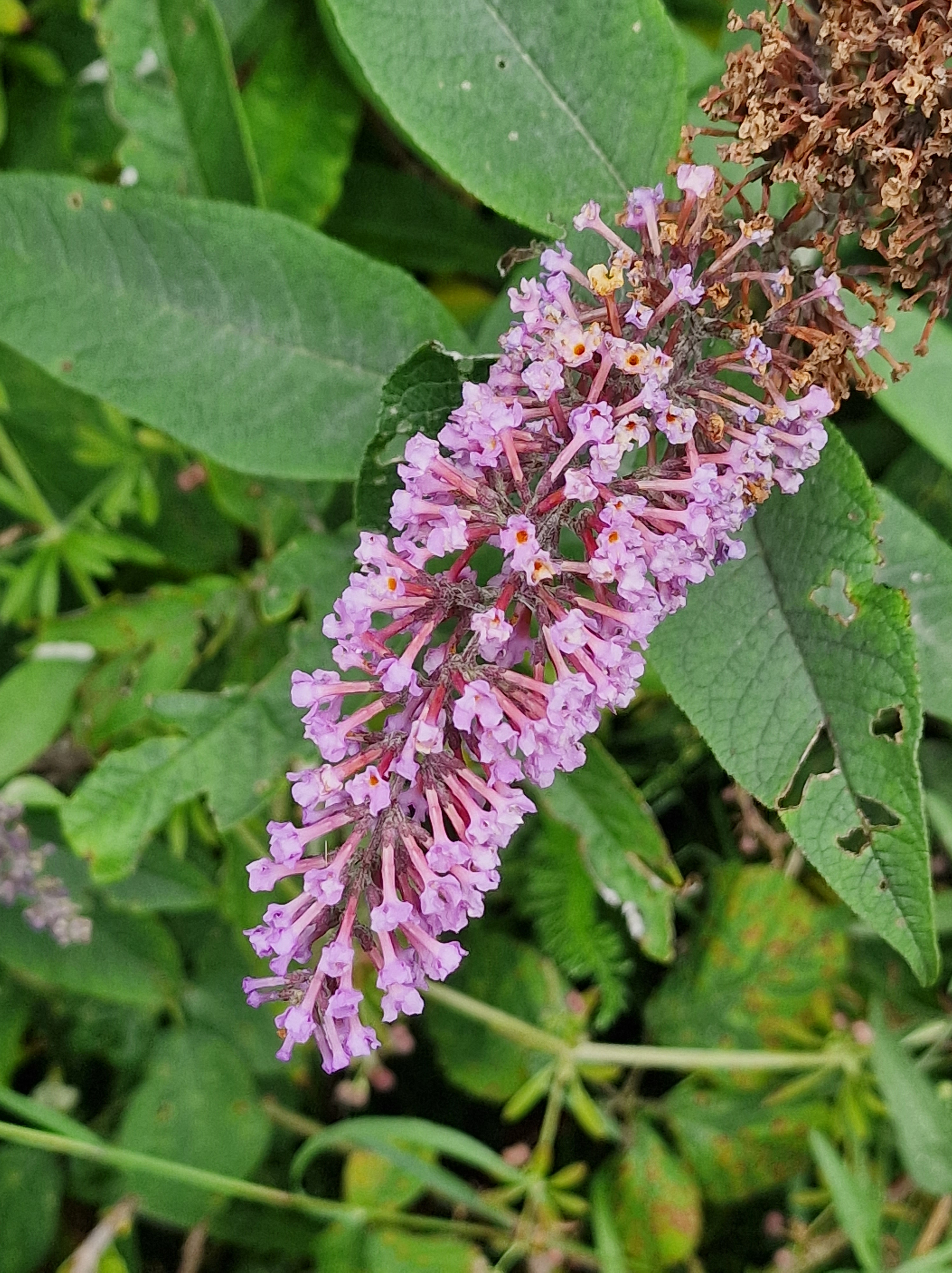
Buddleja davidii flowers, rich in nectar and emitting fragrant compounds which attract many insect species over large distances. Photo: John Grace.
All lovers of nature would like a ‘Butterfly Bush’ in their garden. With a name like that, who can resist? Since its introduction into Britain in 1896 it has ‘escaped’ into the wild many times, and now is a familiar component of the urban flora, adorning railway lines, derelict land, neglected buildings and even roadsides. Should it be regarded as a welcome and decorative contribution to biodiversity, or should we brand it as a ‘noxious weed’ as some other countries have done?
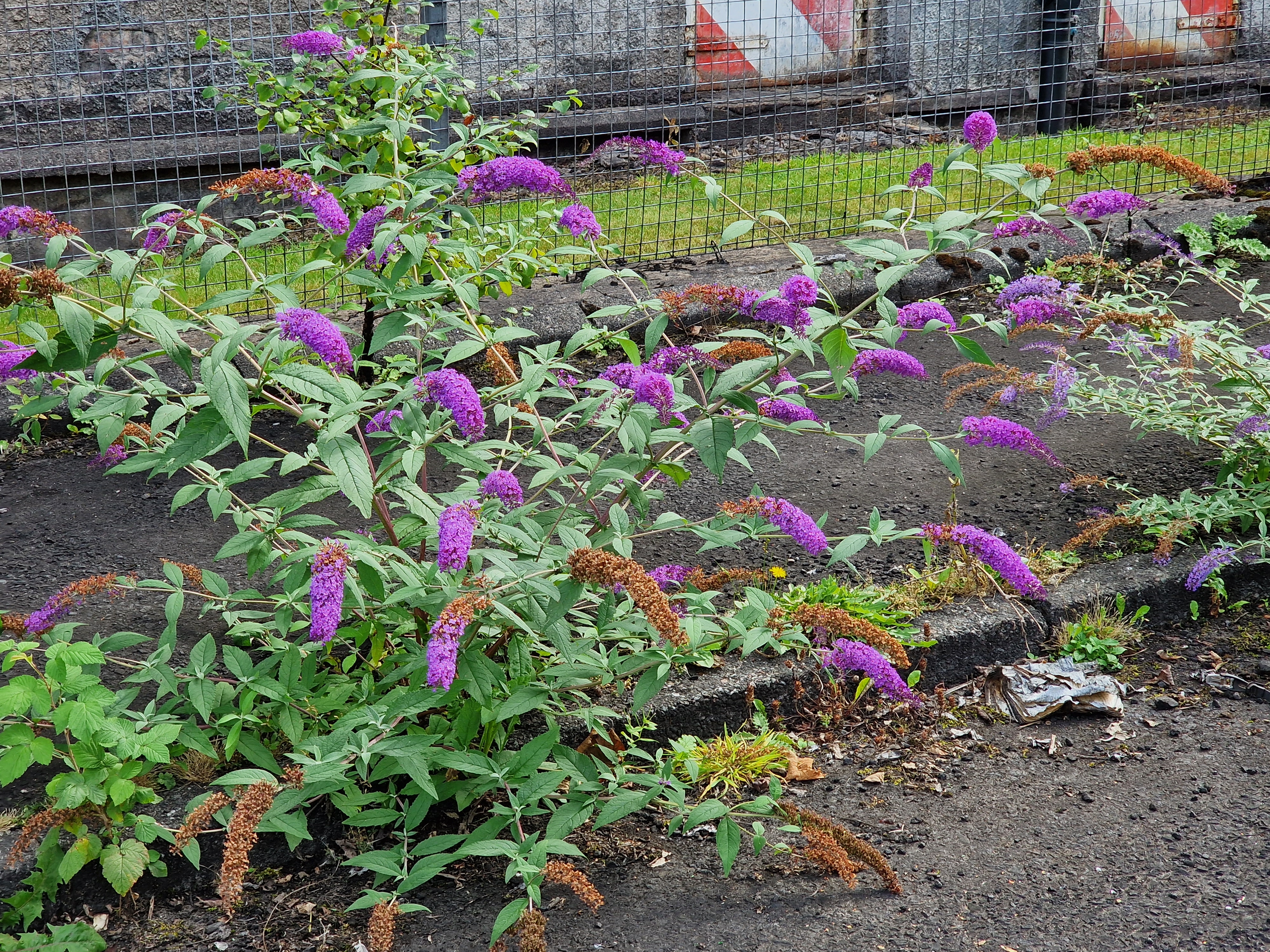
Buddleja davidii, growing and flowering vigorously by the side of a road, Alexandria, West Dunbartonshire, Scotland. Photo: John Grace.
Its appeal as a garden plant is undisputed. It grows in almost any soil, develops rapidly, produces flowers at an early age, and forms an architectural display of beautiful arching stems bearing attractive and fragrant flower spikes, ensuring the garden is visited frequently by the prettiest lepidopterans. Moreover, we have many opportunities to purchase these plants from garden centres, and they come not just as the familiar purple ‘wild type’ but in cultivars and hybrids with different shapes, sizes and colours.
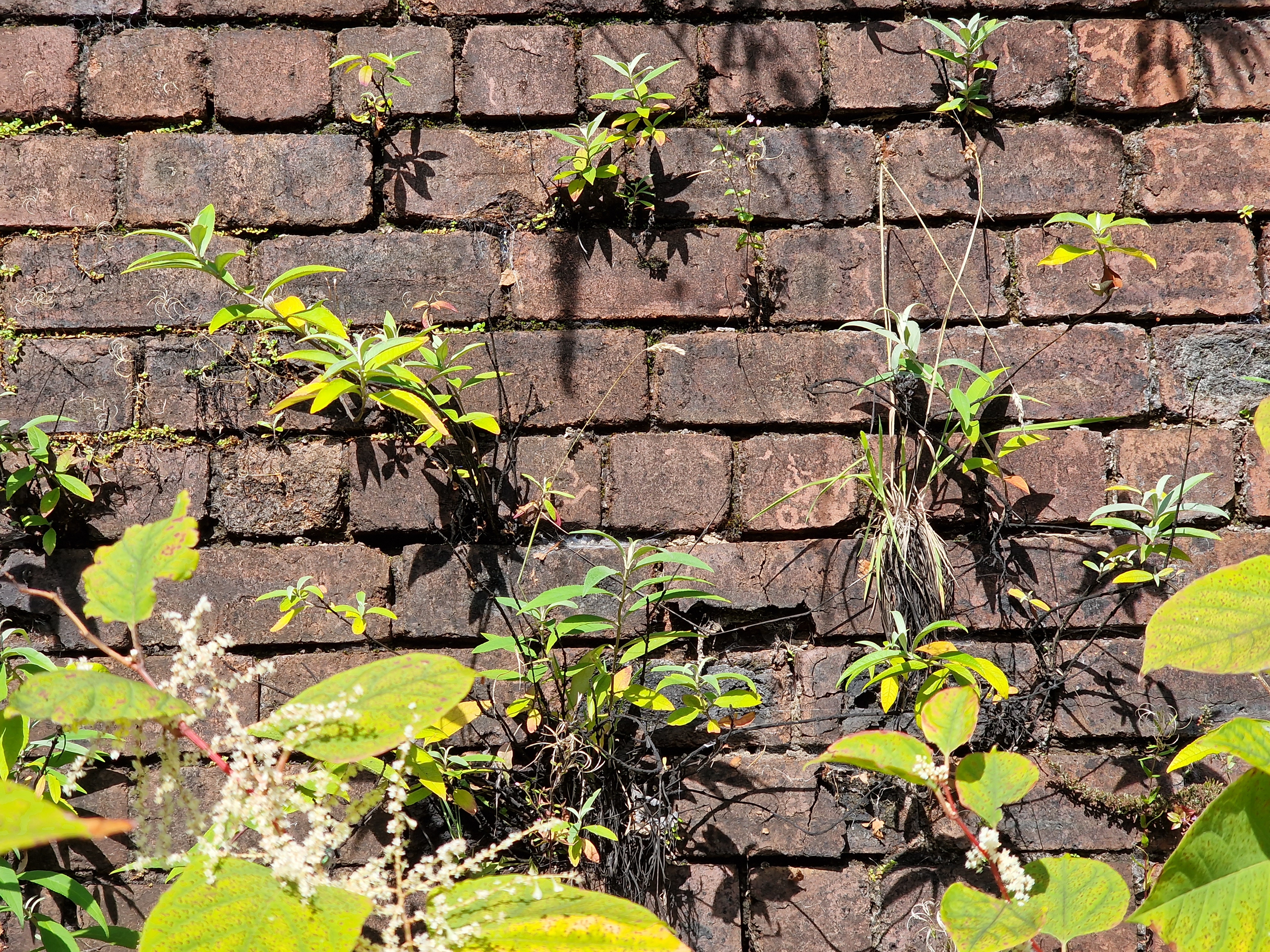
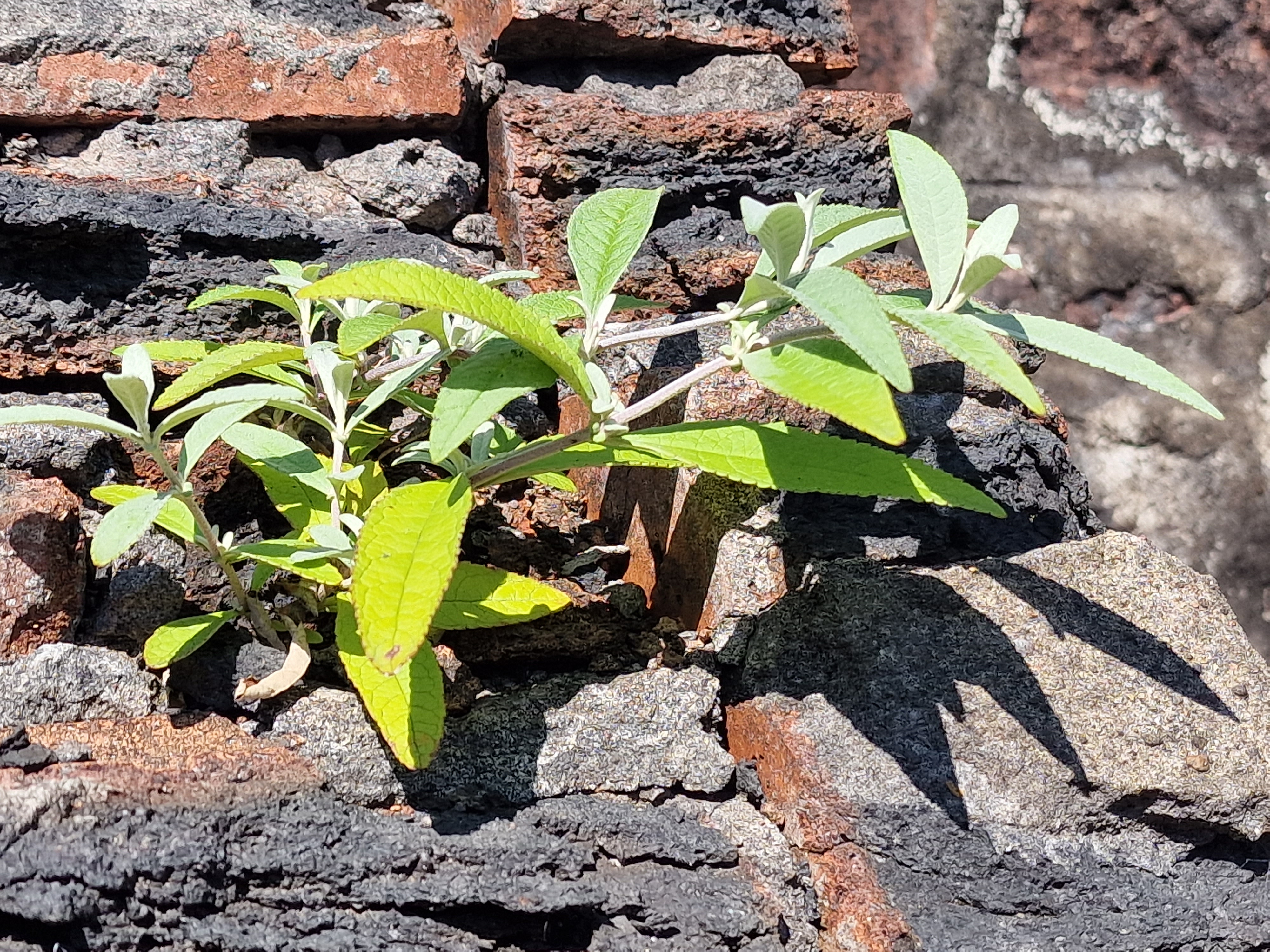
Seedlings establishing on old brickwork. Acidic root exudates may slowly dissolve the mortar, thus weakening the wall. Photos: John Grace.
Its history is well known (Tallent-Halseth and Watt 2009). The plant was ‘discovered’ in China by the French missionary Father Armand David (now called simply Père David) in the late nineteenth century. He was commissioned by the Paris Natural History Museum to collect hitherto unknown animals and plants. He carried out his work diligently: his discoveries included the Giant Panda and the small deer that takes his name. He found this plant growing on mountain slopes from Gansu (a northern province) to Zhejiang (in the East of China). It was introduced to European gardens several times from the 1890s but British records suggest that it did not appear ‘in the wild’ until the 1920s; and inspection of old railway photographs suggest it was quite uncommon until 1980 (Stace and Crawley 2015). It now covers all of England and Wales, and much of Ireland and Scotland. How does it spread?
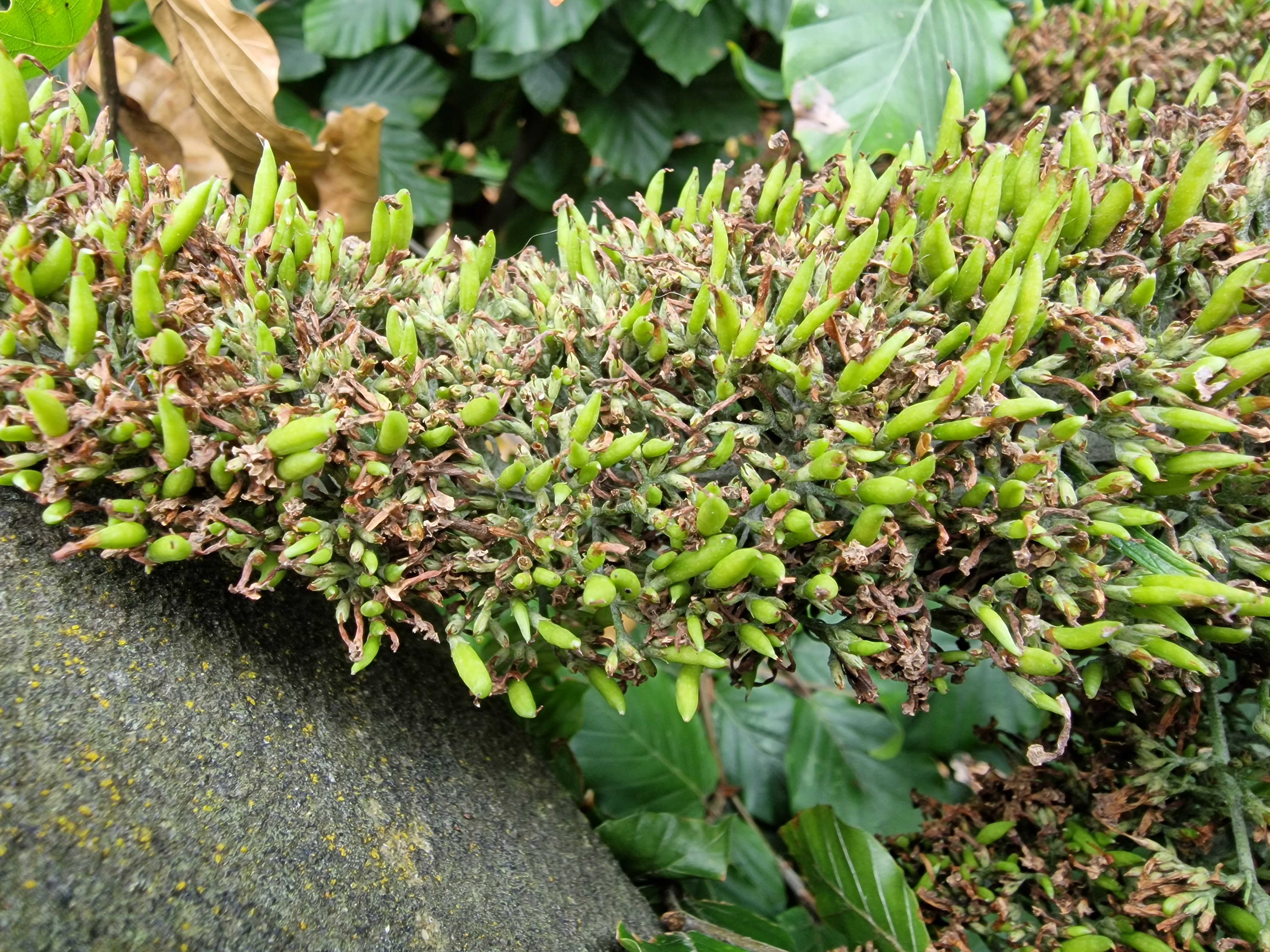
Seed capsules looking like numerous miniature bananas, late August, a garden in Edinburgh. Seeds are contained in cylindrical two-valved capsules 5-9 x 1.5-2 mm. The image shows that many of the flowers were pollinated and have set seed. Photo: John Grace.
Most of its small flowers are pollinated by insects to produce viable seeds in a banana-shaped capsule. A single spike of flowers can produce 40,000 seeds. Each seed is tiny and has peculiar pointed ‘wings’ which enable it to be carried in the wind. There may be other ways for it to get around too. Robinson et al. (2018) collected soil samples from topsoil being transported during building operations. Many species emerged from the soil, but the dominant species was B. davidii.
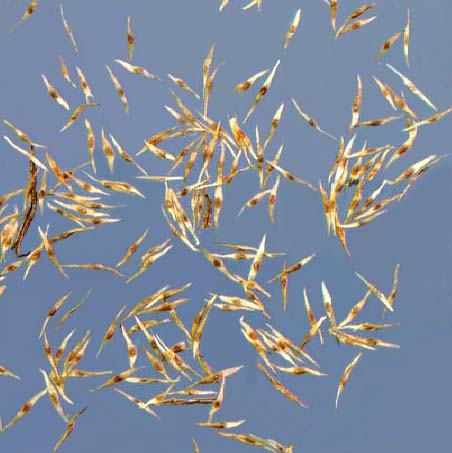
Seeds of Buddleja davidii. They weight about about 0.1 mg each. Source: https://creativecommons.org/licenses/by-sa/3.0/rs/deed.en, via Wikimedia Commons. The original uploader was Gmihail at Serbian Wikipedia., CC BY-SA 3.0 RS
Of course, there are plenty of species which can move rapidly by means of tiny winged seeds or, more often, a hairy appendage. Many years ago Sir Edward Salisbury tested common weeds to see which stayed air-borne the longest when dropped from ten feet (Salisbury 1961). The winner was the now-ubiquitous Rosebay Willow Herb Chamaenerion angustifolium, but B. davidii was ranked seventh in his table of data.
Is the species really a noxious weed, as branded by several countries and parts of the USA? The dictionary definition of noxious is “harmful, poisonous, or very unpleasant”. Unlike several of the invasive aliens it does not compete for space with native vegetation, at least in Britain, and so in my judgement it is not ecologically harmful. Moreover, it is far from ‘unpleasant’ in most people’s eyes. But it can be harmful to buildings, especially to brickwork. Roots of all plants exude organic acids such as citric and malic acids. This habit serves plants rather well, slowly dissolving minerals to release useful elements like phosphorus and calcium. These acids are weak and mineralisation is therefore a slow but sure process. Buddleja plants generally live for only around 20 years, but in this time significant damage can be done and the structure of walls made of bricks can be undermined. A picture in Stace and Crawley (2015) suggests walls can be destroyed by the roots of Buddleja. The same authors stress the high cost of controlling plant growth on railway lines (several applications of herbicide per year are required to keep the track in safe condition). Of course, Buddleja davidii is only one of the many species to colonise railway lines. As I was thinking of what to write about this plant, I went to my nearest railway bridge to view the vegetation on the track. It’s not a busy line, but it transports radioactive waste from the Torness Power Station (East coast) to Sellafield (West coast). The line itself is clear of vegetation but several invasive shrubs are on the embankment. They are all species which must have looked magnificent in the grand gardens where they were first cultivated. But now they have escaped from cultivation (Fallopia japonica, Leycesteria formosa, Cotoneaster and Buddleja davidii).
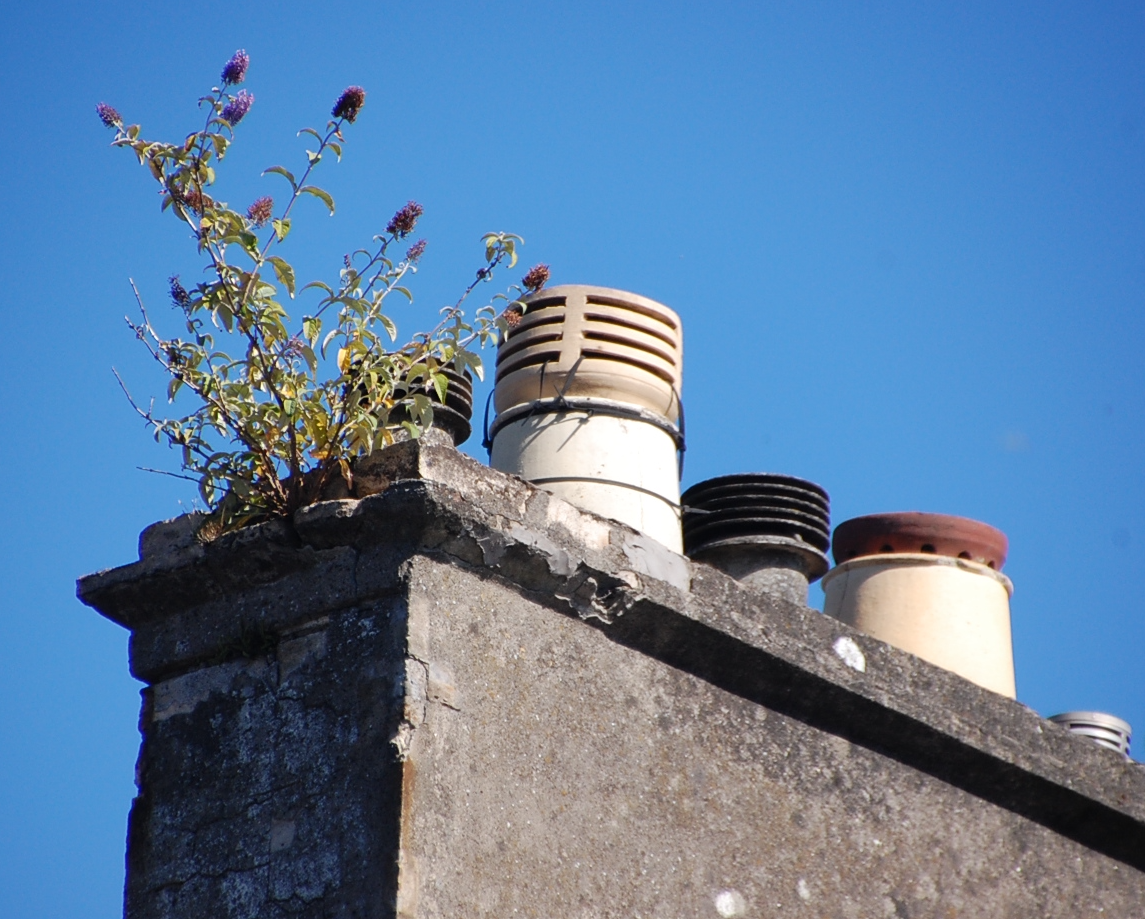
The owner of this house may well consider the plant to be ‘noxious’ as she will need to hire a helping-hand to remove the young plant. Location: Stranraer, Scotland. If left unchecked it may damage the stonework and cause the chimney stack to collapse. Photo: John Grace.
Which countries label Butterfly Bush as ‘noxious’? I consulted CABI (2022) to find out. In New Zealand it is listed as being noxious by the Ministry of Agriculture and Forestry and it cannot be propagated, released, displayed or sold under Biosecurity Laws. In the USA it appears on the ‘most invasive’ species list of the Pacific Northwest Pest Plant Council and the native Plant Societies of Oregon and Washington. The Washington State Noxious Weed Control Board listed B. davidii as a Class B noxious weed. B. davidii is a category 3 ‘watch species’ in the New York metropolitan region.

Buddleja davidii, global distribution according to GBIF.
There are many species in the genus Buddleja (over 140 species endemic to Asia, Africa, and the Americas). The story of the genus’s name is a story of friends and influence. A Scottish botanist William Houstoun was in contact with Carl Linnaeus; he suggested the plant should be named after his friend and amateur botanist Reverend Adam Buddle (1660-1715). Linnaeus agreed, even though Adam Buddle had nothing to do with the genus or species; he specialised in bryophytes. The spelling of the genus can be Buddleia or Buddleja. In the text of Linnaeus’s book Species Plantarum, published in 1735, it was spelt with the ‘j’. However, in the index and in later works he spelt it with an ‘i’. The discrepancy seems to have been something to do with the technology of printing at the time: ‘i’ was printed ‘j’, ‘u’ was printed ‘v’ and ‘s’ was printed ‘f’. So really, we ought to follow Lineaus’s intention and spell it Buddleia but recent convention has it as Buddleja.
The author of this particular species of Buddleja, was Adrien René Franchet (1834-1900) a botanist based at the Paris Natural History Museum who, naturally, named it after its collector, Père David.

Buddleja davidii, British Isles. On the left with black symbols is the pattern up to 1999; on the right with red symbols is the current pattern. Data from the BSBI.
The species continues to increase its range in the British Isles. On-line suppliers as well as Garden Centres will sell you one. And the Royal Horticultural Society continues to recommend nine varieties of B. davidii in its current Award of Garden Merit list. However, I suspect that the cultivars are less liable to produce huge numbers of viable seeds (the BSBI’s distribution maps do show the distribution of some cultivars, but only a few Recorders are likely to know the cultivar names so the record is incomplete).
If you are an amateur gardener and you want to buy Buddleja from your local Garden Centre please remember that the ‘j’ is silent. Otherwise they will laugh at you.
References
CABI (2022) https://www.cabi.org/isc/datasheet/10314#tomeansOfMovementAndDispersal
Robinson BS et al. (2018) Sweet flowers are slow and weeds make haste: anthropogenic dispersal of plants via garden and construction soil. Journal of Urban Ecology doi: 10.1093/jue/juy004
Salisbury E (1961) Weeds and Aliens. Collins, London.
Stace CA and Crawley MJ (2015) Alien Plants. Collins, London.
Tallant-Halsell NG and Watt MS (2009) The Invasive Buddleja Daviddi (Butterfly Bush). Botanical Review. 1-34.
©John Grace