Euphorbia paralias – 9th October 2023 –Sea Spurge
I discovered Sea Spurge on a shingle beach just to the south of Ballantrae in South Ayrshire. It’s on the list of ‘Scarce Plants in Britain’ and that makes two scarce plants in one small area, as the Oyster Plant Mertensia maritima is also there. Nearby, is Scots Lovage Ligusticum scoticum, but that’s a more common species. I already knew about the Oyster Plant but I hadn’t seen Sea Spurge or Lovage at this location. Every time I go walking at Ballantrae I find something of interest.

Jan Kops, Public domain, via Wikimedia Commons. Kops (1765 – 1849) was a Dutch agronomist and botanist, also founder of the long-lived journal “Flora Batava” in 1800.
Spurges are strange plants. They all have a milky latex, rich in chemical compounds, some of them poisonous. Their flowers are like none other, having no sepals or petals but with the reproductive organs arranged openly on what the herbalist John Gerard described as ‘a little platter’). But they do have nectar to attract pollinating insects. We wrote about the structure of these peculiar flowers in an earlier article, and the painting by Jan Kops provides further detail especially with the images c and d above.
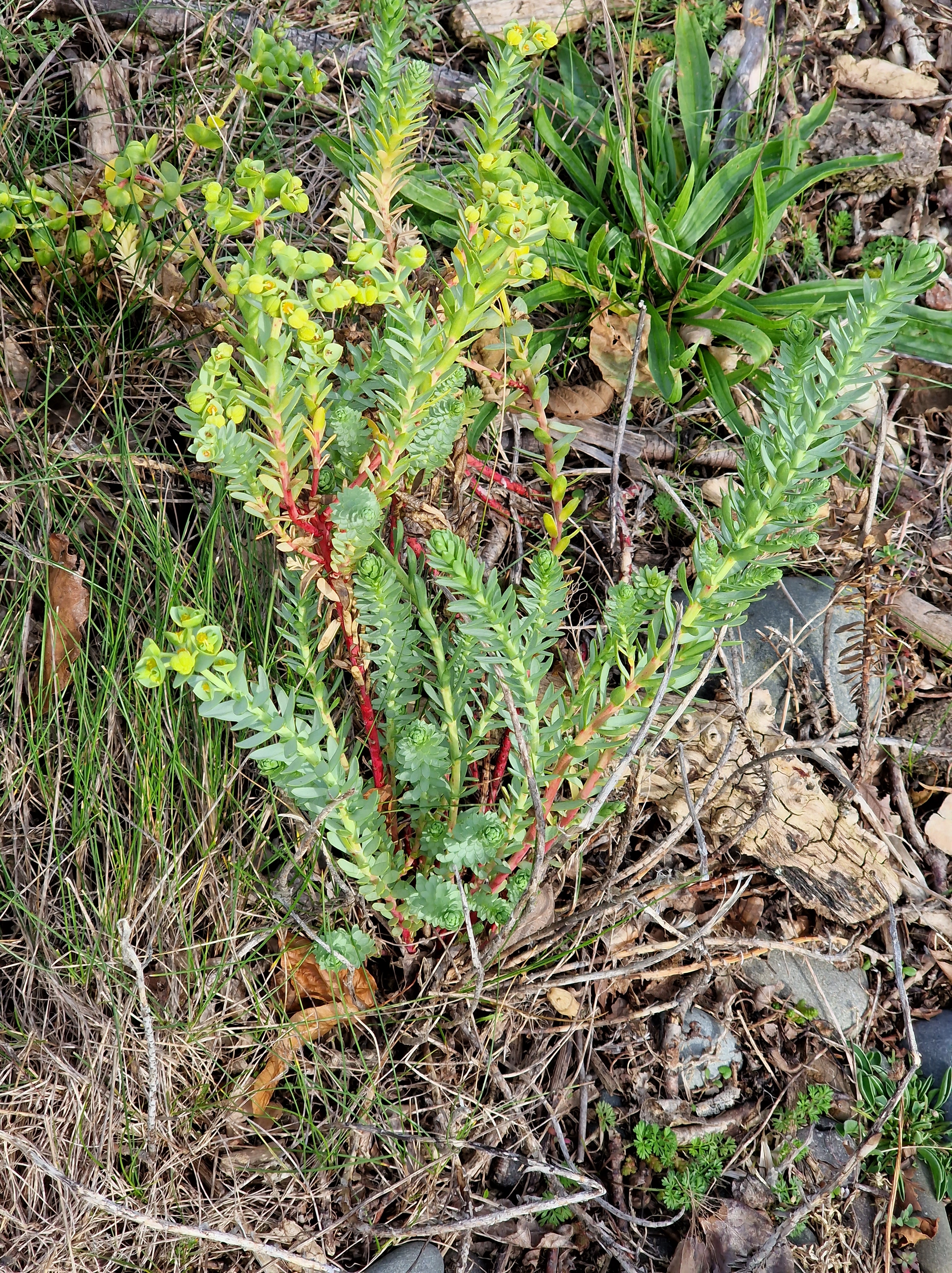
Euphorbia paralias in late September 2023. Photo: John Grace
The genus of the spurges is Euphorbia, named after Euphorbos, a Greek physician who married the daughter of Anthony and Cleopatra. The plant Family is the Euphorbiaceae, a huge family containing plants as diverse as the Brazilian rubber tree Hevea brasiliensis, the Poinsettia (Euphorbia pulcherrima, beloved at Christmas for its red leaves that look like flowers) and Jatropha, the plant with the oil-rich seeds that were hailed as a new source of diesel fuel.
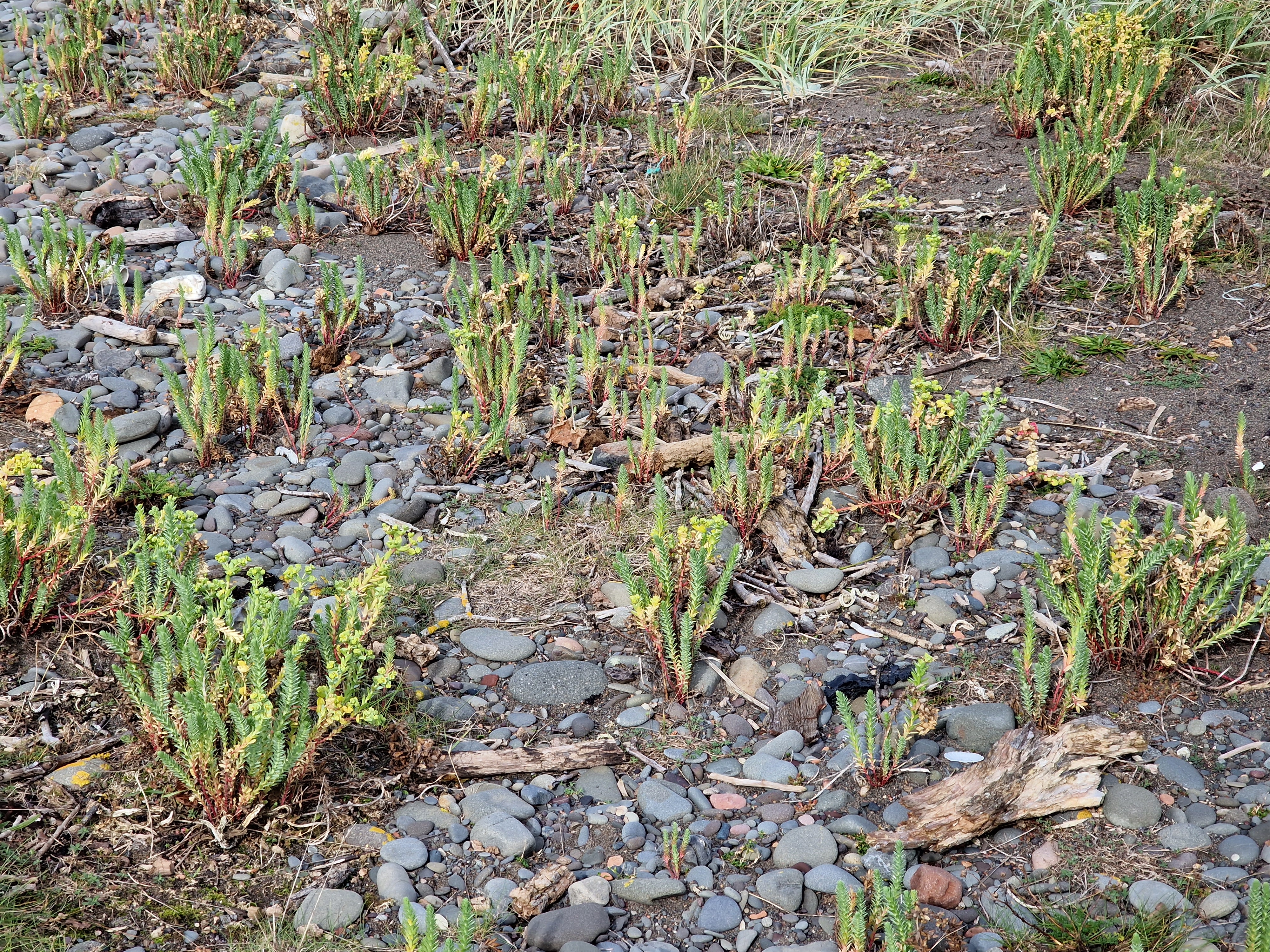
Population of Euphorbia paralias on a shingle beach, south of Ballantrae in South Ayrshire. Late September 2023. Photo: John Grace
Many Euphorbias are succulents, and a few look like just like cacti (no leaves, fleshy stems) with the physiological features of cacti (keeping their stomata closed in the daytime to conserve water and taking up CO2 at night using CAM photosynthesis).
Here in Ayrshire the Sea Spurge Euphorbia paralias is close to its northern limit. It can be found on the West Coast of Arran and a little further north in Bute. But on the eastern shores of both Scotland and northern England it is conspicuously absent. The English limit in the east is somewhere near Skegness (apart from one outlier at Redcar near Middlesborough). In Western Europe it hugs the coastline and occurs occasionally inland but it peters out as we move to the Eastern Mediterranean. It occurs sporadically on the coast of Morocco and is also well represented in the Canaries. I think we may conclude that it is warmth-loving.

Fruiting in late September. Each floral structure consists of 1 female and several male flowers housed within a cup-shaped cyathium (which Gerard called ‘a little platter’). This specimen has finished flowering and the globose fruits can be seen at different stages of development. The remains of the several male flowers are the yellow structures. See also the painting by Jan Kops at the start of this article. The fruits are rough but the seeds within are smooth. Each fruit will burst open to release three seeds over distances of up to a few metres. Photo: John Grace.
It is a perennial native plant, first described in Britain in 1562 by William Turner and featured with its old name Tithymalis paralias in Gerard’s 1597 Herbal. The several stems arise from a woody tap root, and the lanceolate leaves are fleshy, glaucous and glabrous. The plant grows to about 50 cm. The lower part of the stem is frequently red. The flowers appear from June to September and are typical of the Euphorbia genus; each plant produces around 2,000 seeds, released from their casing ballistically and dispersed a few metres from their source.
There is a related species, Portland Spurge, E. portlandica. It has a similar distribution but is rarer; and it sometimes form hybrids with E. paralias. The critical feature separating the two in keys is: seeds of paralias are smooth and those of portlandica are rough.
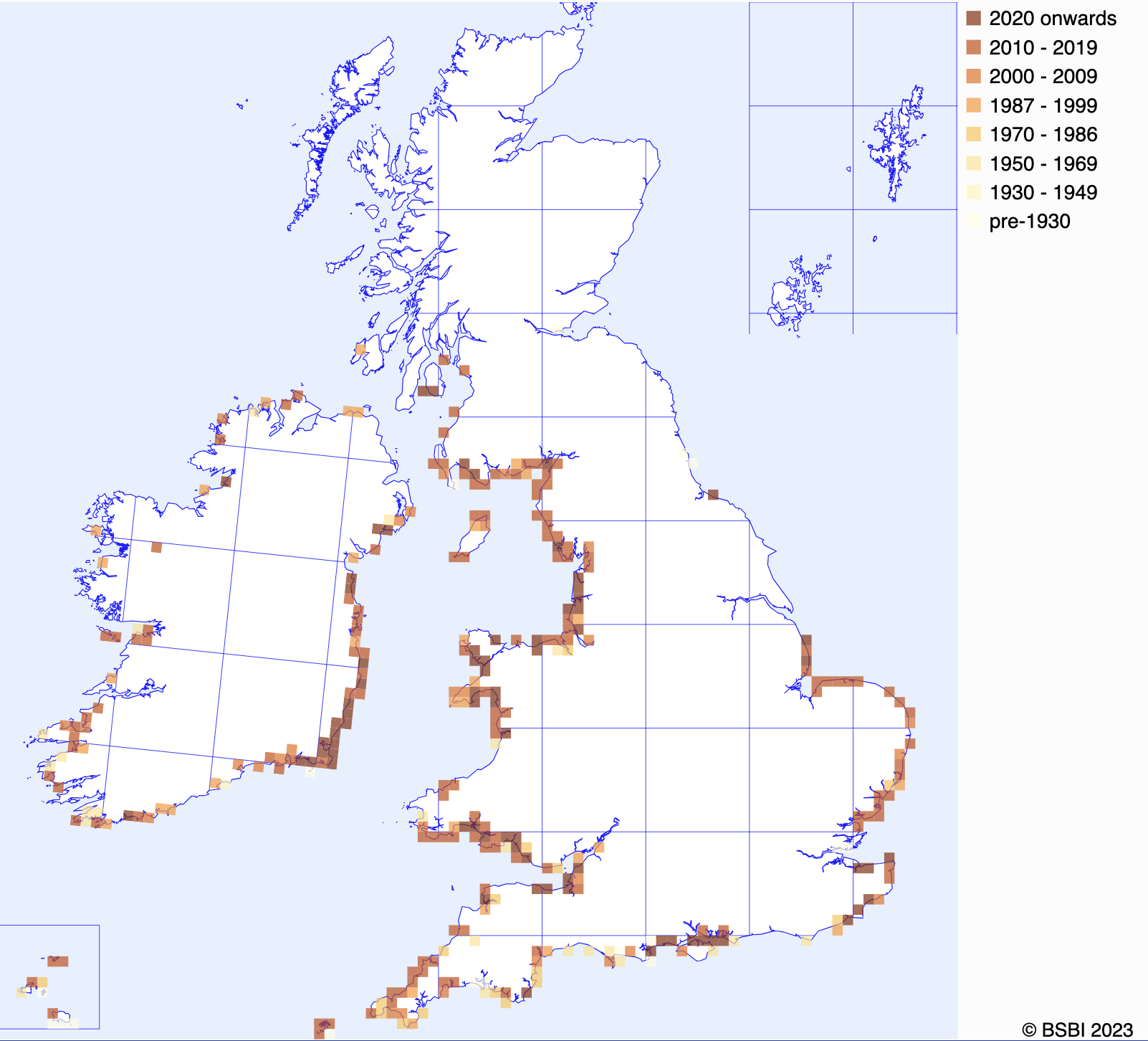
Distribution of E. paralias in Britain and Ireland, according to BSBI.
Rather little has been written about its ecology in the British Isles. For Australia and New Zealand where it was introduced accidentally in the 1920s (possibly in ships’ ballast water) it has become invasive and there is more comment and research. The spread in Australia is well documented by Heyligers (2002) who also demonstrated that the seeds can be dispersed in ocean currents. Like many aliens, it does better in the ‘new’ environment where it may not have so many pathogens and herbivores to contend with as it does in its native range. In Britain it has at least 10 insect herbivores (Hemiptera and Lepidoptera). They have had plenty of time to evolve resistance to the toxic milky latex that forms the plant’s defence mechanism.
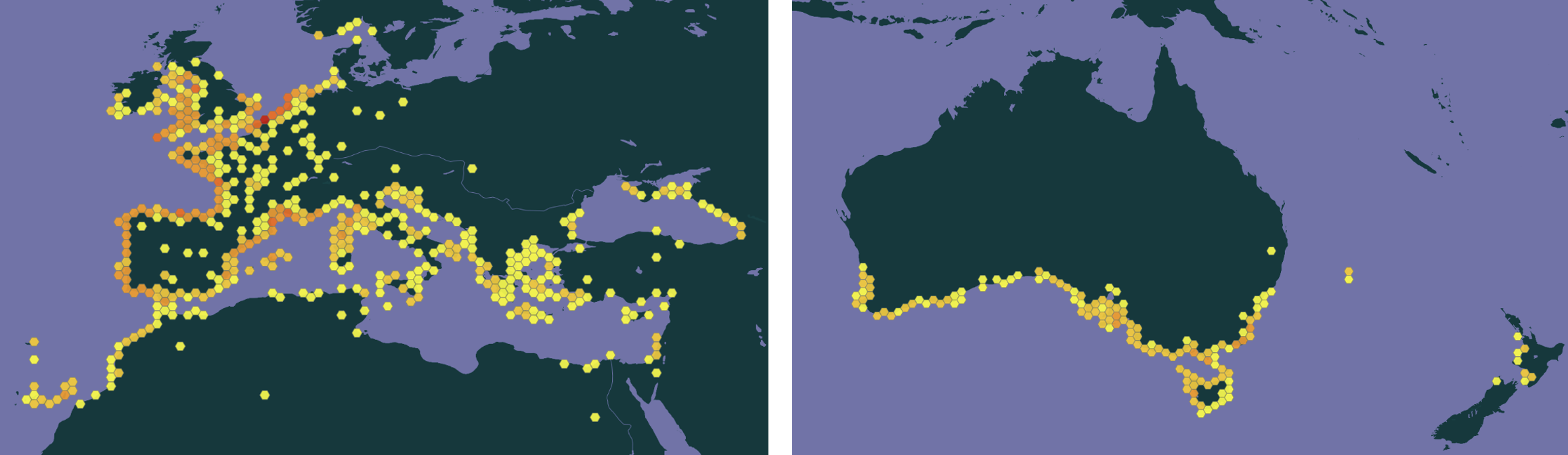
Native distribution in Europe and alien distribution in Australia/New Zealand according to GBIF. See also the summary in Plants of the World Online where more records from North Africa are shown.
In the south of Australia it occupies large sections of beach and constitutes a health hazard as the sap can cause skin and eye irritation. There has been an effort to introduce biological control, using a fungal pathogen Venturia paralias introduced from Europe and released into the wild in 2021 (Hunter et al 2021). A thorough account of the project is here.
An interesting recent paper compares its alien distribution in Australia with the native distribution in Europe (Giulio et al 2021). The authors compiled environmental data (climate, soils, human disturbance) for both distributions and compared them. One might have expected the native distribution would represent the complete range that the species can possibly occupy whilst the introduced populations would occupy a small but increasing sub-set of the ‘environmental space’ as they slowly fill the range. The authors found that the species has not yet moved into all its possible ‘European-like’ space, but it has expanded into some novel environments (different from those in Europe). A close inspection of the data suggests that some of the Australian range is at a higher temperature than the European range. Has the species in Australia evolved to tolerate higher temperatures? Probably not, as there hasn’t been enough time for it to do so. My best guess is that the species fails in the warmer parts of Europe because of its ‘enemies’ (insects and fungi).
As with all members of the Euphorbia genus, the composition of the milky sap has been the subject of much research. I used the Web of Science and typed <Euphorbia paralias> as the search term; it yielded 57 ‘hits’ and nearly all of them are about these chemical compounds: diterpenes, triterpenes, coumarins, flavonoides, ingenol, paralinones. Some of these are anticancer, antioxidants, antidirrhoeal and antileishmanial.
E. paralias seems to have been little-used in herbal medicine (it isn’t even mentioned by the website Plants for a Future, perhaps because it is much too dangerous). I have read that ingenol is the only Euphorbia diterpenoid that has undergone successful pharmaceutical development. It’s used for the treatment of dry patches on the skin known as actinic keratosis.
You may have wondered about the specific name, paralias. It’s from the Greek, Paralia, meaning “beach” or “coastline”.
References
Giulio S et al (2022) Invasion dynamics and potential future spread of sea spurge (Euphorbia paralias) across Australia’s coastal dunes. Journal of Biogeography, 49, 378–390. https://doi-org.ezproxy.is.ed.ac.uk/10.1111/jbi.14308
Heyligers PC (2002) The spread of the introduced Euphorbia paralias (Euphorbiaceae) along the mainland coast of south-eastern Australia. Cunninghamia 7, 563–578.
Hunter GC et al (2021) Exploring the host range and infection process of Venturia paralias isolated from Euphorbia paralias in France. European Journal of Plant Pathology 159, 811-823.
©John Grace