Banksia serrata – 25th December 2023 – (Old Man Banksia)
In the late Cretaceous Period, about the same time as flowering plants appeared, the land we call Australia became isolated, and therefore the stage was set for evolutionary pathways quite different from those developing in the rest of the world. This week we are focusing on the iconic Australian wildflower, Banksia. The story begins with one of the first botanical expeditions to Australia.

Banksia serrata growing as a component of coastal scrub, Merimbula, New South Wales, Australia. Photo: John Grace.
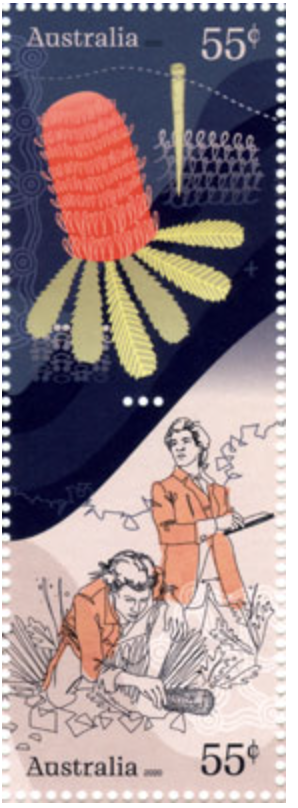
In 1770 the British ship HMS Endeavour captained by James Cook was on a mission of discovery when it ran aground on the east coast of Australia. Whilst the vessel was being repaired, its two botanists Joseph Banks and Daniel Solander went ashore to see what they could find. They saw flowers that were completely different from those of their homeland, and made an extensive collection. The plant we now call Banksia serrata was one of the more intriguing specimens in their collection; Solander called it Leucadendrum serratifolium. Later (1782) it was described by Carl Linnaeus the Younger (son of the more famous Linnaeus) who named it after Banks. As it was the first Banksia ever to be described it became the type specimen of the genus.
Banks and Solander collected three other Banksia specimens: B. ericifolia, B. integrifolia and B. robur. Their achievement is commemorated by this postage stamp.
I saw Banksia serrata last week in a friend’s garden on the coast of New South Wales. Later, he took me on a short drive into the dense coastal vegetation of Merimbula. We drove the bone-shaking track into rough bushland where Banksia serrata was frequent.
The common names are: old man banksia, saw banksia, saw-toothed banksia and saw-leaved banksia. It is sometimes called red honeysuckle or red banksia from the reddish colour of its timber. The indiginous Cadigal tribespeople called it wiriyagan and used its boiled flowers to make an energy drink.
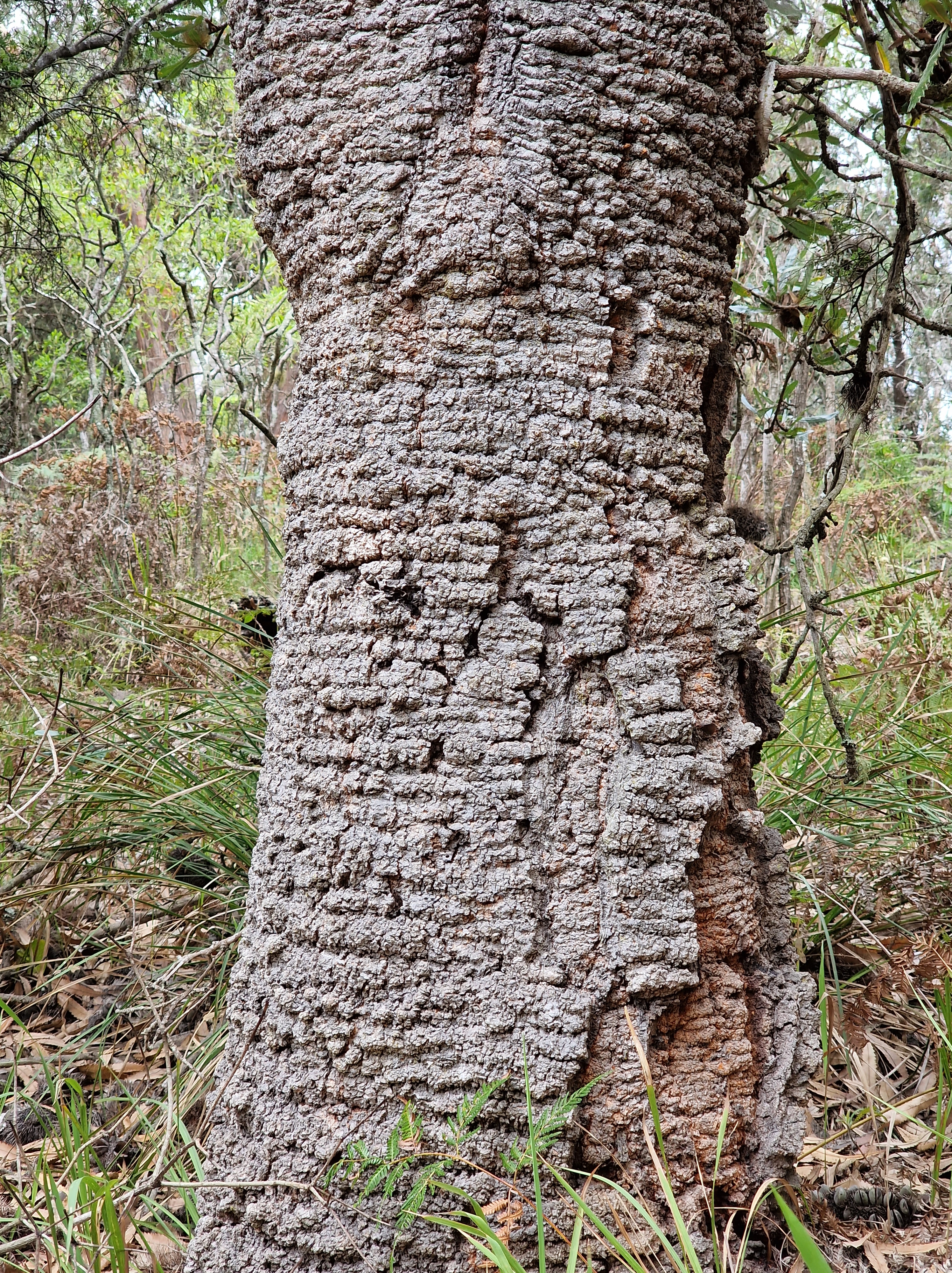
The bark is grey in colour, gnarled and thick, often with longitudinal fissures. Photo: John Grace.
It forms a gnarled shrub or tree (up to about 8 metres tall) and has a thick and warty-looking grey bark. The leaves are leathery and serrated, dark green above and paler below. The inflorescence forms a large cone-like structure, with a few hundred small flowers springing from the woody central column. Each tiny flower is a tube that splits to reveal a protruding structure: they call it the ‘pollen-presenter’. It is hooked so that any creature visiting the flower will depart with pollen grains on its body. The flowers are a food source for many birds and mammals. The avian visitors include the noisy honeyeater, the red wattlebird, the rainbow lorikeet and the yellow-tailed black cockatoo. The mammalian predators attracted to these sweet-tasting flowers include the sugar glider, the pygmy possum, bush rat and flying fox.

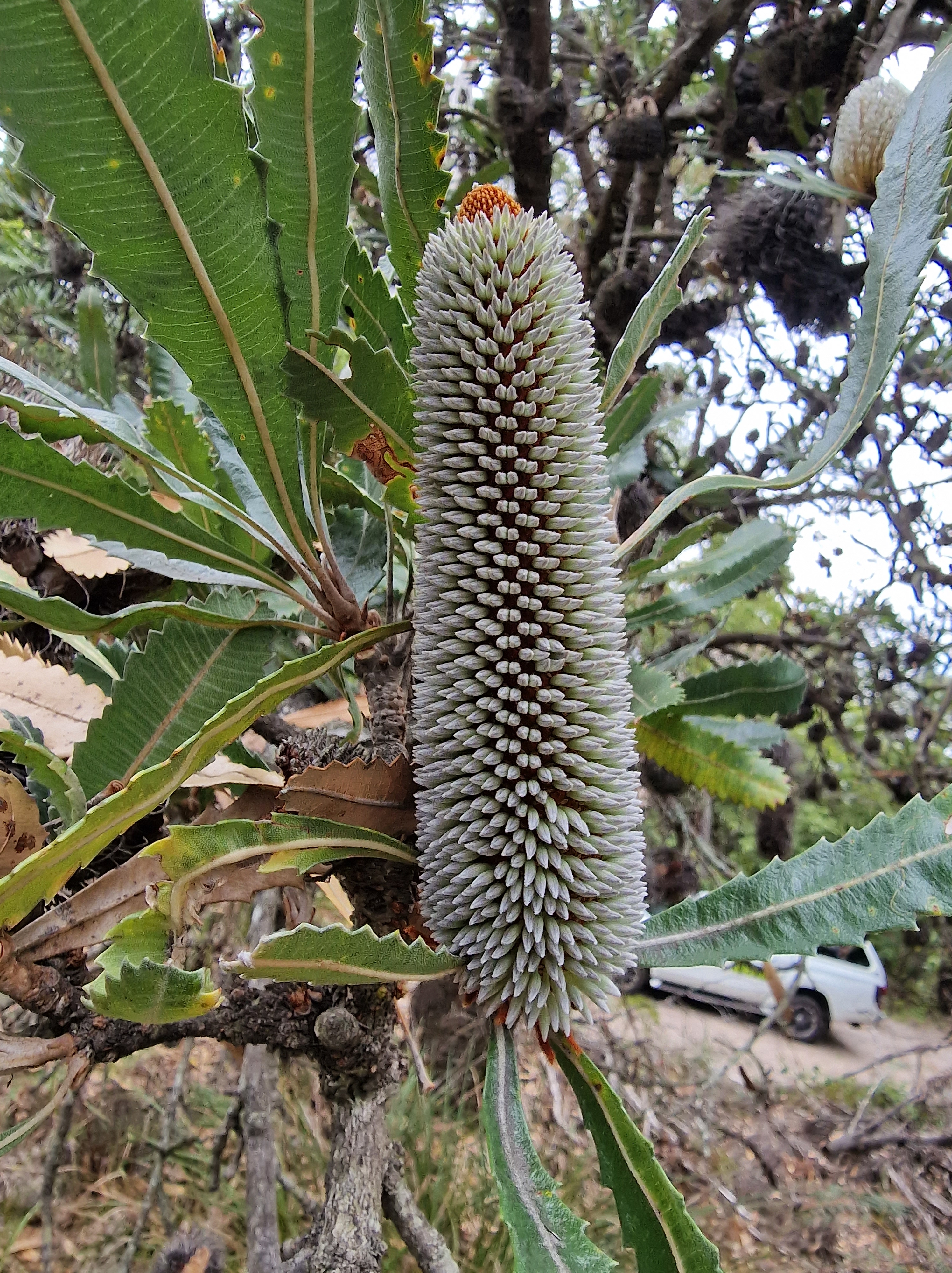
Two examples of the cone-like inflorescence, with several hundred dove-grey flowers, not quite open yet (mid-December). Note also the serrated leaves. Photos: John Grace.

Another example, an image from the Blue Mountains, New South Wales. The ‘cone’ is especially well developed in this case. The structure can be up to 15 cm tall. Image: Chris Jeffree
The flowers are rarely self-fertilized, even though the animal raiders must surely deposit pollen on the stigmas of the flower. It is thought that a mechanism of self-incompatability prevents self-pollination. When the raiding animal visits another tree, some of their pollen load is deposited on the stigmas and cross-fertilization occurs. Not all the flowers develop seeds, but those that do are protected by a resin-filled woody shell (‘follicle’) that remains attached to the cone. These seeds remain viable in their follicle for several years. Those that do not develop simply whither, giving the ‘cone’ a bedraggled appearance.

On this cone, half the flowers are fully open to reveal the yellowish curved ‘pollen-presenter’ (a feature of the Proteaceae). Image: Cas Liber, Public domain, via Wikimedia Commons
Bush-fires often kill above-ground parts of the plant but the below-ground ‘ligno-tubers’ can sprout new growth. The cones may fall to the ground and the fire temperatures cause release of the seeds and trigger their germination. To perpetuate the species, fire is necessary. If it is too frequent the more vulnerable seedlings and saplings will be killed, and if too infrequent (more than about every 20 years) there will be no regeneration.

A ‘cone’ picked from the ground. Only a few flowers have produced follicles – most have simply withered. Some follicles have opened, others remain closed. The English name ‘Old Man Banksia’ is well-deserved. Photo: John Grace.
Banksia belongs to the plant Family Proteaceae, which has 1,660 known species distributed mostly in Australia and South America. Abundant pollen occurs in Cretaceous coal deposits in New Zealand. Occurrence in both S. America and Australia has prompted a few authors to claim that the Family may have been widespread before Gondwana broke up (circa 300 million years ago) and some people call it a ‘Gondwanian family’. However, most early pollen deposits of Banksia suggest a late Cretaceous origin (about 60 million years ago). Taxonomists have struggled somewhat to place it in the ‘tree of life’, and the latest work by the Angiosperm Phylogeny Group (2016) based on molecular and morphological evidence suggest it belongs to an early clade which includes water lilies (Nelumbonaceae) and plane trees (Platanaceae). Kinship with plane trees is astonishing for most of us, and the analysis should be regarded as provisional.
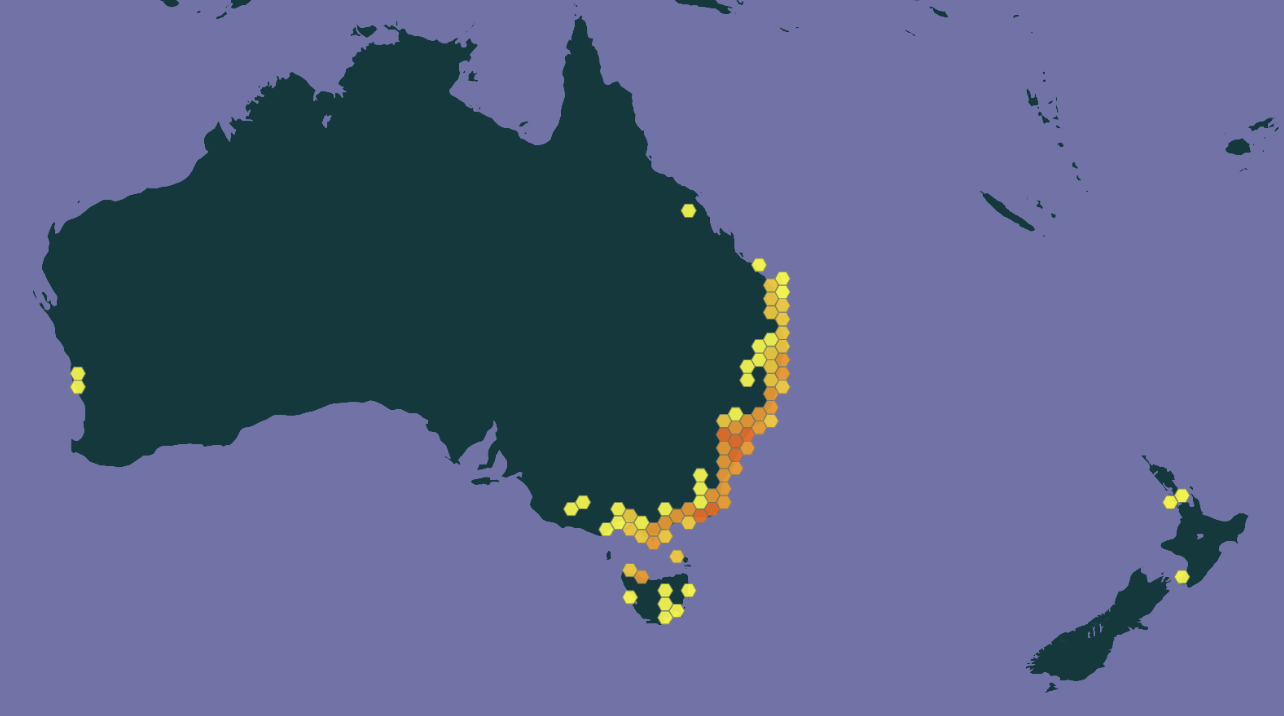
Current distribution of Banksia serrata according to GBIF (Global Biodiversity Information Facility). There are just a few records elsewhere in the world where the plant may have escaped from cultivation.
Acknowledgement
Thanks are due to Waverney Ford for guiding me to the plants in and around Merimbula, New South Wales.
References
Angiosperm Phylogeny Group (2016). “An update of the Angiosperm Phylogeny Group classification for the orders and families of flowering plants: APG IV”. Botanical Journal of the Linnean Society 181, 1–20. doi:10.1111/boj.12385
Goldingay RL and Carthew SM (1998). Breeding and Mating Systems of Australian Proteaceae. Australian Journal of Botany. 46, 421–437. doi:10.1071/BT97037.
Vaja V and Raine JI (2003) Pollen and spores in marine Cretaceous/Tertiary boundary sediments at mid-Waipara River, North Canterbury, New Zealand. New Zealand Journal of Geology & Geophysics 46, 255–273.
©John Grace