Citrullus colocynthis – 18th December 2023 – (a desert gourd)
We were in Western Australia last week and the temperature reached 40 oC under perfect blue skies. The road north from Carnarvon took us through sparse and low-growing shrublands, dominated by species of Acacia (called ‘Wattles’ here) but at this time of year almost nothing remains in flower. We took a left turn towards the coast to a place called Quobba, once a thriving sheep-farming station but now a conservation area. By the roadside we spotted patches of green foliage with fruits that looked like tennis balls. What could they be?
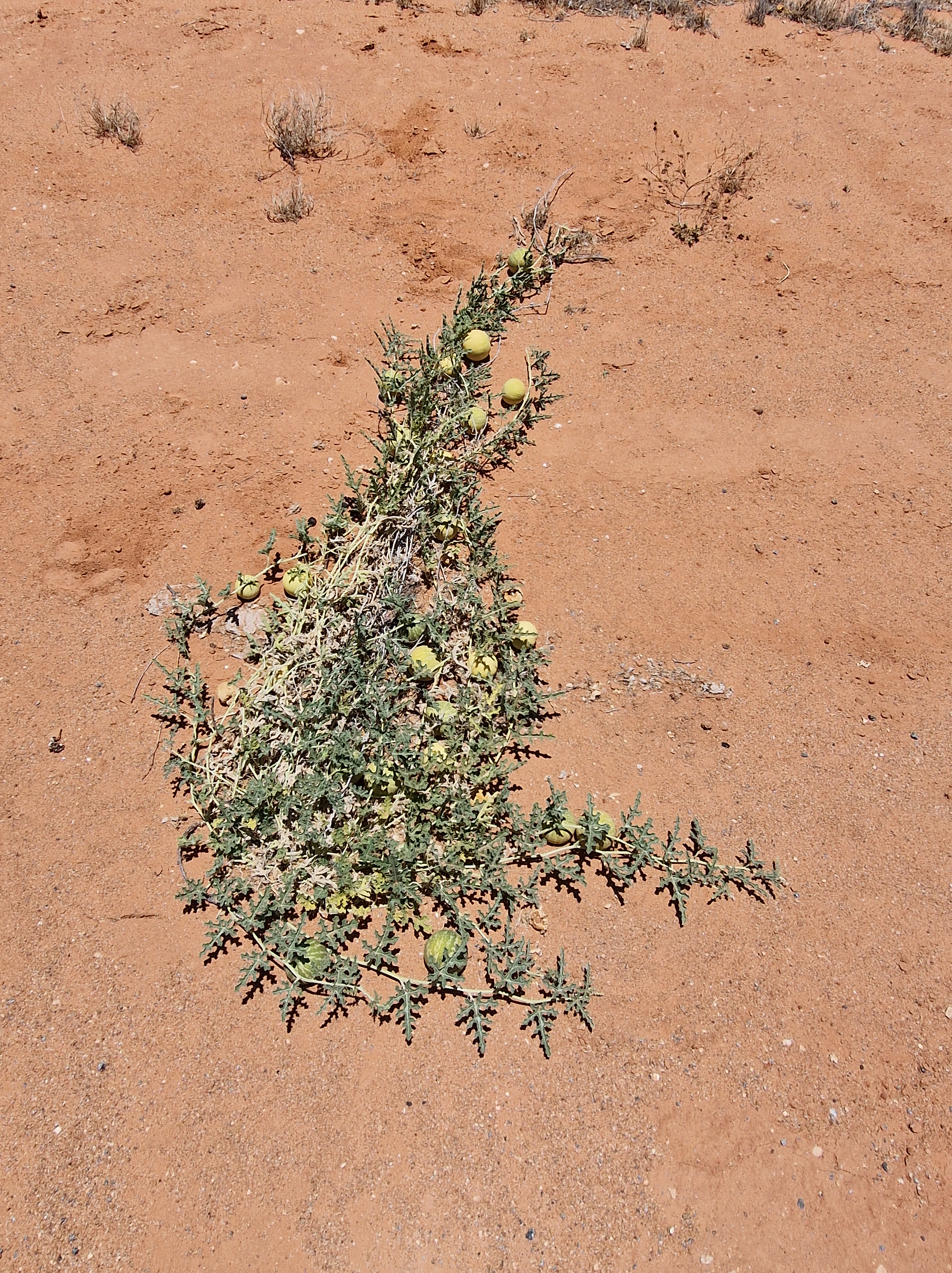
This is what we saw, mid-December 2023 on the road to Quobba, Western Australia. The stems trail to about 2 metres. There are some dead stems, presumably last year’s growth. Photo: John Grace.
We stopped the car to take a look. I recognised this plant immediately, having seen it in Saudi Arabia years ago where we did research on its water economy: it was the remarkable Citrullus colocynthis, a desert gourd, also known as bitter apple, bitter cucumber, desert gourd, Egusi melon and vine of Sodom.

Botanical illustration by Franz Eugen Köhler, Köhler’s Medizinal-Pflanzen, publication dates 1887 and 1890. Public domain, via Wikimedia Commons.
It is a close relative of the water-melon Citrullus lanatus. Cultivated water-melons you see in supermarkets everywhere have large and more or less seedless fruits but the wild form is not much different from Citrullus colocynthis. The flowers, leaves and fruit bear a striking resemblance, but the water-melon fruits are larger and the leaves are less divided. I found that the two species are often confused and some authors think that C. colocynthis is the wild ancestor of water-melon.
The flowers are monoecious (as most cultivated melons are too) and yellow. The fruit is green at first, often marbled with darker streaks, then becoming yellow at maturity. They are highly visible but the several feral goats and other livestock that roam around Quobba seem uninterested in them.
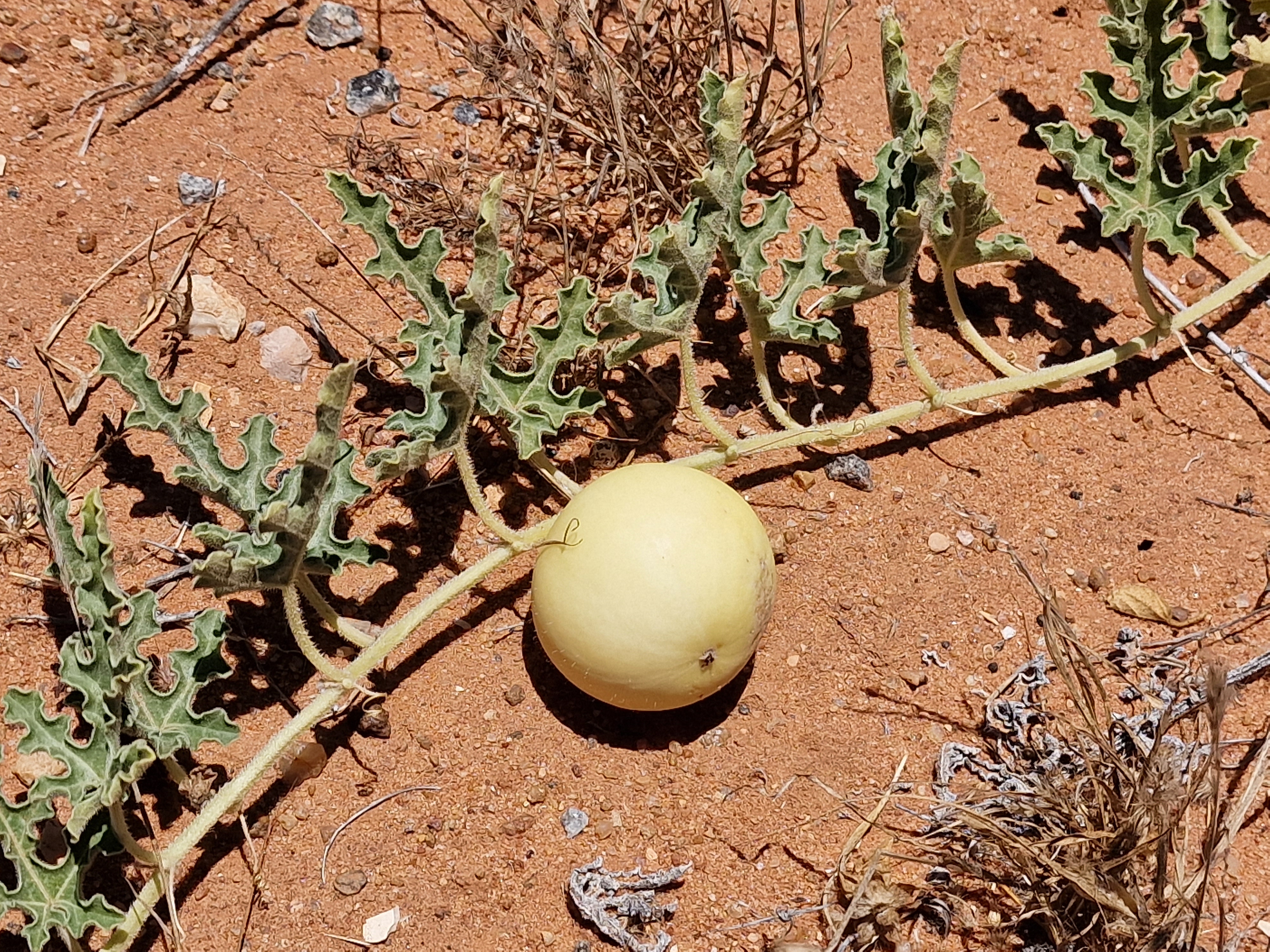
Detail of mature fruit and leaf attachment to the trailing stem. The species has tendrils but in this case they are not well-developed. They can be seen in the left-hand corner of the image (compare with Köhler’s illustration). The tendrils enable it to climb, vine-like, on shrubs. Photo: John Grace.
Citrullus colocynthis was introduced to Australia long ago, and has found a home in the arid regions. Where we saw it, near Quobba, the average annual rainfall is a little over 220 mm. Its native range includes north Africa, the entire Mediterranean region and much of Asia (see map, below). Its early spread in the dry areas of Australia may have been the result of grazing by camels. Afghan camel train operators were active in these lands in the 1860s and the camels may have dispersed the seeds in faeces.
It has a deep tap root. I have read that its roots were found 10 metres below the surface when the Suez Canal was dug. Most desert plants have a reduced leaf area or no leaves at all, but this one adopts a completely different strategy. It is an example of a desert plant that is a ‘water-spender’. It has numerous stomata (comparable to cucumber) and a high transpiration rate to keep cool. The cooling effect of a high rate of evaporation can be considerable – earlier researchers found the leaf temperature could be up to 7 degrees cooler than air temperature. We grew it in a controlled environment chamber at the University of Edinburgh and found that when it gets too hot (around 42 degrees) it swivels its leaves to a vertical posture, thus reducing the heat load from the mid-day sun. We saw the same thing in the Saudi desert and again last week. With the air temperature at 40 degrees, these plants were beginning to do the same thing.
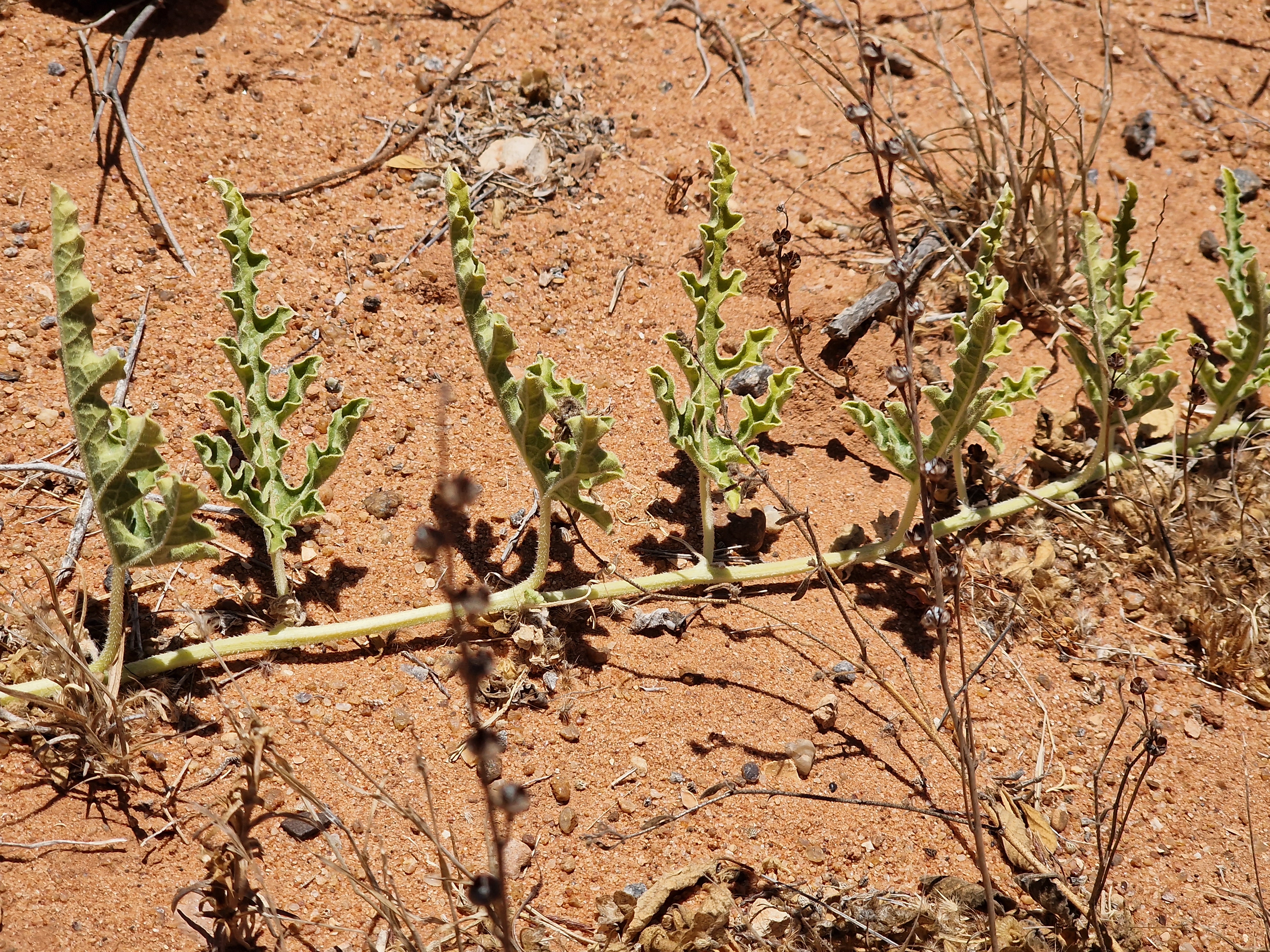
Late morning: the leaves have adopted a vertical posture to reduce the solar heat load, also they have curled up somewhat. Photo: John Grace.
It can be eaten but it is extremely bitter and its fruits cause diarrhoea (or worse, depending on dose). Nevertheless, it has been used by humans since ancient times. One source says “The characteristic small seed of the colocynth have been found in several early archaeological sites in northern Africa and the Near East, specifically at Neolithic Armant, Nagada in Egypt; at sites dating from 3800 BC to Roman times in Libya; and the pre-pottery Neolithic levels of the Nahal Hemar caves in Palestine”. It seems the seeds are especially valued, not only as an ingredient of soup but also because they are a source of oil. The oil yield is so high that it is one of several dryland species that have been proposed as a source of biofuel. Under cultivation the seed yield is reported to be between 6.7 to 10 tonnes per hectare, with oil yields that might be as large as 3 tonnes.
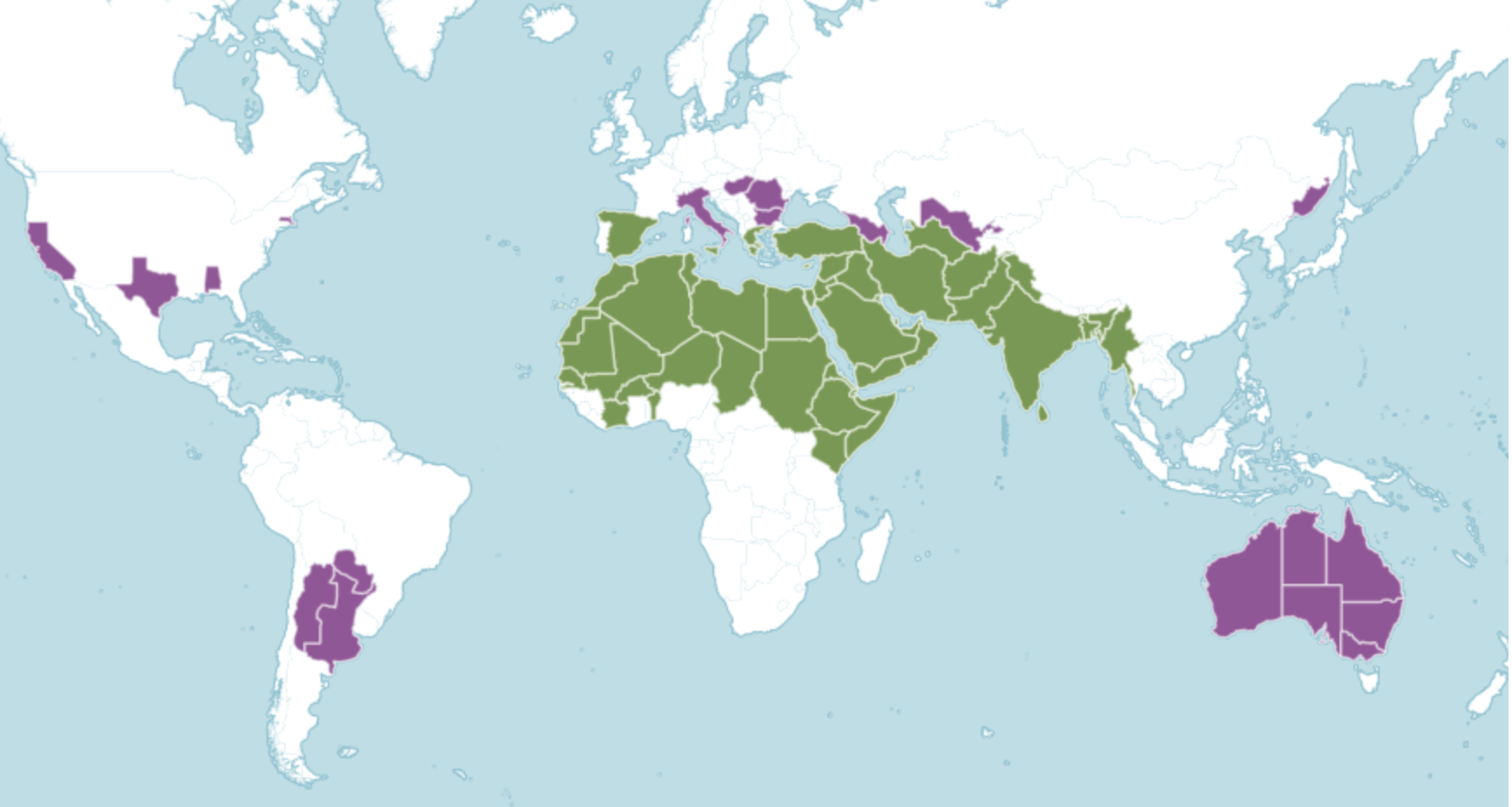
Global distribution of Citrullus colocynthis. Green areas are the native range, purple is where the species has been introduced by humans. From Plants of the World Online, Kew.
The history of the use of this species by humans is told by Lloyd and Cincinnati (1898). I knew already that the plant is supposed to be the wild gourd of the Old Testament but I had no idea its true history. Over a hundred years ago the fruits were brought by Jaffa traders to England and sold as Turkish colocynth, a medicine. It isn’t one I’d like to try. Another source says “It is a powerful drastic hydragogue cathartic producing, when given in large doses, violent griping with, sometimes, bloody discharges and dangerous inflammation of the bowels. Death has resulted from a dose of 1 1/2 teaspoonsful of the powder. It is seldom prescribed alone. It is of such irritant nature that severe pain is caused if the powdered drug be applied to the nostrils; it has a nauseous, bitter taste and is usually given in mixture form with the tinctures of podophylum and belladonna. Colocynth fruits broken small are useful for keeping moth away from furs, woollens, etc.”
References
Althawadi AM and Grace J (1986). Water-use by the desert cucurbit Citrullus colocynthis (L) Schrad. Oecologia. 70, 475–480.https://link.springer.com/article/10.1007/BF00379514
Lloyd JU and Cincinnati O (1898) Citrullus colocynthis. The Western Druggist, Chicago, USA. https://swsbm.henriettesherbal.com/ManualsOther/Citrullus%20colocynthis-Lloyd.PDF
Schulze E-D, Lange OL and Koch W (1972) Eco-physiological investigations on wild and cultivated plants in the Negev Desert III. Daily courses of net photosynthesis and transpiration at the end of the dry period. Oecologia 9, 317–340. (article in German with English summary )https://link.springer.com/article/10.1007/BF00345336
Other sources
https://inaturalist.ala.org.au/taxa/160657-Citrullus-colocynthis
https://globalfoodbook.com/12-key-benefits-of-egusi-melon-citrullus-colocynthis
©John Grace