Leonurus cardiaca – September 2nd 2024 – (Motherwort)
This week’s plant is one you may not have seen before. I saw it for the first time a week ago, on a friend’s allotment plot, where it appeared spontaneously. It’s a species which may have been grown in gardens of old as a medicinal plant, sometimes escaping into the wild. Nowadays it’s rare, and especially so in Scotland.

Old illustration of Motherwort, Leonurus cardiaca, by Johann Georg Sturm (1742–1793). Sturm was a German natural history illustrator. Public domain, via Wikimedia Commons.
It belongs to the Lamiaceae, the Family of mint, deadnettle and sage. It has the characteristic family features: petals fused to form an upper and lower ‘lip’, leaves that are borne in opposite pairs, and a stem that’s square in section. Many plants in this Family are culinary herbs, adding deep flavours and aromas to everyday dishes.
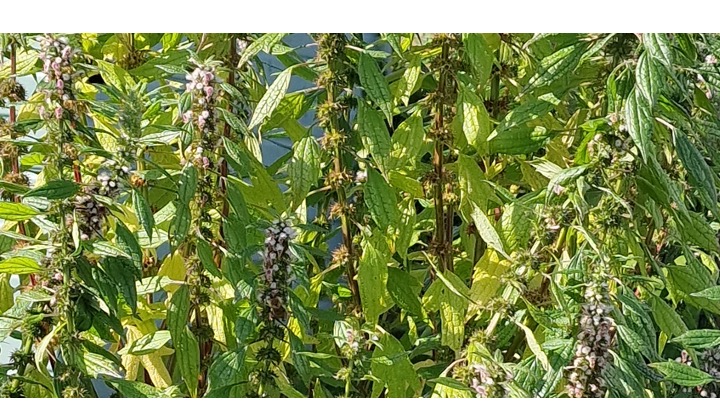
The plant we saw on the Edinburgh allotment was a single specimen which the plot-holder had left to grow, out of curiosity. It was in full flower (late August), quite tall (circa 1.4 metres), flexing slightly in the breeze. When I revisited the site a few days later there were several bumble bees in attendance, attracted perhaps by the faint scent and perhaps further encouraged by the bee-like appearance of the flower itself (resembling the bee-mimicry shown by some orchids).

Detail of flowering spike. Image: Sue Jury.
I searched on the BSBI data base to see where else in Scotland the species had been recorded: last year it turned up at the car park of the railway station in Prestwick Town, on the West Coast of Scotland. I went there last week and happily found it, but alas its flowering was almost finished and the plants looked miserable by the boundary fence. There were however many of them, suggesting a linear spread by rhizomes. We have often found rare and interesting plants in car parks, presumably they come on the treads of tyres and boots.

The entire plant at the Edinburgh allotment, late August. Growth is strong and there are many branches, each one bearing flowers. Image: John Grace.
I also looked in some old books to see if it has any history in Scotland. Sonntag’s 1894 Pocket Flora of Edinburgh says this:
Location: rare; waste places; introduced; Water of Leith near Stockbridge, Fisherrow; Colinton Woods, North Queensferry.
A search on the BSBI data base showed rather few records for the whole of Scotland. It has been recorded in the past at Findhorn (where there is a spiritual community/ecovillage) and at Knockando (there is a woolmill – perhaps a clue to its introduction). It was seen in 2018 by Mick Crawley in Edinburgh, at Greyfriars (a popular tourist attraction with much continental footfall).

Detail of flower, highly attractive to bumble-bees. The whole plant is hairy, and the teeth of the calyx are very sharp, perhaps deterring grazing animals. Image: John Grace.
It is not native to the British Isles; it came here from Europe and/or the eastern part of Russia. In Britain it was recorded by Gerard in his 1597 Herbal. He said “ It joyeth among rubbish, in stony and other barren and rough places, especially about Oxford; it profiteth well in gardens”. I was surprised to find it missing from the BSBI’s list of archaeophytes. These are the species that came here between the neolithic period and the year 1500 AD, regarded by botanists as a sort of ‘honorary native’ and sometimes loved and cherished by the public. But we really can’t tell if this one was long-established at the time when Gerard was working; possibly it had only just arrived, making it a neophyte (i.e. alien).

Left: shadow of terminal region showing the arrangement of flower-clusters and leaves. Right: a range of leaf-shapes from the apex of the spike (leaves entire) to the basal region (leaves divided, ternate). Image: John Grace.
It appears to be widespread in Europe. Muratet et al (2017) illustrate it in their recent urban flora of France; they say it is found on “friches nitrophiles, seches sur sols sableux” which roughly translates to “nitrophilous wastelands, dry on sandy soils”

Distribution of Motherwort in Britain and Ireland (apparently it is extinct in Ireland). Note: there are many squares where the plant has not been seen lately, perhaps extinct or possibly overlooked. Map from BSBI/Maps.
The English name ‘Motherwort’ suggests it has been a useful medicine for mothers. The French name ‘Agripaume cardiaque’ translates simply to ‘cardiac motherwort’. In China there is a closely related species Leonurus japonicus, one of the 50 species of ‘fundamental medicinal herbs’. Its Chinese name is yì mǔ cǎo (益母草) literally “beneficial herb for mothers”. I looked in Culpepper’s 1653 Complete Herbal to find out more about the uses of the herb in Elizabethan England. He says:
“..it makes women joyful mothers of children, and settles their wombs as they should be…it is held to be of much use for the trembling of the heart, and faintings and swoonings; from which it took the name Cardiaca…it also provokes urine and women’s courses, cleanses the chest of cold phlegm, oppressing it, kills worms in the belly.”
He also said: “it grows only in gardens with us in England”.
I looked at lists of medicinal plants from medieval monasteries in Britain, hoping to find evidence for an early introduction, but I found none. I did find that the plant was grown in monasteries in Norway, at several places (see Asen 2009). Perhaps it came to us with the Viking invasions. We may never know.

Motherwort at the railway-station car park in Prestwick, Ayrshire, 27th August 2024. Here, it grows in a poor and litter-bestrewn environment but still flowers and produces seed. Image: John Grace.
For Plant of the Week I always like to dig out long-forgotten research on the ecology of the species, but a search on Google Scholar for motherwort revealed nothing of significance. I was however impressed by the huge amount of research that has been done to identify biologically-active compounds contained in the leaves. A recent review of the literature (Fierascu et al 2019) can be found here. As well as a survey of the many bioactive compounds, the authors provide a nice synopsis of the uses of the plant:
“The plant, original to Asia and southeastern Europe is now world-spread, due to its medicinal use. The potential application in treating several cardiac disorders, as well as female-specific afflictions, made L. cardiaca a very good candidate for development of alternative treatments, in both traditional eastern and modern medicine. Besides the traditional medical use, motherwort is used in some cuisines as condiment in various vegetable soup recipes, particularly the lentil or split peas ones, or for flavouring of beer and tea, thus increasing the potential intake of the medicinal plant by the general public”.

Global distribution of Leonurus cardiaca. Countries where it is considered native are coloured green. Purple indicates the species has been introduced. Image from Plants of the World Online, https://powo.science.kew.org/
References
Asen PA (2009)Plants of possible monastic origin growing in the past or present medieval monastery grounds of Norway. Plants and Culture: seeds of the cultural heritage of Europe. Edipug;ia s.r.l. www. Edipuglia.it
Fierascu RC et al. (2019) Leonurus cardiaca L. as a Source of Bioactive Compounds: An Update of the European Medicines Agency Assessment Report. Biomedical Research International. doi: 10.1155/2019/4303215
Muratet A, Muratet M and Pellaton M (2017) Flora des Friches Urbaines. Xavier Barrel, Paris.
©John Grace