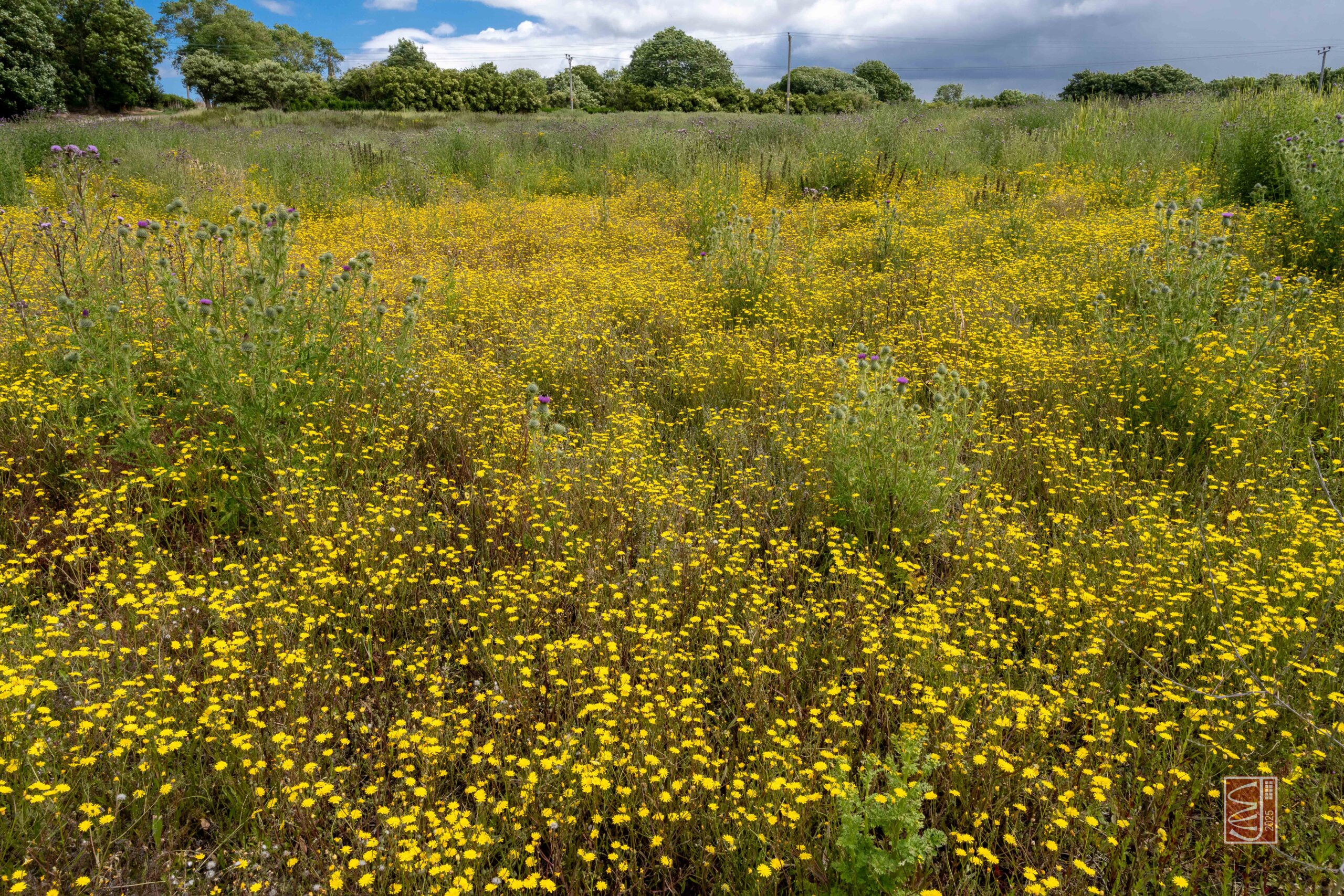
Crepis capillaris – June 23rd 2025 – Smooth Hawksbeard
There are many sorts of yellow daisy-flower and their identification is a challenge even for experienced recorders. Their English names are also confusing: the Hawksbeards, Hawkbits, Hawkweeds, Catsears and Dandelions. So where do we begin? We can put aside Dandelions provided we are content to ignore its 200 or more micro-species, and refer simply to ‘the Dandelion’. Anyway, it’s easy to tell a dandelion: it is the only common one with both milky latex and one large flower-head on each stem.

Crepis capillaris, showing the general structure of the plant. Image: Chris Jeffree.
As for the rest, there is a good online beginners’ guide to identification here, by Hazel Metherell. Or, if you have an appetite for You Tube, and wish for a full-blown tutorial, you may enjoy Paul Green’s movie.
Worldwide, the daisy Family, Asteraceae (once called Compositae) is vast with over 32,000 known species, but in Britain we have only a few hundred of them, and even less in Scotland. This week we look at one of the most common yellow daisy-flowers, Crepis capillaris the Smooth Hawksbeard. It adorns roadsides, verges, walls and waste places throughout the British Isles and is often taken for granted, being both common and innocuous. Ecologists have often overlooked it, leading one reviewer to write “In view of its widespread occurrence, Crepis capillaris deserves more study than it has so far received”.

Crepis capillaris flowers. Note the red tinges, the bracts (‘phyllaries’) that support the floral structure (short outer ones and an inner elongated set), and hairiness. Image: Chris Jeffree.
Crepis capillaris is an annual (sometimes biennial) native plant. If you are a beginner, you need to know that the ‘flowers’ of the Asteraceae are really bunches of many tiny florets sitting on a little platform called the receptacle to make a composite flower head (hence the old Family name Compositae). Many Asteraceae have two sorts of florets in their composite flower-heads. Think of the common daisy, with central disc florets (yellow) and surrounding strap-like ray florets (white). However, Crepis capillaris has only ray florets. There are about 40 of them, and they are bright yellow, sometimes with red colouration underneath. The flowers attract pollinating insects and must be cross-pollinated to set seed.

Appearance after flowering. See the white tips protruding and compare with the cut-away view in the picture below. Image: Chris Jeffree.
The wind-blown seeds have a ‘parachute’ of soft white hairs and they are shed from the dandelion-clock head (see the image below). They germinate readily in the autumn although a few may stay in the soil, apparently dormant, for a year or two (Roberts 1986). The seedlings survive the cold winter months. The plant tolerates a wide range of soil types but has a preference for soils with a high pH (more than 6).
It needs rather open sites because is not a good competitor (Grime et al. 1988). Its rosette of basal leaves is easily over-shadowed by faster-growing and leafy species that thrive in the most fertile soils, and so the soil type where Crepis capillaris is generally found is classed as ‘infertile’. Crepis capillaris begins to flower in May and continues until autumn when the plant dies, although in mown grass it may survive as a rosette of leaves.
The rosette leaves resemble those of dandelions, being toothed, but are usually smaller (5-25 cm). There are a few strap-like leaves on the branched stem. Leaves are not hairy, but the stem usually does have hairs.

Cut-away view. The seeds have a parachute of hairs (called a ‘pappus of hairs’, the pappus being a modified calyx). The hairs are white and not branched. Image: Chris Jeffree.
Although the species has been somewhat ignored by researchers, it does have two ‘claims to fame’. It was one of the first species to be taken into outer space – perhaps it was only the second, after Thale Cress Arabidopsis thaliana. There are quite many publications from the Soviet Russian Salyut 6 space programme (eg Dubinina and Chernikova 1968 and Anikeeva et al. 1983). Salyut 6 was a forerunner of the International Space Station, having human crews from 1977-81. As well as astronomical observations the cosmonauts carried out a limited set of experiments in astrobiology. After 827 days of space flight, seeds were brought back to Moscow, and tested for germination, mitotic index and chromosomal aberrations1 in their root meristems.

The seed-head just before dispersal. Much like a Dandelion (Taraxacum). Image: Chris Jeffree.
There were indeed chromosomal aberrations, and the viability of seeds and seedlings was reduced; also many plants did not set seed. The most likely cause of such effects is surely the high doses of cosmic radiation that occur in space2. Human space exploration is likely to encounter such hazards, although my reading of articles on the cause of death in astronauts suggests the effects must be small if they exist at all.

Crepis capillaris, left: distribution in Britain and Ireland from BSBI/Maps and right: the world distribution according to GBIF. The native range is Europe.
The second claim to fame is that Crepis capillaris is said to have the least number of chromosomes of all plant species, with 2n=6 although the six are relatively large. In the plant kingdom, many species have far more chromosomes3, but they are often small and therefore hard to study. Thus, the humble C. capillaris is a good model organism to study chromosome organisation in plants, and to assess the impact of environmental stresses on the mutation rate. Grant and Owens (1988) found 162 chemical assays had been made on C. crepis, of which 85% caused chromosome aberrations. For example, they found that caffeine had no effect on chromosomes whereas colchicine caused aberrations. Using such assays, it becomes possible to test the effect on chromosomes of the many chemical pollutants found in drinking water or in rivers, and thus help to define human safety limits.
Most wild-flowers are useful to humankind in some way or another.
Notes
1the term ‘aberration’ can mean breakage or any change in the structure or number of chromosomes, usually caused when cell division does not take place properly. It is not the same as ‘mutation’ which implies a change in the genetic code at some point on any chromosome.
2some of the radiation from space (solar and galactic) is deflected by the Earth’s magnetic field, so astronauts in space experience higher doses than most people, even when in the spacecraft.
3a recently discovered fern, Ophioglossum reticulatum, has over 1400 chromosomes, but most plants are in the range 10-50. A large number of chromosomes does not imply more genetic code.
References
Anikeeva ID, Kostina LN and Vaulina EN (1983). Experiments with air-dried seeds of Arabidopsis thaliana (L) heynh. and Crepis capillaris (L) wallr., aboard Salyut 6. Advances in Space Research 3 (8), 129-133.
Dubinina LG and Chernikova OP (1968). Space effects in Crepis capillaris seeds. Jap J Gen, 43(9), 470-474.
Grant WF and Owens ET (1998) Chromosome aberration assays in Crepis for the study of environmental mutagens. Mutation Research/Reviews in Mutation Research, 410, 291-307.
Grime JP, Hodgeson JG and Hunt R (1988) Comparative Plant Ecology. Cambridge University Press.
Parker JS et al (1991). The population cytogenetics of Crepis capillaris IV. The distribution of B-chromosomes in British populations. Heredity 66, 211-218.
Rice A. et al. (2015) The Chromosome Counts Database (CCDB)–a community resource of plant chromosome numbers. New Phytologist, 206,19-26.
Roberts H A (1986) Seed persistence in soil and seasonal emergence in plant species from different habitats. Journal of Applied Ecology 23, 639-656.
©John Grace