Epipactis helleborine – January 26th 2026 – Broad-leaved Helleborine (aka the Glasgow Orchid)
There are good reasons why Orchids occupy a special place in the hearts and minds of plant-hunters. We think of them as ‘charismatic’. Why? Their flowers often have a strange appearance, and most species are rather rare with short flowering periods. The delight in finding an orchid is palpable, especially so if it’s rare.

Epipactis helleborine in woodland at Bo’ness near the the south bank of the Firth of Forth. The plants grow up to 80 cm and flowers can be found throughout the summer. Image: Chris Jeffree.
But Epipactis helleborine is not rare; it is one of the more common orchids. We recorded it many times in the Urban Flora project, nearly all the records being around Glasgow. Some European authors have described it as ‘weedy’ or even ‘invasive’. In Scotland, its distribution map shows it to be in the urban belt from Glasgow to Edinburgh. Its spread in Scotland seems to have been relatively recent. We found useful information in the book The Changing Flora of Glasgow by Dickson et al. (2000): these authors found no records in the Glasgow area before 1970. They say “nobody had realised until the Flora of Glasgow survey just how readily found this plant is”. Yet, it is a native species and may have been common in past times – Hooker’s Floras of 1821 and 1884 mention it as Epipactis latifolia, and Hopkirk’s Glasow Flora Flora Glottiana of 1814 says Broad-leaved Helleborine is “in woods and pastures, frequent”. According to the modern BSBI records it is increasing in Scotland and Ireland but decreasing in central and northern England.

Detail of flower spike. Image: Chris Jeffree.
If we use BSBI/Maps to zoom in to the Central Belt of Scotland we can see how the species is especially common around Glasgow, extending into Ayrshire. No wonder some people call it ‘the Glasgow orchid’.
It tolerates urban conditions very well. The habitats of this species in Glasgow are gardens, graveyards, parks, close to railings, woodlands, coal bings, disused railways, old quarries and lime dumps (Dickson et al. 2000). Some of these sites presumably are contaminated with de-icing salt, heavy metals like Lead, Zinc and Cadmium, pollution from vehicles and the many residues from Glasgow’s industrial past including arsenic and chromium (Wragg et al. 2017). This plant doesn’t mind – I was intrigued to see a fine specimen on a busy roundabout where the dose of pollutants must have been substantial.

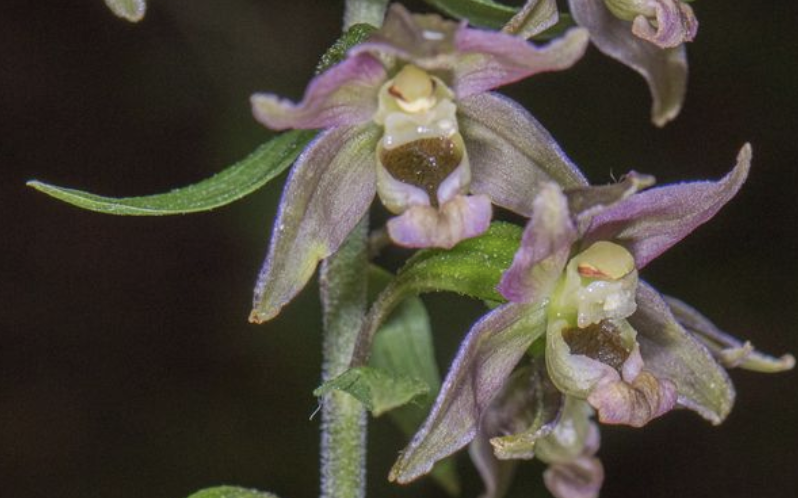
Close-up of flowers and stems, showing sparse pubescence. Image: Chris Jeffree.
Similar patterns have emerged on the continent. Wittig and Wittig (2007) surveyed Germany’s most populous state (Nordrhein-Westfalen), containing the industrial heritage of the Ruhr area. They found E. helleborine to be the only German orchid species which had not only maintained its area and population size but enlarged. It is very hard to explain why this species, above all orchids, has shown this ‘ruderal’ tendency in recent decades.

Epipactis helleborine has been introduced to North America. This mage is from the grounds of Museum of Modern Art, New York, by Chris Jeffree.
Orchids produce millions of tiny, dust-like seeds for long-range dispersal in the air. To germinate and develop they require the assistance of a mycorrhizal partner to supply their nutrients, often spending several years below-ground before green orchid leaves emerge above-ground (Dearnaley et al. 2016). Perhaps their tiny seeds are especially well-distributed where vehicles are continuously mixing the air and carrying dust-like seeds in their wake. (Note: we do notice our car gets very dirty when driving through Glasgow, but there is no evidence that this is a mechanism of seed dispersal in our busiest cities). We don’t know: it’s a ‘bold hypothesis’ that needs testing. A more likely theory relates to the diversity of the available mycorrhizal partners. It seems that E. helleborine can partner with a wider range of fungi than other species, and therefore it can establish almost anywhere as long as the soil is not being disturbed by cultivation.

Distribution of E. helleborine in Britain and Ireland, with detail of records from around Glasgow. From BSBI/Maps.
There are several other Epipactis species in Britain but all the others are rare. You may view images of their flowers here, but beware – the shape and flower colours of E. helleborine are highly variable and identification requires expertise. I believe most are pollinated by large flying insects in search of nectar, and in the case of E. helleborine the nectar contains an opioid which may prolong each visit. Three of the seven species, the Narrow-lipped, the Dune and the Green-flowered are self-pollinated.

Epipactis sancta, one of the rarest orchids, known only from dunes of Lindesfarne (Holy Island). Its status as a species is questioned by Bateman (2020) who supposes it to be a form of Epipactis dunensis. Image: Chris Jeffree.
E. helleborine also occurs in North America. Stories that it was taken there by early settlers as a cure for gout may be fanciful. It hasn’t yet reached Australia and New Zealand.
References
Bateman RM (2020). Implications of next-generation sequencing for the systematics and evolution of the terrestrial orchid genus Epipactis, with particular reference to the British Isles. Kew Bulletin, 75(1), 4-26.
Dearnaley J et al. (2016). Structure and development of orchid mycorrhizas. Chapter 5 of Molecular Mycorrhizal Symbiosis, pages 63-86. Wiley.
Dickson JH and MacPherson P (2000). The Changing Flora of Glasgow: Urban and Rural Plants through the Centuries. Edinburgh University Press.
Jakubska-Busse A and Gola EM (2010). Morphological variability of Helleborines. I. Diagnostic significance of morphological features in Epipactis helleborine (L.) Crantz, Epipactis atrorubens (Hoffm.) Besser and their hybrid, Epipactis x schmalhausenii Richt.(Orchidaceae, Neottieae). Acta Societatis Botanicorum Poloniae 79, no. 3.
Kolanowska M (2013). Niche conservatism and the future potential range of Epipactis helleborine (Orchidaceae). PLoS One, 8(10), e77352.
Wittig R and Wittig M (2007). Epipactis helleborine (L.) Crantz–the first (semi) ruderal orchid species of Central Europe. Feddes Repertorium, 118(1‐2), 46-50.
Wragg J et al. (2017). Linkage between solid-phase apportionment and bioaccessible arsenic, chromium and lead in soil from Glasgow, Scotland, UK. Earth and Environmental Science Transactions of the Royal Society of Edinburgh 108, no. 2-3, 217-230.
©John Grace