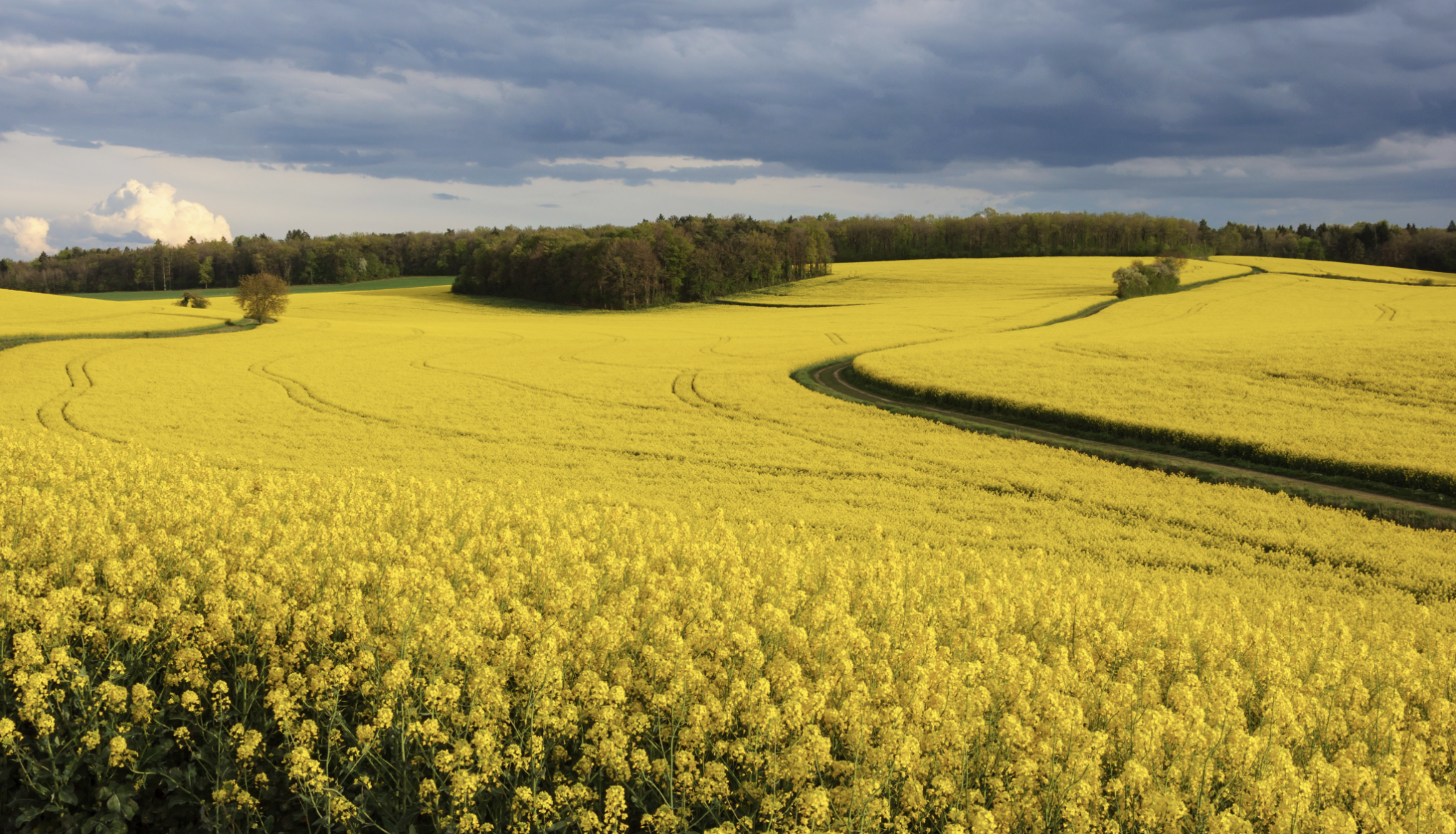
Brassica napus subspecies oleifera – May 4th 2026 – Oilseed Rape
Readers may have recently seen bright yellow fields of oil-seed rape. This is a subspecies of Brassica napus a plant that seems to have arisen through a cross between cabbage (Brassica oleracea) and turnip (Brassica rapa). The coming-together may have occurred several thousand years ago in the Mediterranean region or western Europe where both species overlapped.

Brassica napus. By Walther Otto Müller, Public domain, via Wikimedia Commons. Walther Otto Müller, also Otto Müller, (1833 – 1887), was a German botanist and gardener.
Its ‘domestication’ for oilseed production began in Europe around the 16th century, and now the plant has been ‘improved’ to become a cultivated crop wherever the climate is ‘temperate’, but especially in Europe, North America and Australia/New Zealand. The cooking oil we buy as ‘vegetable oil’ is usually from the seeds of oil-seed rape, whilst in North America they call it CANOLA, an interesting word invented in the 1970s by Canadians: ‘CAN’ stands for Canada, ‘O’ is oil and ‘LA’ is ‘low acid’. From its hybrid origin to its modern form as canola, we see the power of plant breeding and biotechnology to transform a once-marginal crop into a staple of global agriculture. Its oil is relatively healthy and doesn’t start to smoke until very high temperatures are reached.

Field of Oilseed Rape in full flower. Image: Chris Jeffree.
The oil is valuable, not just as a cooking oil. Much of UK’s production is used to make biodiesel, and therefore to reduce our dependency of fossil fuels. It is also used in making margarine, mayonnaise, soap, lubrication for jet engines; what’s left after oil extraction makes good animal feed. The oil may also reduce our reliance on palm-oil and thus ease the pressure of tropical deforestation. Thus, altogether, the modern cultivars are very useful plants supporting our ‘way of life’. Farmers in the UK have found it profitable to grow (although ‘profitability’ in farming depends on so many external variables including government support – but I don’t want to delve into farm economics here). I have heard that in the Czech Republic, 16% of farmland is oilseed whilst in UK, oilseed is 4%–5% of the total croppable area. Some people love it, but others hate it (more about that later).

Oilseed Rape at an urban location in Leith. Image: Chris Jeffree.
What about its biology? As already mentioned, it appears to be an allopolyploid formed by the cross between a wild cabbage (Brassica oleracea with 2n=18 chromosomes) and wild turnip (Brassica rapa with 2n=20 chromosomes). The resulting hybrid would not have been fertile as chromosomes would fail to match, but after chromosome doubling a fertile offspring with 38 chromosomes emerged as a new species.

Oilseed rape being visited by St Mark’s Fly. Note the convex top ‘dome’ of the inflorescence (see also the ‘domes’ in the previous picture from Leith). Image: Chris Jeffree.
As with many members of the Brassicaceae (the Mustard and Cabbage Family) it has yellow flowers arranged in a cross and pollinated by insects. Flowers appear from March to June, and the seeds are produced in a two-part pod (‘siliqua’). Each seed weighs between 3 to 5 mg, with an oil content of 35–50%. Many plant species have oil in their seeds – it serves as an energy source during germination and early growth (somewhat better than starch reserves). Brassica napus can be annual or biennial. There is a slender tap-root. Overall, it is very much like wild turnip Brassica rapa (previously called Bargeman’s cabbage because it grew alongside canals), and can be confused with modern cultivated turnips that have ‘escaped’. The key difference described in Stace’s Flora is:
B. napus: Buds slightly overtopping open flowers, forming convex ‘dome’, petals usually greater than 11 mm
B. rapa: Buds overtopped by open flowers, forming concave ‘bowl’, petals less than 12 mm.
Confusion between the two has arisen because ‘rapa’ sounds like ‘rape’ whereas ‘rapa’ is the Latin name for turnip.

Oilseed Rape in East Lothian. Image: Chris Jeffree
As a crop plant, it prefers deep, fertile, well-drained soils with pH 6.0–7.5. High levels of nitrogen fertilizer are generally used by farmers to achieve maximum yields (150–200 kg N per hectare). The plant often escapes from fields, and now occupies many wild habitats including roadsides, waste ground, docks, cities and towns. It is an urban ‘weed’, sometimes on walls, pavements and gutters. It doesn’t tolerate competition in its early stages of growth, but once established it grows quickly in the spring (from seeds germinated in the autumn). We have found it in all these habitats in our urban flora project, although it is more common in England where it is more oil-seed rape is grown.
In agricultural conditions the species is vulnerable to several pests and diseases. The Cabbage Stem Flea Beetle Psylliodes chrysocephala is the most damaging. This is a tiny beetle with powerful hind legs that enables it to jump like a flea. Its larvae burrow through the stems and feed on the juicy tissues of Brassica napus. Formerly the damage was controlled by spraying with systemic pesticides but those were neo-nicotinoids and they were banned in 2018. This resulted in less oil-seed rape being grown but I believe alternative means of control have now been devised.

Cabbage Stem Flea Beetle Psylliodes chrysocephala, 3.0–4.0 mm in length. Attribution: Udo Schmidt, CC BY-SA 2.0 https://creativecommons.org/licenses/by-sa/2.0, via Wikimedia Commons
How does the oil-seed rape ‘escape’ from cultivation? There was an interesting study by Crawley and Brown (1995). They recorded the distribution of the plant alongside the M25 motorway (for foreign readers: this motorway encircles London). They found that road verges next to the carriageway carrying lorries towards the main rape seed crushing plant at Erith in Kent had significantly more plants than the opposite verge carrying traffic away from Erith. The obvious interpretation was: the heavily loaded vehicles carrying the crop to the crushing part spilled their seeds on their own side of the road; but on return in the opposite carriageway, they had no seed to spill. So, the seeds literally ‘fell off the back of a lorry’. Further work was done in France (Pessell et al 2001). They showed that roadside plants included genotypes that are no longer grown commercially, showing that the plants were truly ‘naturalised’ forming new plants over several generations.

An early stage of growth, showing the smooth and glaucous leaves resembling cabbage. Image: Chris Jeffree.
Of course, there are other sources of seed, including soil which has been moved from farmland to road verges, and birdseed. Possibly seed is transported in the guts of birds but very few remain viable.
The negative aspects of growing oil-seed rape on a commercial scale are often stressed as follows:
(i) health issues. Some people complain of respiratory difficulties, headaches, fatigue and dizziness, caused by the sweet and sickly smell of the volatile chemicals released by the plants to attract pollinators. Most flowers smell, but when there is a whole field of them, and in certain meteorological conditions, the smell may be overpowering. Some people claim the symptoms are caused by allergy to pollen but as the flowers are insect-pollinated not wind-pollinated this may be rare. Rather few pollen grains are likely to be airborne. Some of the on-line complaints can be seen here, where the plants are dubbed by asthma-sufferers as “yellow enemies in the fields”.

British and Irish distribution of Brassica napus subsp. oleifera, from BSBI Maps. Note: recorders do not (usually) record species seen growning in a field as a crop, so the squares denote observations from the ‘wild’.
(ii) environmental issues (GM crops). Modern varieties have been selectively bred since the 1970s for safe and healthy human consumption (for low erucic acid, low glucosinolate). There is a fear that they may have been genetically engineered for resistance to the herbicide glyphosate, and if this trait were accidentally transferred to other wild species then weed control using glyphosate would become impossible. This fear is probably unfounded, as genetically modified B. napus is not allowed to be grown in Britain. However, genetically modified oil-seed rape is grown commercially in Canada, USA and Australia. Commercial cultivation is generally strictly limited or banned in Europe, though GM rapeseed for processing may be imported to UK.
(iii) environmental issues (land-use). The issue here is: should we be using good agricultural land to grow oil when the prime human need is for food? We should keep in mind that the inputs of nitrogen as fertiliser involve the high energy costs of making ammonium, and this should be taken into account when trying to assess the fossil fuel savings of using biofuel as opposed to fossil fuel (although for much of Europe fossil fuels are being replaced with renewable sources of energy).
For the future, farming will change as a result of spiralling costs of fertilisers and fuels. Growing oil-seed rape with a high input of fertiliser may become financially impossible. Farmers may need to restrict the application of N-fertilisers for growing oil (also for growing grass and cereal crops for cattle-feed). They will need to invest effort into recycling nitrogen stocks and growing N-fixing plants like clover to restore soil nitrogen. It seems from the work of Pessel et al (2001) that Brassica napus will continue to be seen growing wild and is likely to increase. It isn’t invasive and it helps to feed the flying insects in spring and early summer.
References consulted
Crawley MJ and Brown SL (1995) Seed limitation and the dynamics of feral oilseed rape on the M25 motorway. Proceedings of the Royal Society, B. Biological Sciences 259, 49-54.
Fell PJ et al. (1992) Oilseed rape—a new allergen?.Clinical & Experimental Allergy 22, 501-505.
Firbank LG et al. (2003) An introduction to the Farm-Scale Evaluations of genetically modified herbicide-tolerant crops. Journal of Applied Ecology, 2-16.
Pessel F et al. (2001) Persistence of oilseed rape (Brassica napus L.) outside of cultivated fields. Theoretical and Applied Genetics 102, 841-846.
Rich TCG (1991) Crucifers of Britain and Ireland. Handbook 6. BSBI, London.
Attribution of image – the one at the top, Rapeseed field near Planay, Côte-d’Or department, Burgundy, France: Myrabella/Wikipedia Commons/CC BY-SA 4.0
©John Grace