Veronica chamaedrys – June 1st 2026 – Germander Speedwell
This week we present a very common plant, the Germander Speedwell, Veronica chamaedrys. Its flowers impressed me last Sunday whilst viewing the wildflower meadows at Gypsy Brae near Crammond (Edinburgh), where an Edinburgh University field experiment has been running for several years. The speedwells were flowering profusely in the Spring sunshine, stealing the show whilst most other species were still in bud.

Germander Speedwell, Veronica chamaedrys, flowering profusely in semi-natural grassland at Gypsy Brae, Edinburgh in late May 2026. Image: John Grace.
There were many flying insects at Gypsy Brae. Indeed, Veronica chamaedrys plays an important role in supporting biodiversity. Its nectar-rich flowers attract a variety of pollinators, including bees, hoverflies, and butterflies. Early-emerging insects benefit from the plant because it blooms relatively early in the growing season. Pollination occurs primarily through insects transferring pollen between flowers, though the plant is also capable of self-pollination.

Germander Speedwell, showing the arrangement of the flowering stems in relation to the leaves (flowers in axillary racemes). Image: Richard Milne.
It is a native perennial, forming patches. The stems run along the ground for a few centimetres, making roots sometimes, before ascending and making flowers. It is a plant of somewhat infertile grasslands and can be a ‘weed’ in lawns and gardens. Its habitat requirements are more often met in the uplands, where competition from fast growing ‘loutish’ species is less intense. I was interested to read that it has turned up at 848 metres above sea-level, on the Moor House National Nature Reserve in the Pennines of England, a place I know well from my days as a PhD student. This seems to be the highest elevation it has ever reached in Britain.
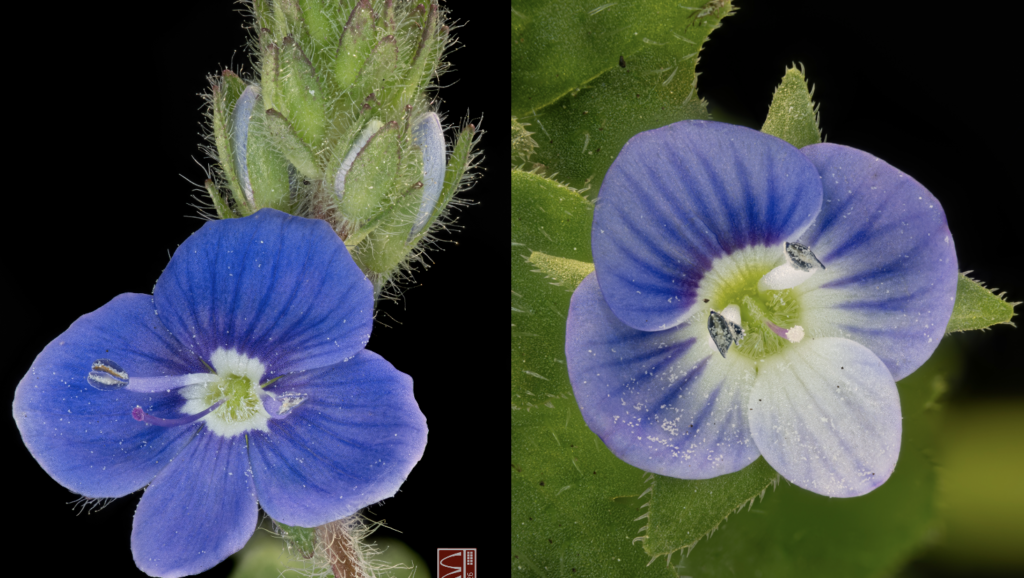
Flowers of Veronica chamaedrys and V. persica compared. They are similar. All Veronica flowers are bilaterally symmetrical with a smaller lower petal. Images: Chris Jeffree.
We have found it many times in our Urban Flora project. Some of its regular habitats are: parks, roadsides, footpaths, graveyards, derelict buildings and walls. Grime et al. (1988) say it prefers calcium-rich habitats, and that may be why we found it around buildings and roads. We occasionally see it in deciduous woodlands. Before urbanisation, where might it have lived? Perhaps it was rare – on shallow soils and rocks exposed to the deposition of seeds or as a woodland plant.
There are quite many speedwells, all with blue flowers, four petals and two stamens. Stace’s Flora lists 33 species, but Veronica chamaedrys is perhaps the most important ecologically, and the easiest to identify: it has two lines of shaggy hairs running down its stem. If your eyesight is good, there is no need for a hand-lens to see them.

Close-up of stem and leaves, coarsely hairy with stem hairs in two distinct lines. Image: Chris Jeffree.
Identifying the other speedwells can be a time-consuming activity. The good news is that there are only nine common ones. I’ve put them in a Table below, along with their Ellenberg scores for Light, Moisture, Alkalinity and Fertility1. It’s clear that V. chamaedrys can tolerate some degree of shade (but not as much as the Wood Speedwell), it avoids acidic soils (unlike the Heath Speedwell) and does not require especially fertile soils (unlike the Slender and Common-field speedwells). Six of the nine are natives, and the three aliens often appear as garden weeds. But they are easily pulled out.

Comparing environmental preferences of the common Veronica species in Britain, using traits originally proposed by Ellenberg, extracted from the database of Henniges, MC et al. (2022).
Where do speedwells belong in the tree of life? Previously they were in the Scrophulariaceae (figworts) but sometimes they have been given their own Family, the Veronicacea. However, molecular genetics has helped to resolve the confusion. These days, speedwells are placed in the plantain Family, the Plantaginaceae, the Family of snapdragons and foxgloves. Yes, it does seem strange – they do not resemble foxgloves – but modern classification is based on DNA, not appearance.

Flowers are 8-12 mm across, leaves without petioles. Stem and leaves hairy. Image: Chris Jeffree.
Within the genus Veronica, it turns out that V. chamaedrys and the familiar V. arvensis, are ‘outliers’, and considered to be together in a separate subgenus (Wang et al. 2016). I thought this might show up in their Ellenberg scores, but it does not.
Why is Veronica called ‘Speedwell’? Rival theories have been proposed (i) the plant was used as a good luck charm for travellers to hasten their journey (speeding well on their way) (ii) the plant was used in medicine, as a ‘get well soon’ message. The name Veronica has a religious derivation. Here’s what wikipedia tells us:
Saint Veronica, also known as Berenike, was a widow from Jerusalem who lived in the 1st century AD. She was moved with sympathy seeing Jesus carrying the cross and gave him her veil so that he could wipe his forehead. Jesus accepted the offer, and when he returned the veil the image of his face was miraculously captured on it. The resulting relic became known as the Veil of Veronica, and this (supposed) relic is kept in St. Peter’s Basilica in the Vatican. ‘
The species name, chamaedrys means ‘charisma’ or ‘gift’ whilst ‘Germander’ may be from the Greek ‘chamai’ meaning ‘on the ground’.

Left: Global distribution of Veronica chamaedrys from GBIF and the native range (green) according to Kew’s Plants of the World Online (purple represents ‘introduced’).
Traditional uses include making a medicinal tea, good for coughs. Flora Britannica describes this 18th Century practice: “the dried leaves picked from the stalks, were sold in our markets, and people made tea of them”; but overharvesting seems to have been a problem as “the plant was in a manner destroyed for many miles around London”. Speedwell tea can still be purchased but seems to be made of Veronica officinalis.
Notes
1Ellenberg Indicator Values used here are part of an expert-based scoring system to estimate the environmental preferences of plant species. For a good description, see here https://padapt.eu/info/ellenberg-indicator-values.html. If you read German you might like to look at Ellenberg, H. et al. (1991) Zeigerwerte von pflanzen in Mitteleuropa. Scripta Geobotanica 18.
References consulted
Corner RWM and Robinson L (2012) Flora of Great Dun Fell, 12 years on: a cautionary tale BSBI News 119, 4-7.
Cornwell I et al. (2025) Sown and self-seeding species in planted wildflower meadows increase floral abundance and richness in a Scottish semi-natural coastal grassland.” Plant Ecology & Diversity 18, 249-266.
Dale MP and Causton DR (1992) The ecophysiology of Veronica chamaedrys, V. montana and V. officinalis. I. Light quality and light quantity.” Journal of Ecology, 483-492.
Henniges, MC et al. (2022) A taxonomic, genetic and ecological data resource for the vascular plants of Britain and Ireland.” Scientific data 9
Stace C A (2019) New Flora of the British Isles.
Wang JC et al. (2016) Evolution of morphological and climatic adaptations in Veronica L. (Plantaginaceae). PeerJ. 4, e2333.
©John Grace