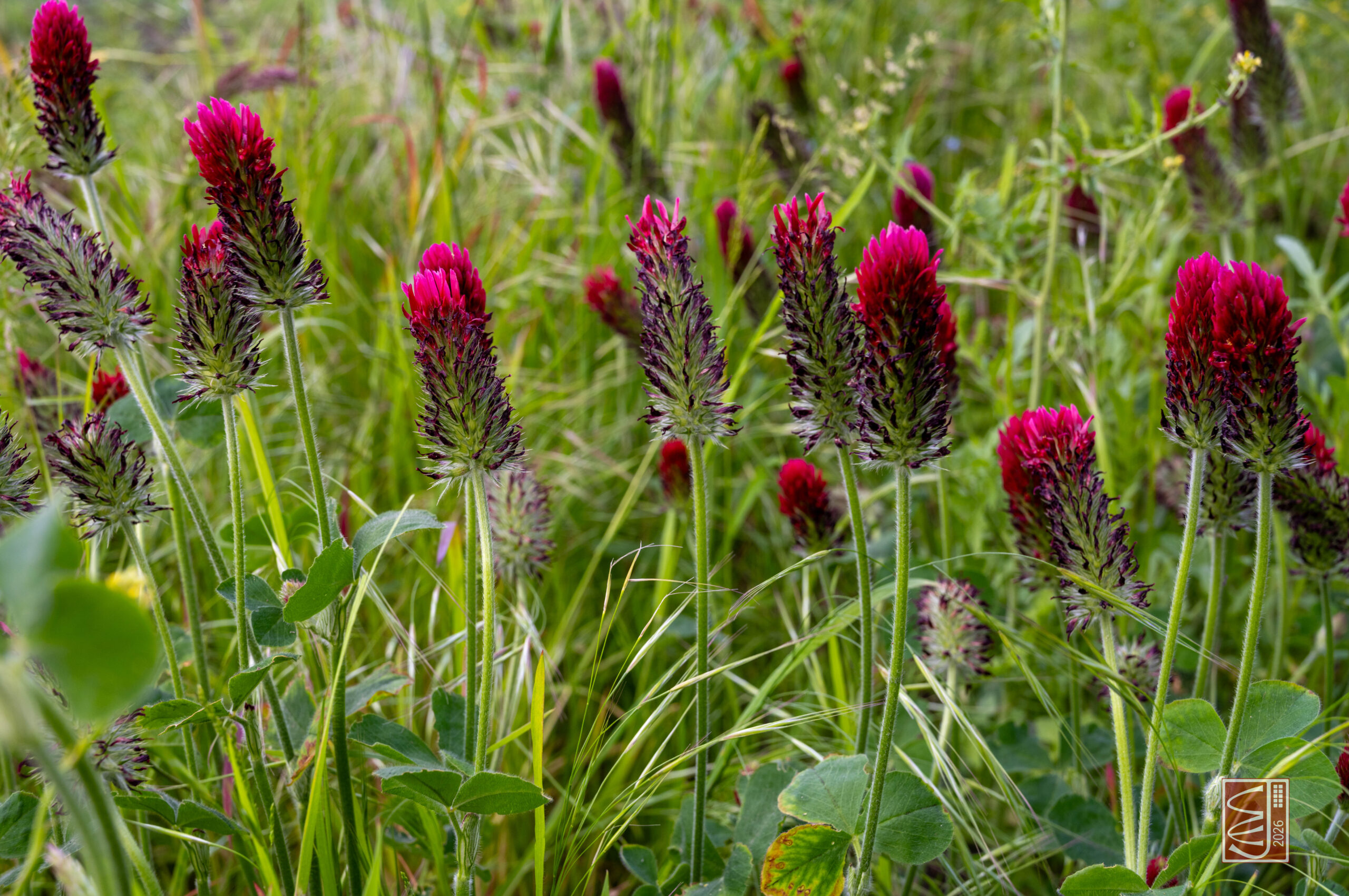
Trifolium incarnatum – June 8th 2026 – Crimson clover
We all like clovers and bees like them too. This one, known as the Crimson Clover, isn’t often seen in Scotland. In olden times, it was grown for animal feed and in some parts of the country the plants seem to have hung on. Nowadays it is sometimes included in ‘wild-flower mixtures’ for those people who want to make an artificial meadow. I recently purchased a bag of seeds for the garden. Like almost all clovers, this one ‘fixes’ nitrogen and enriches the soil and so it’s a good way to improve fertility and grow better crops. More about that later.

Scarlet Clover (Trifolium incarnatum), Inveresk, East Lothian. Image: Chris Jeffree.
It is native in some parts of Europe, and the authors of Kew’s Plants of the World Online think it is native here in Britain. But the Botanical Society of Britain and Ireland begs to differ. They class it as a ‘neophyte’ or alien, and say it was cultivated in Britain by 1640 and seen in the wild in 1798 (in Durham).
It is more often cultivated in the USA, see here. The article lists the many uses including cover crop, green manure, silage, insect habitat and wildlife. The one that made me chuckle was ‘Roadside erosion control and beautification’ (we don’t often use the word ‘beautification’ but it is indeed a standard English word).

Scarlet Clover, inflorescence. Image: Chris Jeffree.
This is an annual plant, with seeds that normally germinate in late summer to produce seedlings that survive the winter and then grow fast in the Spring. I saw it flowering at an allotment a few weeks ago – it looked magnificent, adding splashes of colour to a dull scene. That’s when I decided “I want some seeds of that”. I bought a whole kg for £11.
Pollination is by bees. However, it has been known for a very long time that bees can’t see the colour red. Their eyes have three spectral types of photoreceptors, peaking in ultraviolet, blue and green. It means that a surface we see as ‘red’ must be ‘black’ to a bee. So why are flowers of Trifolium incarnatum red? My guess is that parts of the flower, the little bits that look green and white to us, strongly reflect the sun’s ultraviolet and so they sparkle like jewels against the black background.

Detail of inflorescence, showing the individual pea-like flowers. Image: Chris Jeffree.
I looked up its ecological preferences. It can grow in very poor soils, and it tolerates dry conditions, but it does need good light. In a field, it can ‘fix’ between 100 to 150 kg of nitrogen per hectare per year, only slightly less than farmers will spread on their fields as fertilizer to grow grass and other crops. The difference is, of course, that most farmers buy bags of fertilizer at great expense1 and at a huge energy cost for the electrical power to make nitrogen fertilizer. Our clovers obtain energy ‘for free’, using the sun as their energy source, along with nitrogen gas from the atmosphere.
As most of our readers will know, the nitrogen ‘fixation’ involves the symbiotic relationship with a bacterium (‘Rhizobium’) that lives in the roots. Young clover plants become the host of the bacterium at an early stage in their life, when they become naturally infected by the Rhizobium that lives in the soil. This process is of course happening all over the planet with the many species in the clover family (Fabaceae) – another great example of the adage: “it’s the little things that run the world”2.

Scarlet Clover, ripe seedhead. Image: Chris Jeffree.
My old view of this process was that it was a simple matter – that the clover plants must decompose (i.e. rot) in the soil to release their nitrogen. Recent studies show a much more interesting phenomenon, with the involvement of silicon (Si). Silicon is the second most abundant element in the earth’s crust, usually combined with oxygen as SiO2, which we know as silica or sand. It isn’t usually considered as an essential element for plants, but some plants have lots of it (e.g. grasses and horsetails). It’s taken up from the soil with water, because silicon reacts with water to make silicic acid i.e. H4SiO4. The silicon is therefore swept in with the transpiration stream, and can be deposited in cell walls, strengthening the plant and giving it some resistance to grazing.

Trifolium incarnatum: single-seeded pods and seed. Image: Chris Jeffree.
Coquerel R et al. (2025) carried out a greenhouse experiment that illustrates the power of Silincon. They used a member of the cabbage Family – Brassica napus, i.e. Rapeseed, to represent the crop, and Trifolium incarnatum as the nitrogen donor plant. In the greenhouse, the crop plant was grown in soil which was either ‘without Si’ or ‘with Si’. They set up an experiment so that the roots of the clover were split between the ‘donor’ plant and the ‘receiver’ plant. To track the nitrogen, they used an isotopically-labelled form of nitrogen, 15N. They found that the labelled N was ‘rhizodeposited’ in the soil of the ‘receiver’ and that the process was greatly enhanced by the presence of Si.

The experimental set-up (Coquerel R et al. 2025). When the soil on the left had silicon (Si) the transfer of nitrogen from scarlet clover was faster. The image is covered by a Creative Commons licence.
There was no need to wait for the decomposition to occur. ‘Rhizodeposition’ is the process whereby plant roots exude organic compounds into the surrounding soil, thus ‘feeding’ both the microbial populations and other plant roots.
I have several questions about this research: (i) what happens in ‘real’ fields where the two species are grown together (ii) does agricultural soil normally have enough Si as H4SiO4 and (iii) whatever can be the mechanism?
Irrespective of the answers to these research questions, why aren’t more farmers growing Trifolium incarnatum to save money on nitrogen fertilizer? Surely, growing clover isn’t just for ‘organic’ growers but for all arable farmers. The idea of ‘sustainable farming’ hasn’t really caught on, despite clarion calls from none other than John Beddington3 and many others.
There are two subspecies. The one we have written about is Crimson CloverTrifolium incarnatum subsp. incarnatum. The other is the much rarer Long-headed CloverTrifolium incarnatum subsp. molinerii, recorded only a few times in England and never in Scotland.

Distribution of Trifolium incarnatum in Britain and Ireland, brom BSBI/Maps
Notes
1Nitrogen fertilizer is made by first making ammonia (NH3) by the Haber process which combines N2 and hydrogen (H2) at very high temperature and pressure, globally consuming 3% to 5% of all the world’s natural gas production.
2The quote is from E.O. Wilson, the famous biologist who coined the word ‘biodiversity’, but he was thinking of insects not bacteria.
3John Beddington was a PhD student at Edinburgh University, working on the population dynamics of deer. He rose to become the UK Government’s Chief Science Advisor.
References consulted
Beddington J (2011) Foresight. The future of farming. Final Project Report. London: The Government Office For Science.
Coquerel R et al. (2025) Silicon Supply Improves the Rhizodeposition and Transfer of Nitrogen from Trifolium incarnatum L. to Brassica napus L. Plants, 14, 1246.
Gou X et al. (2023) Leguminous Plants Significantly Increase Soil Nitrogen Cycling across Global Climates and Ecosystem Types. Glob. Change Biol. 29, 4028–4043.
Handreck KA and Jones LHP (1967) Uptake of Monosilicic Acid by Trifolium incarnatum (L.)Aust Jnl of Bio Sci 20, 483–486.
Hempel de Ibarra N et al. (2014) Mechanisms, functions and ecology of colour vision in the honeybee. J Comp Physiol A 200, 411–433. https://doi.org/10.1007/s00359-014-0915-1
McKenna P et al. (2018) Red clover (Trifolium pratense) in conservation agriculture: a compelling case for increased adoption. International Journal of Agricultural Sustainability, 16(4-5), 342-366.
Mueller T and Thorup-Kristensen K (2001) N-Fixation of Selected Green Manure Plants in an Organic Crop Rotation, Biological Agriculture & Horticulture: An International Journal for Sustainable Production Systems, 18, 345-363.
©John Grace