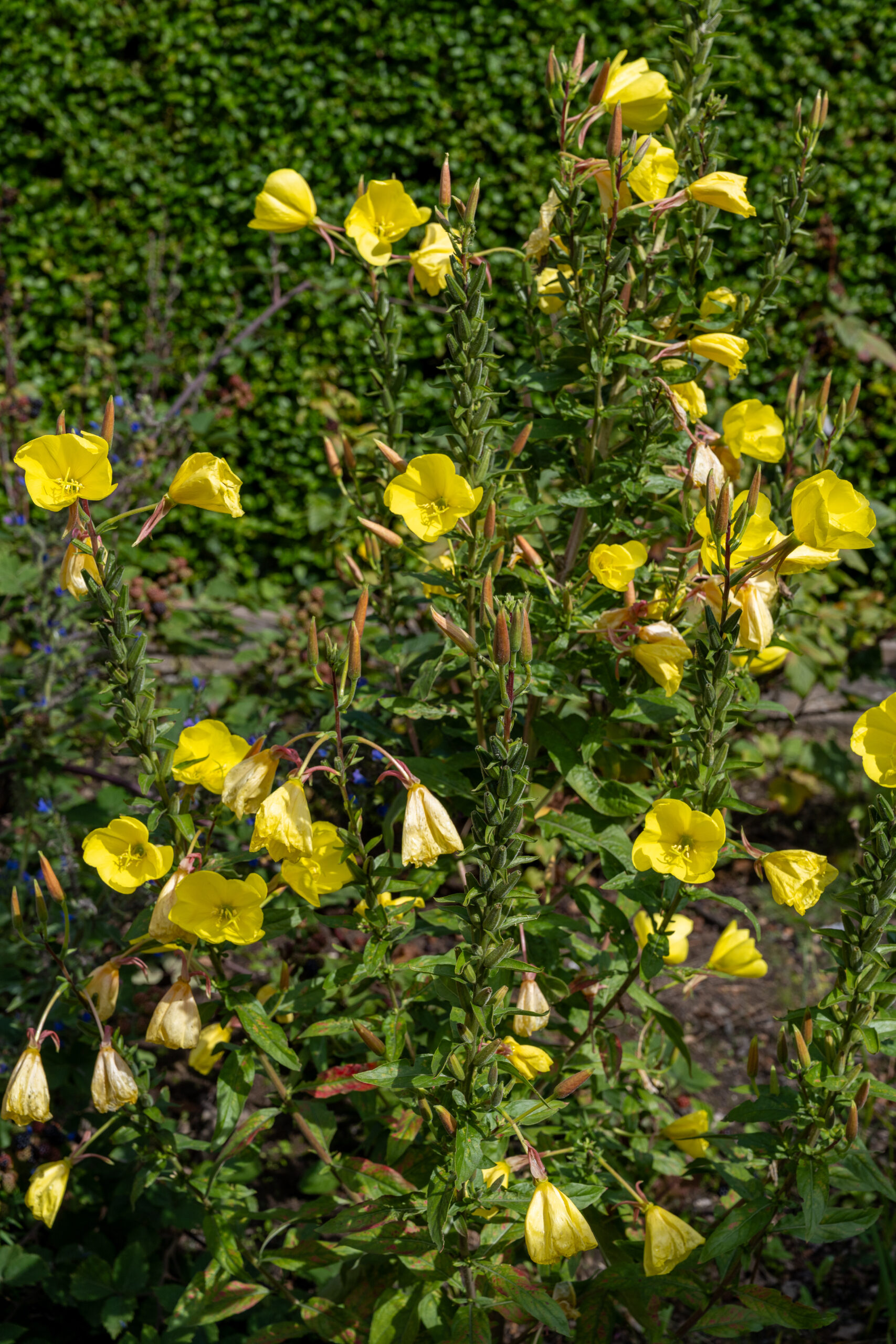
Oenothera biennis – August 31st 2026 – Evening Primrose
The Common Evening Primrose (Oenothera biennis) is so-called because it opens its flowers in the evening, rather rapidly, and closes them in the following day before withering. This seemingly wasteful feature is an adaptation to pollination by Hawk Moths (called Sphinx Moths in North America). The moths fly at dusk and are attracted to the lemon or vanilla-like fragrance. They use their straw-like tongues (proboscises) to reach deep into the flower to drink the abundant nectar. What’s left in the morning may be useful for honeybees, bumblebees, and hoverflies.

Original book source: Prof. Dr. Otto Wilhelm Thomé Flora von Deutschland, Österreich und der Schweiz 1885, Gera, Germany.
This plant belongs to the Onagraceae, the willow-herb Family, which also contains the beautiful plants of Fuchsia and the more delicate Circaea, the enchanter’s nightshades. Strange bed-fellows, you might think, but pull the flowers apart and you can see a similarity. They usually have 4 sepals, 4 petals, and 8 stamens; in Oenothera and Fuschia the pollen grains are tied together by sticky threads (visible with a hand lens).

O. biennis, showing large showy flower with green reflexed sepals. Image: Chris Jeffree.
Oenothera biennis was introduced from North America and cultivated in Britain by 1629; it was first recorded in the wild in 1725. Its cultivation may have been for the oil extracted from the tiny seeds. Even today, this oil can be purchased in the UK from most Hight Street chemists as well as the many on-line suppliers, some of them making extra-ordinary claims of its efficacy for many ailments. The medical conditions for which relief is claimed include eczema, breast pain, rheumatoid arthritis, premenstrual syndrome and menopausal symptoms. However, the National Centre for Integrative Health (in the USA) says “There’s not enough evidence to support the use of evening primrose oil for any health condition”.

Newly-opened flower. There are four petals, but because they are heart-shaped it may look like more. Image: Chris Jeffree.
My recent sightings of the plant have been on allotments, by the coast and along roadsides. I think the roadside observations result from ‘wildflower plantings’ to cheer up the hapless drivers stuck in morning queues on the A77 around the town of Ayr. The plant is not common in Scotland – surprisingly it was recorded only once in the Urban Flora survey (Kirkaldy, on derelict ground). The BSBI Atlas describes the habitat as “sand dunes, riverbanks, waste ground, railway sidings and roadsides, in neglected cultivated fields, quarries, sand-pits and refuse tips. It is rarely naturalized for more than a few years even where large numbers occur on freshly opened ground”. It is much more common in southern England than in Scotland.

O. biennis, young plant overwintering as a rosette. Image: Chris Jeffree.
The plant is biennial. The seeds germinate in autumn or spring, forming a rosette plant with a tap-root, capable of over-wintering. In the spring a flowering stem emerges and extends up to 1.6 metres (usually less). After flowering the seeds scatter to the ground, and some may remain viable in the soil for many years.
Quite early on (1908), it was discovered that Oenothera has very strange chromosomes. In other plants (and animals) the chromosomes from the male and female ‘pair up’ at meiosis (forming ‘homologous pairs‘), lining up side-by-side on the equatorial plate; and by physically ‘crossing over’, they swap tiny bits of DNA. This mixing creates new genetic combinations (geneticists say ‘recombination’). Then the chromosomes pull apart and the cell divides to form male male and female gametes. But Oenothera is quite different. The 14 chromosomes join together at their tips to make a circle, and recombination does not occur. Exactly how this works, and the consequencies for further evolution is a topic that has intrigued plant cytogeneticists since the ring structures were first discovered.

This Oenothera is growing by a coastal path at Ballantrae, Ayrshire. The reddish (not green) sepals suggest it may be the hybrid with the Large-flowered Evening-primrose, called ’Intermediate Evening Primrose’, Oenothera glazioviana x biennis = O. x fallax. It has other glazioviana characters too (hairs with red bulbous bases, long style). The Oenothera genus is peculiar in that crosses breed true and perpetuate themselves indefinitely.
No wonder that Oenothera plants are difficult to identify to species level. Stace (2019) in his New Flora of the British Isles, introduces Oenothera by saying “A critical genus where species limits are a matter of opinion”. There are 145 to 160 species of Oenothera in the world. The BSBI recognises several British species, and its plant crib lists four: O. biennis, O. glazioviana, O. stricta and O. cambrica but there are more1. There are also hybrids. I must confess, I am still learning about Oenothera, trying to reconcile the facts: how can so much variation occur, given what we know about the strange ring structure formed by the chromosomes and the fact that cross-pollination does not often occur.

Distribution of O. biennis in Britain and Ireland. From BSBI/Maps.
I have tried to discover how the name oenothera came about. In ancient Latin texts, oenothera was described as a plant whose juices, when infused into wine, could induce sleep or act as a sedative. Rome may have borrowed from the Greek: oinos = wine, thēra = ‘a hunt’.

The North American native plant Oenothera biennis has travelled to much of the temperate world, including the southern hemisphere. From GBIF.
Note
1see also Stace (2019) and the excellent images here: http://webidguides.com/_templates/group_oenothera.html
References
Cleland RE (1962) The Cytogenetics of Oenothera, Advances in Genetics, 11, 147-237.
Hall, I. V., Steiner, E., Threadgill, P., & Jones, R. W. (1988). THE BIOLOGY OF CANADIAN WEEDS.: 84. Oenothera biennis L. Canadian journal of plant science, 68(1), 163-173.
Lewis H, Raven PH, et al. (1958) Observations of Meiotic Chromosomes in the Onagraceae, Aliso: A Journal of Systematic and Floristic Botany: Vol. 4: Iss. 1, Article 3. Available at: https://scholarship.claremont.edu/aliso/vol4/iss1/3
Stace CA (2019) New Flora of the British Isles, edition 4. C&M Floristics.
Stace CA and Walker KJ (2020) Oenothera biennis L. in BSBI Online Plant Atlas 2020, eds P.A. Stroh, T. A. Humphrey, R.J. Burkmar, O.L. Pescott, D.B. Roy, & K.J. Walker.
Steckel LE, Sosnoskie LM, Steckel SJ. (2019) Common evening-primrose (Oenothera biennis L.). Weed Technology. 33(5):757-760. doi:10.1017/wet.2019.53
©John `Grace