Achillea millefolium – August 24th 2026 – Yarrow

Botanical artwork by Franz Eugen Köhler (1834–1879) from Köhler’s Medizinal-Pflanzen, Public domain, via Wikimedia Commons
Yarrow is one of the most widespread of native plants, occurring throughout Britain and Ireland, and ascending to 1,210 metres on Ben Lawers, Perthshire. It has a long tradition as a medicinal plant, and one of its early names was ‘Nosebleed’ (fresh leaves were placed inside the nostril, or a poultice of yarrow was applied to the neck or temple).

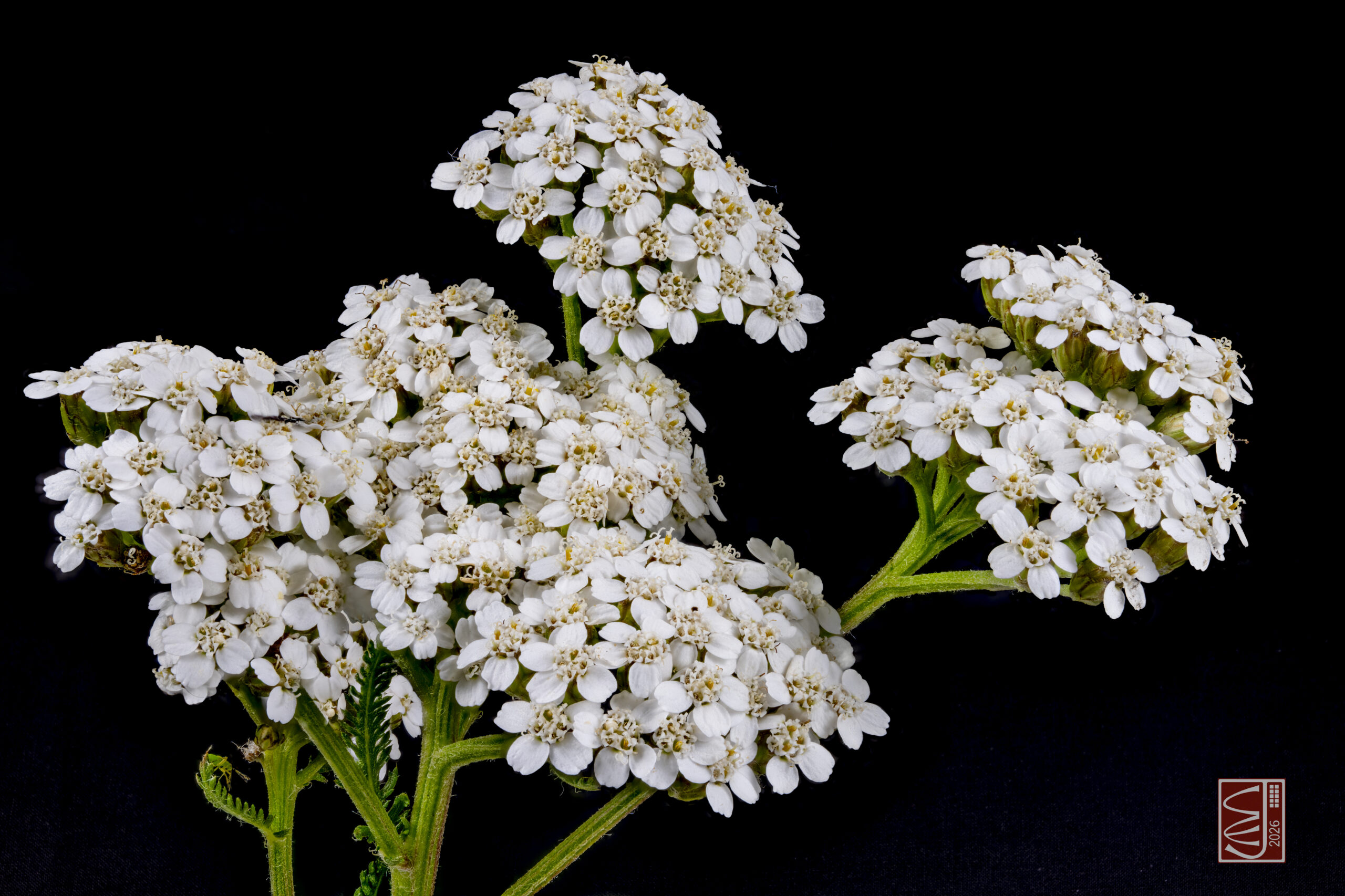
Grouping of the capitula to form flat-topped umbrella-shapes (corymbs), making a platform for insect to alight. Image: Chris Jeffree.
It belongs to the daisy Family, the Asteraceae. It doesn’t look much like a daisy until examined with a hand lens. Each ‘flower’ is a small daisy-like capitulum, 4 to 6 mm across, made up of 3-8 ray-florets (female). The ray florets are not strap-like, as in most daisies, but broad. In the centre of the capitulum there are up to 40 tiny tubular disc-florets (bisexual) packed tightly. The overall arrangement of the capitula on stalks forms a large white, pink or (rarely) red platform (‘corymb’), attractive to flying insects. The plant forms its seeds by cross pollination – the flying insects involved include hover-flies, small bees, butterflies, and predatory wasps; bumblebees stay away.

View from above. The bunching forms a prominent landing-stage for pollinators. Image: Chris Jeffree.
Its range of habitats is huge. It is not usually found in wetlands or woodlands, but practically everywhere else. Grime et al (1988) recorded it on grasslands, wasteland and spoil heaps. It was especially common on spoil heaps (lead mining, brick/mortar and cinders). In the Urban Flora project we find it in all Scottish towns and cities, often in parkland, waysides/verges and waste ground. Its leaves are often seen in mown grass, including lawns. Grime et al (1988) reported it from soils with a very high pH range (4-8). Using the C-S-R ‘strategy’ classification, these authors place it in the centre of their triangular diagram, meaning it can be a competitor, a stress-tolerator or a ruderal. In common parlance, we would say it is a ‘jack-of-all trades’.

The ‘petals’ are the ray florets. Compare with Köhler’s painting at the head of the article. Image: Chris Jeffree.
Indeed, I often find it in unusual places. Earlier this week I risked life and limb to photograph it on the traffic island of a busy roundabout. I also see it by coastal paths, with a few stunted flowering stems arising from a mat of feathery leaves. Evidently the abundant coastal bunnies avoid the leaves. In this year’s dry conditions the leaves have remained fresh and green – demonstrating its drought tolerance. It does not require fertile soils, but when it finds them it can grow well, tolerating competition from tall grasses.
It flowers mostly from June to September, but a few flowering stems remain in the depths of winter. Its peak of flowering is usually in August. Seeds are shed by Autumn and they may germinate either immediately or in the following spring, depending on conditions. Mostly, it reproduces by vegetatively means, sprouting from its long rhizomes – thus it creates patches. Pieces of rhizome that become detached by cultivation can sprout and form a new colony. It is not however, considered as a serious weed, even in those countries and continents where it has been introduced (North America, South America, Africa, SE Asia, Autralia and New Zealand). The best description of its overall biology comes from North America where there are both native and introduced forms of the species (Warwick and Black 1982).

This is from coastal grassland, heavily grazed by rabbits. The stems are much shorter than usual. Note also that the leaves are ungrazed. Image: John Grace.
A recent study from North America investigated how populations of Yarrow may have changed over a period of a hundred years (Losapio et al. 2024). The authors re-visited the Californian sites first described in classic research papers by Clausen and Keck from work in the 1920s; the question posed was: have the plants changed over the long period of climatic change? The locations ranged from near sea level on the Pacific Coast to the alpine zone at 3000 metres above sea level. Fortunately, the sites were still undisturbed and all except one (the hottest and driest) still had populations of Yarrow. They found that plants from warmer sites in coastal and mountain regions now grew taller than 100 years ago, whereas populations from drier sites in the lowlands and foothills became shorter.
Of course, the interpretation of this simple conclusion is not staight-forward. Plants can become taller for many reasons: e.g. longer periods of growth caused by warming, increased deposition of nitrogen from the atmosphere and/or the impact of elevated CO2. In 1920 the atmospheric CO2 concentration was around 300 parts per million (ppm), and now it is 420 ppm.

A red cultivar of Yarrow. Pink forms are often seen in the wild. Attribution: Timmeh 87 at English Wikipedia, Public domain, via Wikimedia Commons
How did it get its name? The genus Achillea is traditionally associated with Achilles, the Greek hero of the Trojan War. According to classical tradition, Achilles used the plant to treat wounds, reflecting the long-standing association of yarrow with wound treatment. Its use in traditional herbal medicine is indeed extensive. The leaves and flowering shoots have historically been employed in preparations intended to treat wounds, digestive complaints, colds and fevers. Yarrow was also traditionally associated with stopping bleeding, although historical medicinal use should not be confused with modern clinical evidence of efficacy or safety.
Yarrow features strongly in British folk traditions. Vickery (1995) describes over two pages of them, many associated with the search for love, especially by placing yarrow under the pillow at bedtime:

References consulted
del-Val E and Crawley MJ (2005). Are grazing increaser species better tolerators than decreasers? An experimental assessment of defoliation tolerance in eight British grassland species. Journal of Ecology, 93, 114–123.
Losapio, G. (2024) Population persistence, phenotypic divergence and metabolic adaptation in yarrow (Achillea millefolium L.) along a climate gradient, CA, 1920 to 2023. EcosphereVolume 15, Issue 12 e70146
Vickery R (1995) Dictionary of Plant-Lore. Oxford University Press.
Warwick SI and Briggs D (1980). The genecology of lawn weeds. VI. The adaptive significance of variation in Achillea millefolium L. as investigated by transplant experiments New Phytol. 85: 451-460.
Warwick SI and Black L (1982) The biology of Canadian Weeds 52. Achillea millefolium. Canadian Journal of Plant Science 62:1, 163-182 10.4141/cjps82-024.
©John Grace