-
Impatiens glandulifera -19th October- Himalayan balsam
Heather Forbes has chosen one of the most notorious invasive plants for her Plant of the Week. For those of a nervous disposition: beware exploding…Continue reading »
-
The Beauty of Muties part 1: a symphony in white.
Richard Milne likes mutants, and has a huge collection of photographs to share with us.Continue reading »
-
Tilia spp. – 12th October – Lime or Linden
Roger West has been investigating the Lime tree, native in England and often planted in parks and gardens in Scotland.Continue reading »
-
FAIR ISLE EYEBRIGHTS: MORE THAN MEETS THE EYE
Richard Abbott takes a look at a new paper about Eyebrights on Fair Isle. With DNA sequencing it has been possible to distinguish difficult species…Continue reading »
-
Alnus glutinosa -5th October- Alder
Roger West has been looking at our native Alder, a familiar tree of wet places which has served mankind well for many centuries, and which…Continue reading »
-
Ambrosia artemisiifolia – 29th September – Common ragweed
A fast-growing plant recently appeared beneath our peanut feeder. We didn’t recognise it, and in the spirit of botanical inquiry we let it grow rather…Continue reading »
-
Polypogon viridis – 21st September – Water Bent Grass
This is said to be one of the fastest spreading plants in the British Isles, yet little is known about its ecology. John Grace found…Continue reading »
-
Adoxa moschatellina – 14 September – Moschatel
This week, Richard Milne writes about finding Adoxa moschatellina (moschatel, aka town hall clock, or five-faced bishop). The clusters of flowers always contain exactly five…Continue reading »
-
Arum maculatum and A. italicum – 7th September – Cuckoo Pints
These plants of shady places are self incompatible and rely on female owl-midges carrying pollen between plants for their fertilisation. The midges are attracted to…Continue reading »
-
Common fungi – rust fungi
These fungi are usually host specific, only infecting particular plant species. Look out for any plants that appear a bit sickly or have distortions –…Continue reading »
-
Common plants – edges and hedges
These species are commonly found growing at the side of paths and buildings and at the foot of hedges. Keep an eye out in other…Continue reading »
-
Lathraea squamaria – 31st August – Toothwort
The native toothwort remains a rare treasure, and seldom grows in the most accessible places, but when life here gets back to normal I’ll be…Continue reading »
-
Botanical Walk – Bennane Head, Ayrshire
This walk is as easy or hard as you want to make it, depending on the detours. You'll see a lot of species, you'll love…Continue reading »
-
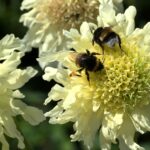
Cephalaria gigantea – 24th August – Giant Scabious
Roger West discovered a giant near his home. It is an alien that was introduced as a garden plant. It thrives in the wild, given…Continue reading »
-
SOME INSECT/PLANT RELATIONSHIPS IN THE BRAIDS AREA OF EDINBURGH.
Barbara and Mike Richardson have been spending the lockdown observing the relationships between insects and plants. Here they describe insects which are pollinators and ones…Continue reading »
-
Angelica sylvestris – 17th August – Wild Angelica
Angelica is one of the most beautiful members of the Apiaceae. But take care, the family has many poisonous relatives including Hemlock and Hemlock Water…Continue reading »
-
Papaver cambricum (Meconopsis cambrica)
by Chris Jeffree: Botanical nomenclature rarely remains static for very long. Most people are probably familiar with the colourful bright yellow or orange Welsh poppy…Continue reading »
-
SCARCE PLANTS IN TOWNS AND CITIES IN SCOTLAND
By Brian Ballinger Many people with an interest in plants are attracted by the concept of rarity. Native plants are usually regarded as being rare…Continue reading »
-
Heracleum sphondylium ssp. sphondylium – August 3rd – Hogweed
Perhaps one of the best botanical drawings of Heracleum sphondylium (image is in the public domain, artist unknown) By Roger West This is a member…Continue reading »
-
Dipsacus fullonum and Dipsacus sativus – July 27th – Teasel
Teasel plants in an urban setting (July, an Edinburgh allotment). Flowers have not yet opened. Compare with the drawing below by Dioscorides. by John Grace,…Continue reading »