Symphoricarpos albus – December 27th 2021 Snowberry
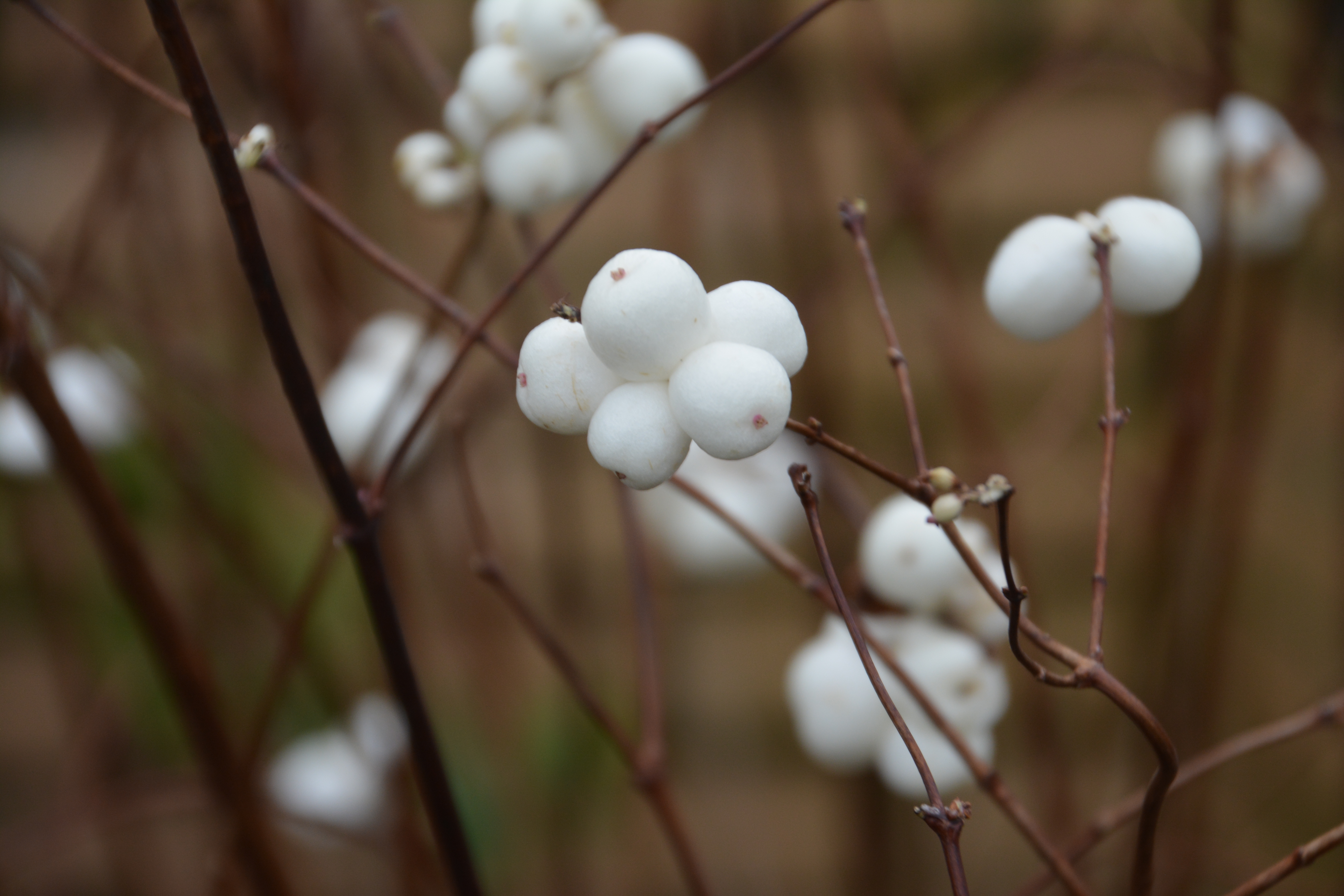
Unless you live in the Scottish Highlands or some far-away northern part of the world, you will probably see no snow this week, but if you are out and about you may well see Snowberries, so-called because their berries are snow-white.
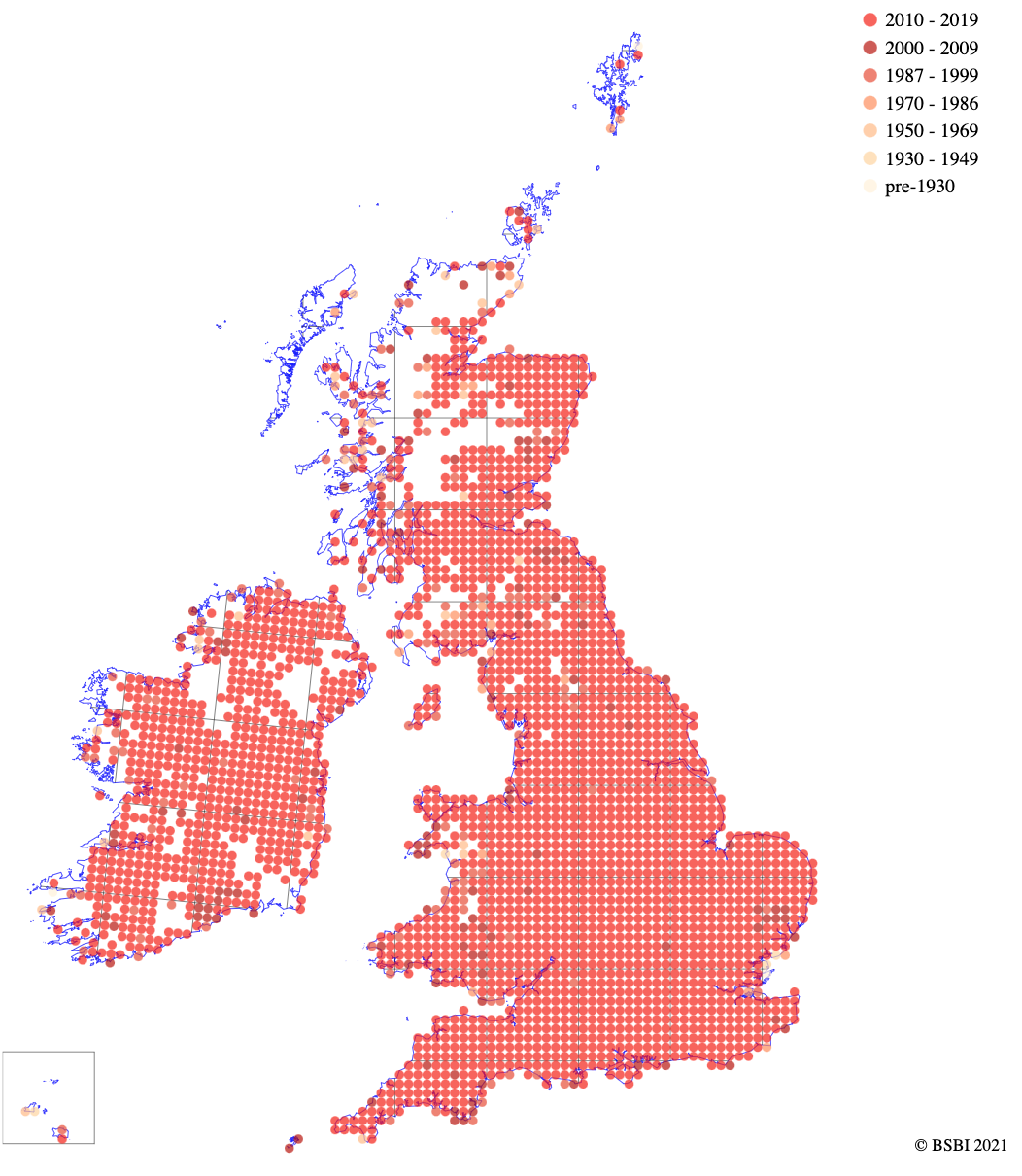
This alien species is a deciduous shrub belonging to the Honeysuckle family, widespread in the British Isles, and native to North-West America where it occurs at forest-edges. In Britain it (almost?) never reproduces by seed; rather, it spreads underground by rhizomes. This vegetative spread is a slow process; it cannot possibly account for the wide distribution (from Guernsey to Shetland). So why is this slowly-spreading plant one of the most common of all alien species? The answer is, it has been planted for hedging and landscaping by local councils, for decoration by gardeners and to provide ‘cover’ for woodland ‘game’ by those who manage woodlands for ‘sporting’ purposes. It tolerates shade rather well, and this makes it especially useful to gardeners who want to fill a shady spot at the end of the garden.
In summer it has pink-white flowers, inconspicuous to us humans but highly attractive to bees, hover-flies and wasps. In autumn these flowers develop into the ‘showy’ white spherical berries, 8-15 mm in diameter, visually attractive to humans but largely ignored by birds. People have said that British birds ignore these berries simply because they are not red or black like most other winter-fare. Berries of the closely related Symphoricarpos orbiculatus (coralberry) are eaten by birds, but it has pink not white berries and so the ‘white-is-not-right-for-birds’ hypothesis is supported. Usually, the Snowberry fruits remain on the plant until January, when they turn brown and drop to the ground. The species is widespread in Europe, especially in Germany, where its berries are said to provide winter food for greenfinches. Possibly the German greenfinches have learnt the lesson that the berries are good to eat whilst British birds so far remain ignorant.

In Germany it reproduces from seed as well as by rhizomes. Is it possible that the German plants are genetically different from ours? Certainly the species shows considerable variation in leaf form and is variously reported as having either 36, 54 or 72 (2n) chromosomes. On the other hand, Germany has a continental climate with warmer summers and colder winters, perhaps closer to the native range, and possibly more conducive to seed establishment. In controlled experiments, the seeds are known to have a very tough outer coat which requires the right type of fungus to break, and also an unusually long exposure to low temperature (Gilbert 1995).

I noticed that the species is described rather differently in the first versus the fourth edition of Stace’s Flora. In the fourth edition of his New Flora of the British Isles, Stace says this species is “Neophyte-natd” whereas in the first edition of the Flora the species is merely “introduced, natd”. Mmm, what does that really mean, to be a naturalised neophyte? Stace and Crawley (2015) have a succinct definition of neophyte as “an alien plant that has arrived in the area in a wild state since 1500 CE” and go on to write a whole chapter called “Our top 52 Neophytes” . Snowberry comes third in their list, after Pineapple-weed and Sycamore. To make matters confusing, Essl et al. (2021) have introduced a similar term, “neo-native”. These are species which are aliens but behave like natives. This term is disliked by some conservationists for obvious reasons (Wilson 2020) – they think we shouldn’t imply that aliens are as worthy of conservation as true natives. Botanical racism? No, it’s just that botanists like to be exact even when the science is uncertain. The uncertainty is usually because the date of introduction is not known – for some species records have been lost or were never kept in the first place. But not so for Snowberry.
When I want to find dates of introduction of any shrub I look at the little book Garden Shrubs and their Histories (Coats 1963). Alice Margaret Coats ( 1905–1978) was a highly talented artist of Scottish descent who spent much of her later years researching the history of garden plants. In the case of Snowberry, she tells us that it came to our shores in 1817 and was rapidly distributed in England by William Cobbett, the controversial MP and campaigner for parliamentary reform. He was a keen gardener and described Snowberry as “A very pretty shrub that comes into leaf more early in the spring than any other that I know of, and has a leaf of singular beauty..”.
As for many other introduced plants, the species has had several English and Latin names which may still be in use. As well as its original name given by Linnaeus, Symphoricarpos albus (L.) it may also be called S. rivularis (Suksd.) or S. racemosus (Michaux). Alternative English names are waxberry and ghostberry.
The plant has been described as “durable” as well as “beautiful” and “elegant” in a genteel article that appeared in Country Life in 2015 (https://www.countrylife.co.uk/gardens/the-beautiful-snowberry-81495). How long does it live? Not much research on this has ever been done, but well-defined annual growth rings can be seen in sections of the stem. Oliver (1995) reports up to 34 rings in one survey. He also looked at the phytosociology of the species: it is often found in highly fertile sites where it accompanies Urtica dioica (Stinging-nettle), Silene dioica (Red Campion), Galium aparine (Cleavers) and Rubus species (various brambles).
The berries are poisonous to humans and extracts have been used to kill fish. The toxic compounds are decomposed by boiling. It is not used by modern herbalists, but it has been used by North American Indian tribes. The web-site of Plants for a Future (PFAF) has more details on herbal uses: https://pfaf.org/user/Plant.aspx?LatinName=Symphoricarpos+albus.
References
Coats AM (1963) Garden Shrubs and their Histories. Vista Books.
Essl F, Pyšek P, Richardson DM (2021) Neonatives and translocated species: different terms are needed for different species’ categories in conservation policies. NeoBiota 68: 101–104. https://doi.org/10.3897/neobiota.68.72849
Gilbert OL (1995) Symphoricarpos albus (L.) S. F. Blake (S. Rivularis Suksd., S. Racemosus Michaux). Journal of Ecology 83, 159-166.
Stace C (2019) New Flora of the British Isles, Fourth Edition. C&M Floristics.
Stace C and Crawley MJ (2015) Alien Plants. Collins.
Wilson JRU (2021) Definitions Can Confuse: Why the “Neonative” Neologism Is Bad for Conservation. BioScience, 70, 110–111, https://doi.org/10.1093/biosci/biz159
John Grace