Senecio vulgaris and S. viscosus – January 3rd 2022 Groundsel

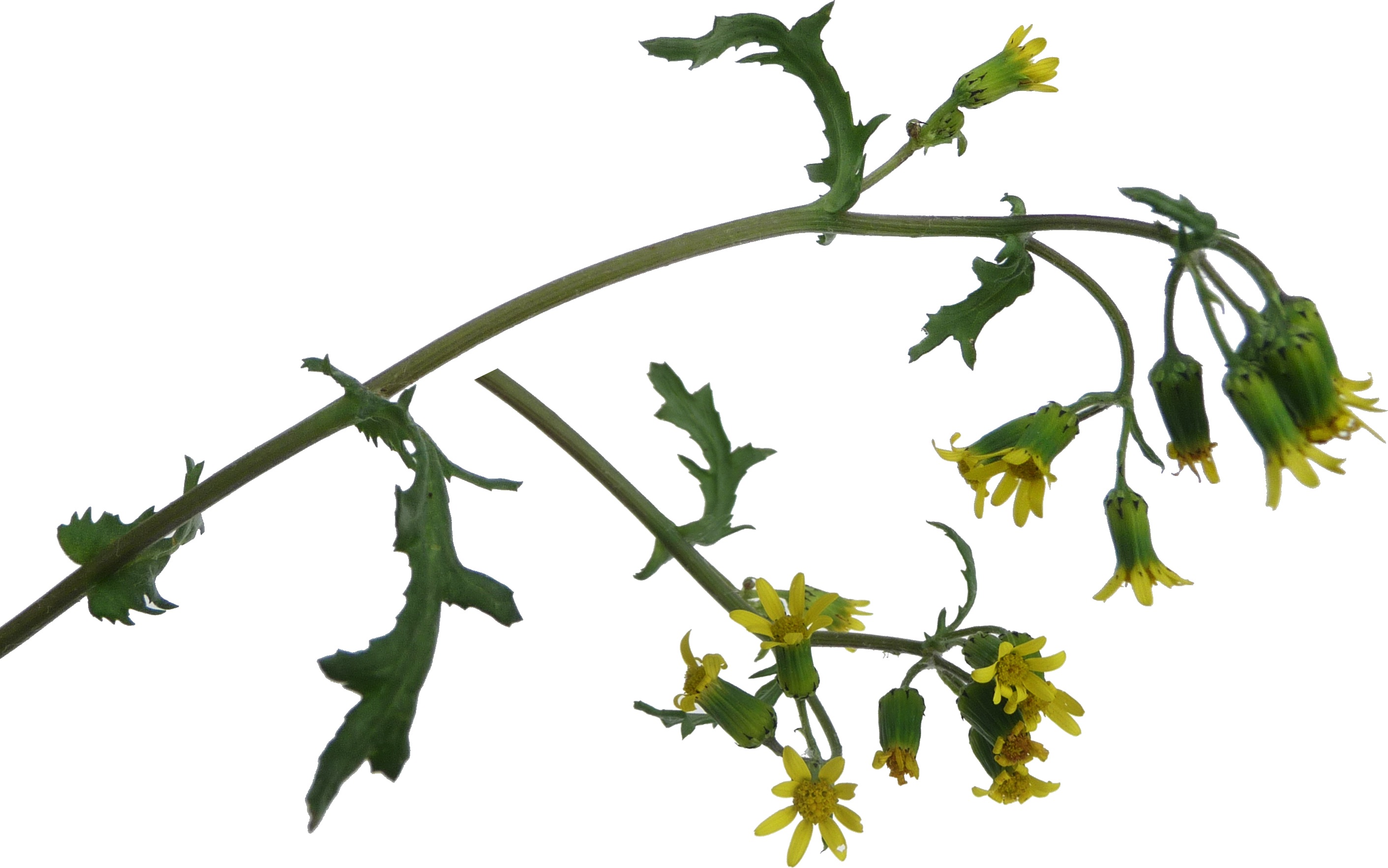
Groundsel (Senecio vulgaris) is one of the most common species in the British Isles. A small and inconspicuous annual plant, it grows as a ‘weed’ in gardens and alongside roads and pavements, on walls, in fields and on almost any rough, disturbed and open ground. It belongs to the daisy family (Asteraceae), but unlike most daisies it usually lacks ray-florets. In contrast, the closely-related Sticky Groundsel (Senecio viscosus) is more daisy-like with yellow ray-florets. Sticky Groundsel’s rays become strangely bent back (‘recurved’), which help to distinguish it from other members of the daisy family. It has glandular hairs which make it sticky and grey, and it often looks in need of a shower as dust and other particles stick to it. S. viscosus grows in similar places to Groundsel but, being somewhat more salt tolerant, it can be found in maritime habitats and along winter-salted roads.
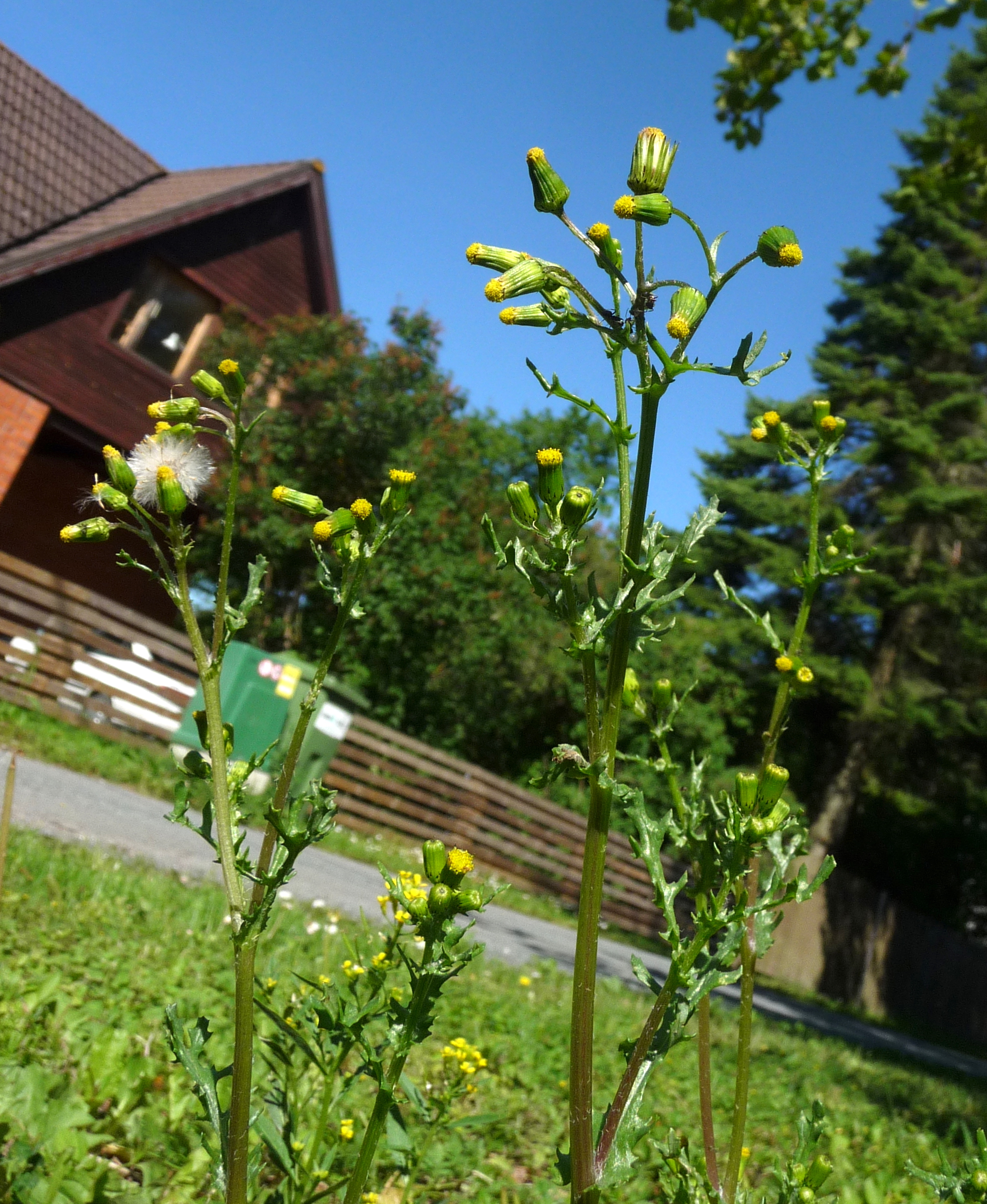
Groundsel is a native European plant. Its English name appeared in 1538 in William Turner’s Herbal and Linnaeus gave it the Latin name of Senecio vulgaris in his Species Plantarum of 1753. The word ‘Senecio’ comes from the Latin senex meaning old man – believed to be a reference to the beard-like hairs attached to the ovary to aid dispersal (the botanical term is ‘pappus’). ‘Vulgaris’ is the Latin word for ‘common’.
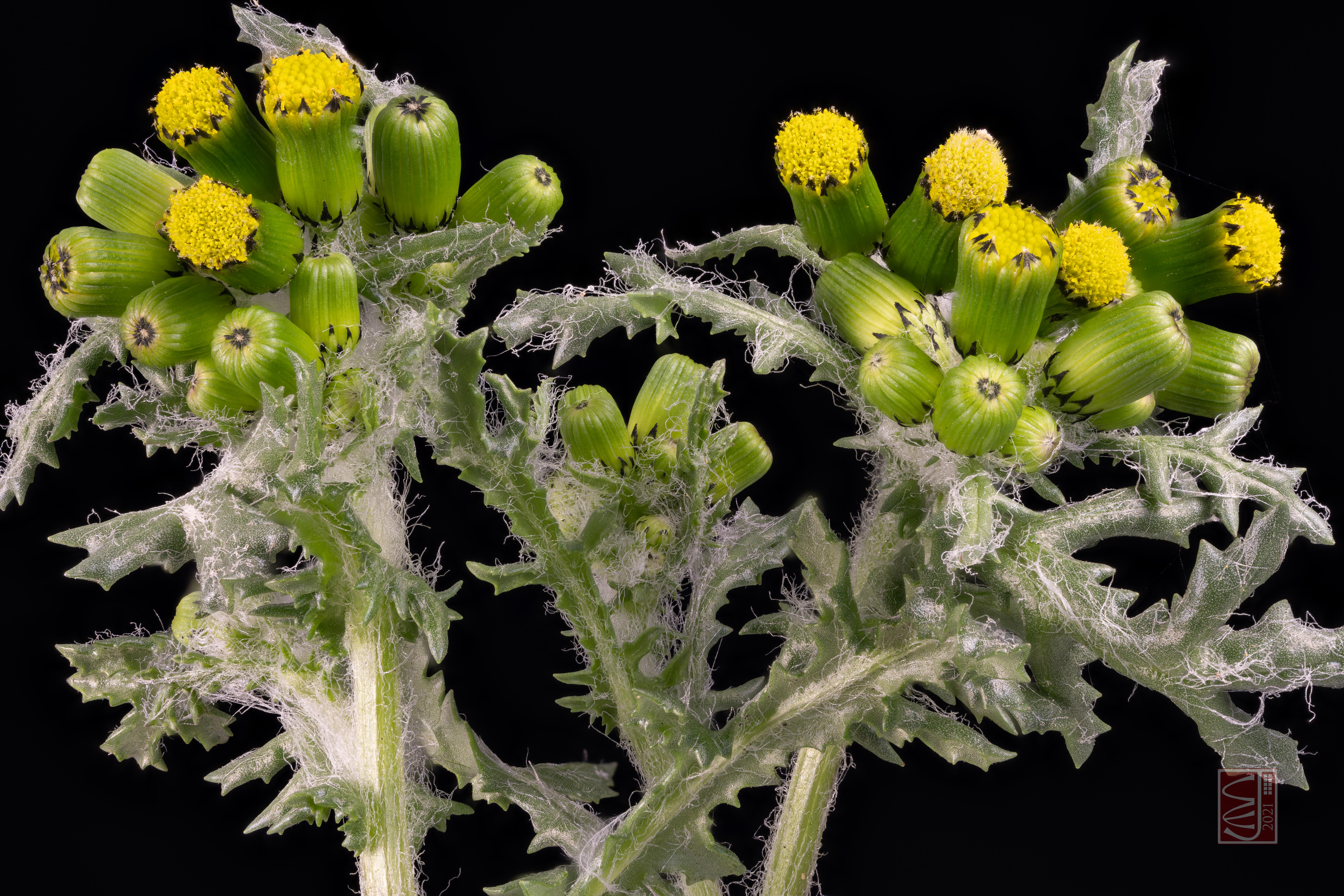
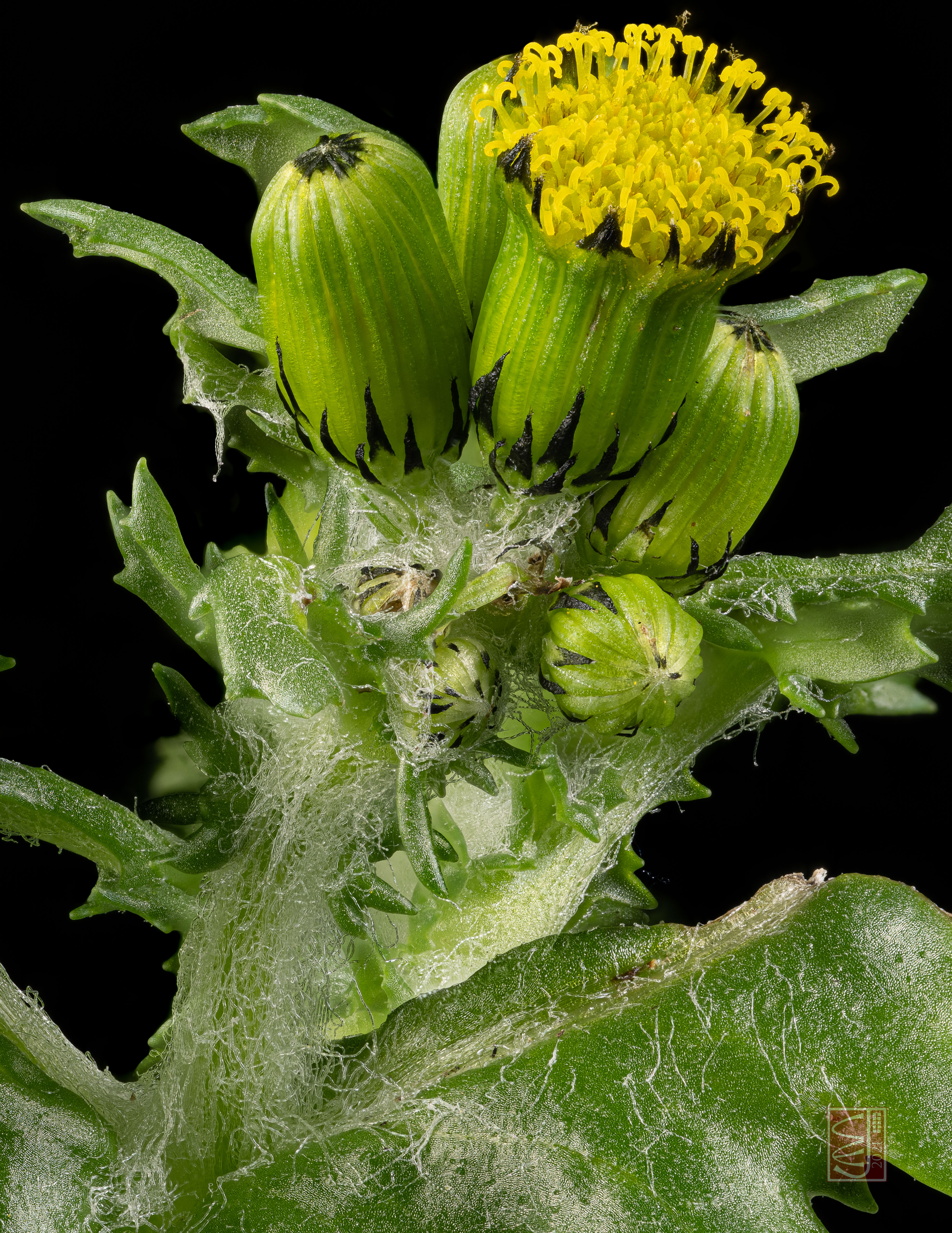
The genus Senecio has over 1000 mostly yellow-flowered species scattered all over the world. Botanical pronunciation is rarely obvious and we can only guess at how the Ancient Romans pronounced their Latin, but in this case the consensus is that Senecio is pronounced suh.nee.shee.ow
Senecio vulgaris is believed to have arrived in the Americas, Australia and New Zealand with the early settlers, hitching lifts in bags of grain. But it is also common in Japan, having been introduced from Europe in the Meiji Era 1868 -1912 when Japan began to ‘open up’ to Western ideas, habits and trade. I like to think the seeds came in with textiles imported from the north of England and perhaps also as contaminants in wool imports from Australia. We will never know for sure.

Some 26 countries of the world consider it ‘invasive’. Well, I suppose it is. The plant develops from seedling to seed in 5-6 weeks and it can therefore easily fit three life cycles into the year. On this basis Edward Salisbury reckoned one plant could make 1000 million individuals from spring to autumn (Salisbury 2009). That’s a Malthusian approach to population growth; in reality only a tiny fraction of seeds are likely to produce a new plant, but considering the wet pappus sticks well to shoes, clothing and animal fur, and the seeds with pappus can blow around in the wind, it is obvious that the species has the potential to invade almost any bare ground. Indeed, the word groundsel is from the Anglo-Saxon groundeswelge, meaning ‘ground swallower’. Groundsel is normally controlled by shallow hoeing, mulching or hand pulling as well as by herbicides. In the 1960s it had the distinction of becoming the first weed to develop resistance to a herbicide – Triazine and its relatives were then much-used herbicides but in 1968 Triazine was reported to be ineffective on groundsel. New and often less dangerous herbicides were soon introduced, including glyphosate in 1970. But the evolutionary arms race between weeds and herbicides continues apace, and now many other species have developed resistance to whatever chemical compounds are used.
The evolution of new species (‘speciation’) need not take millions of years. This realisation did not occur until relatively recent times. One mechanism of speciation is where two species hybridise and produce fertile offspring that are, for whatever reason, reproductively isolated from the parents. A form of Senecio vulgaris known as ‘York radiate groundsel’ was found in York Railway Station in 1979. It was later identified as the hybrid between Senecio vulgaris and the alien plant Senecio squalidus (Lowe and Abbott 2003); the new species was named Senecio eboracensis, after Eboracum the settlement in Roman Britain which became York. The new species is self-pollinated, so it cannot back-cross with its parents. It has not so far expanded its range; on the contrary, Stace (2019) says it is now extinct.
As a species, Senecio vulgaris shows considerable variation. Some plants do have ray-florets (but only a few ray-florets, and they are not very showy at all) and so look more daisy-like (see Richard Milne’s picture, above). One of these is known as the variety hibernicus which may have arisen though hybridisation with Senecio squalidus. My impression is that Grounsel is a rather willing partner in hybridisation with its relatives, although most of the time its flowers are self-pollinated. The types with ray florets are more attractive to pollinating insects and more likely to be out-crossing: Abbott and Irwin (1988) found that syrphid flies visited the outcrossing radiate morph 72% of the time and the self-pollinating non-radiate types only 28% of the time.

Groundsel is one of those species that shows considerable variability, and the short life cycle provides opportunity for rapid micro-evolution. Theaker and Briggs (1993) observed that plants from much-weeded locations competed their life cycles faster than plants from relatively undisturbed sites (‘precocious reproduction’), and that these differences were maintained when the plants were compared under controlled conditions. Clearly, this is an example of micro-evolution. I’ve included in this blog a picture of one individual I saw a few days ago at the gravelly edge of a supermarket car park. These edges are cultivated and weeded to present a ‘tidy’ appearance. This tiny plant is producing a single flower (in late December) after it has made just a few leaves – precocious indeed.
Turning now to the Sticky Groundsel, it is less common and its status as a native is not so clear. There are early records of a sticky groundsel from 1660 suggesting native status but authorities think these plants might have been S. sylvaticus (Pearman 2017). Stace (2019) says S. viscosus is a naturalised alien. We cannot be sure, but I do think it is an interesting plant. Why is it sticky – does it absorb nutrients from particles, could it be slightly insectivorous? These questions await investigation.
All plants in the genus Senecio contain pyrrolizidine alkaloids, potent natural insecticides that repel insect attack. However, many caterpillars of butterflies and moths have developed tolerance and happily feed on Senecio. These compounds are poisonous to some farm animals, damaging the liver. Don’t put groundsels or ragweeds in your salad please.
Here’s a downloadable reference for gardeners with information on the biology of groundsel: https://www.gardenorganic.org.uk/weeds/groundsel
References
Abbott RJ, Irwin JA. 1988. Pollinator movements and the polymorphism for outcrossing rate at the ray floret locus in Groundsel, Senecio vulgaris L. Heredity 60:295–298.
Lowe AJ and Abbott RJ (2003) A new British species, Senecio eboracensis (Asteraceae), another hybrid derivative of S. vulgaris L. and S. squalidus L Watsonia 24: 375–388.
Pearman D (2017) The Discovery of the Native Flora of Britain and Ireland. BSBI.
Salisbury E (2009) Weeds and Aliens. Collins.
Stace CA (2019) New Flora of the British Isles. C&M Floristics.
Theaker AJ and Briggs D (1993) Genecological Studies of Groundsel (Senecio vulgaris L.). IV. Rate of Development in Plants from Different Habitat Types. New Phytologist 123, 185-194.
John Grace