Artemisia vulgaris – 11th September 2023 – Mugwort
This common plant is not ‘showy’ like many species we’ve covered. It nevertheless deserves to be Plant of the Week because of its importance in Herbal Medicine over at least 2000 years. When Gerard wrote his 1597 Herbal it was called Artemisia mater herbarum or ‘Artemisia the mother of herbs’ and recent discoveries support its reputation as a medicinal plant (more about that later).

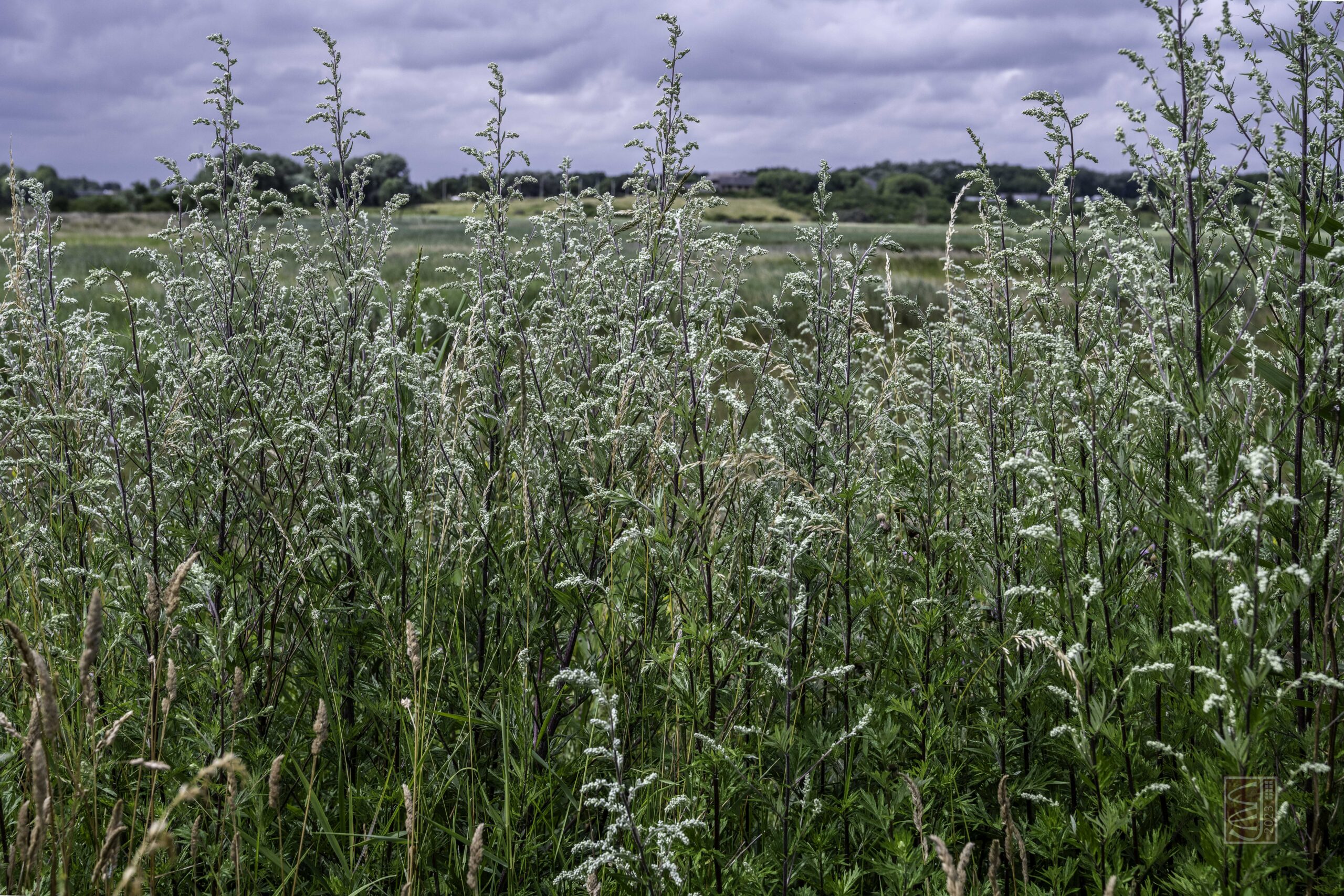
Single clump of A. vulgaris growing in broken mortar next to a derelict fishing cottage, early September 2023. Ballantrae, Ayrshire. Photo: John Grace.
It’s a perennial species, native to Eurasia, Indo-China and parts of North Africa. Its status as a native in Britain is uncertain. Early authors claimed it to be a native plant but Kew’s Plants of the World says it is not. It is probably an ancient introduction (an ‘archaeophyte’), brought here as a medicinal plant. It belongs to the Family of daisies and dandelions, the Asteraceae. Its flowers are tiny and numerous, and a hand lens or dissecting microscope is needed to examine them. They are wind pollinated. The pollen is allergenic, dispersed over great distances and may cause rhinitis, conjunctivitis and asthma.
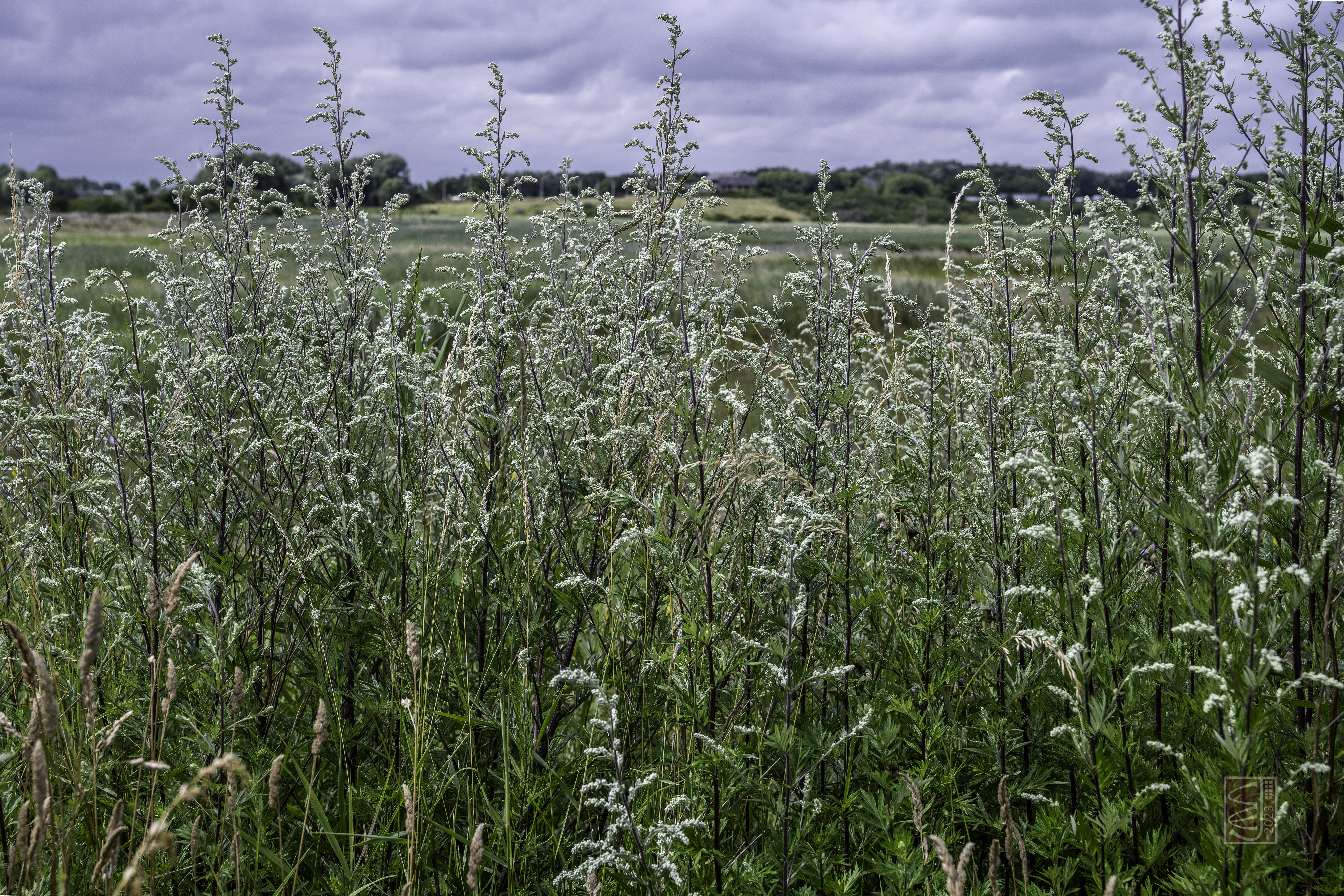
Area dominated by A. vulgaris. Portrack Marsh SSSI Nature Reserve (Teeside). Photo: CHris Jeffree.
The plants form persistent clumps which may be as tall as 1.5 metres, many stiff reddish stems arising from a woody rootstock. The flowers are borne on branches as shown in the image above.
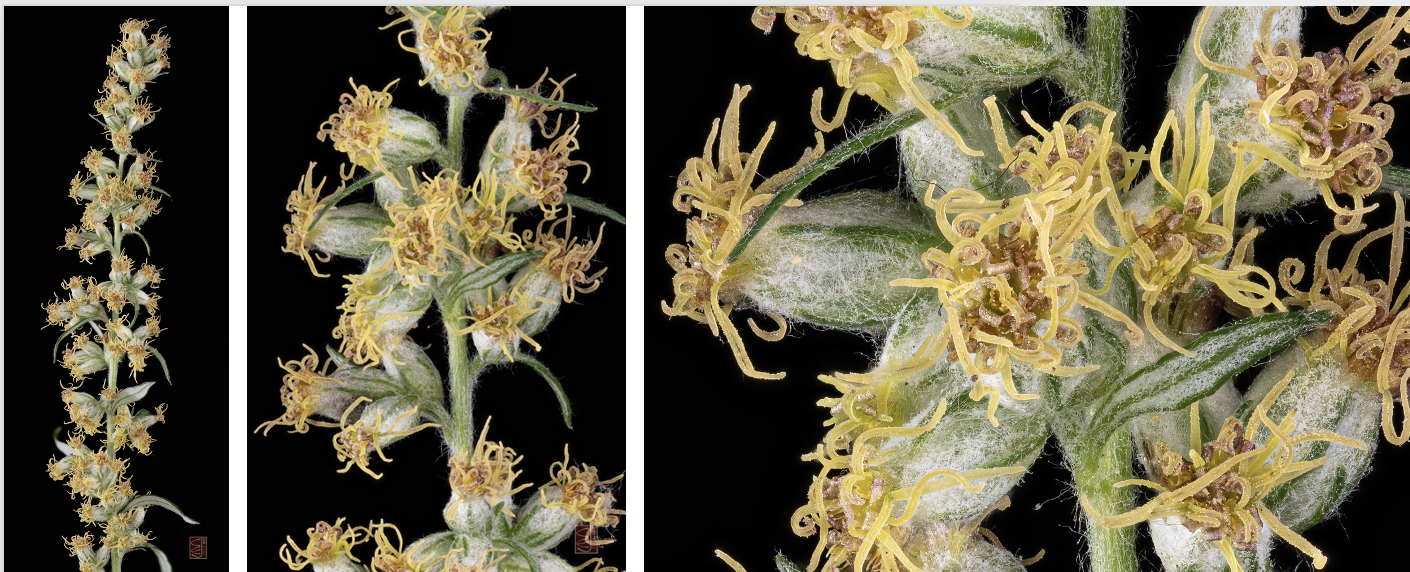
Flowers of A. vulgaris. See text below. Images: Chris Jeffree.
Examination with just a x8 hand-lens reveals yellowish structures arranged on a capitulum (think of the flowering heads of groundsel, but a quarter of the size).
The extra power of a macro-lens shows more detail (see the images above from Chris Jeffree). The yellow structures that look like contorted ray florets are the extended stigmas of female flowers, very rough and well-adapted to intercept and capture the airborne pollen. There are no ray florets. The disc florets, revealed by dissection, are bisexual. The presence of both female and hermaphrodite flowers on the same plant is called gynomonoecy and is quite rare, although present in 200 members of the Asteraceae.
In the Asteraceae, wind pollination has replaced insect pollination not only in Artemisia but in several other cases, notably in the genus Ambrosia (the Ragweeds). Most authors have considered this to be a response to a lack of pollinating insects at some point in the evolutionary history. Wind pollination seems highly wasteful, as only a tiny fraction of the pollen lands on a stigmatic surface, although the wind-pollinated plant has no need to make ‘expensive’ nectar or colourful petals.

The leaves are hairless and dark green on the upper surface but tomentose beneath (appearing white because of many small and matted hairs). The stem leaves at the base of the plant and on the lower stems are much-divided but simple leaves are found on the flowering branches. Photo: Chris Jeffree.
The plant is found in a range of soil types, but never in the most acid soils. It tolerates soils of the highest pH values and therefore it is often seen on derelict sites where concrete has crumbled, roadsides, refuse tips as well as waste places in general. It tolerates drought quite well, and is often seen near the coast (where the sand is calcareous?). It has strong chemical defences, not just against grazing animals but also it can inhibit germination and growth of competing plant species. In some parts of Europe it is a serious weed on arable fields.
Its chemical defences have been the subject of much research, in view of its use in traditional medicine in all parts of the world but especially in China. The web site Plants for the Future has a particularly long section on the medicinal properties, with some emphasis on the treatment of gynaecological ailments. My search on the Web of Science revealed over 700 articles in science journals, most of them related to identifying chemical compounds that might be useful in the control of diseases or pests. Indeed, the English name ‘mugwort’ is from the Old English mucgwyrt, mucg meaning ‘midge,’ referring to its use in repelling flying insects including midges.

Tu Youyou, discoverer of artemesin and recipient of the 2015 Nobel Prize in Physiology or Medicine. Image: Bengt Nyman, CC BY-SA 4.0 https://creativecommons.org/licenses/by-sa/4.0, via Wikimedia Commons
The status of Artemisia in pharmaceutical practice was enhanced when a Chinese researcher Tu Youyou was awarded the 2015 Nobel Prize in Physiology or Medicine for her 1972 discovery of artemisin, a compound that is used in the treatment of malaria. Her remarkable story is told here. Millions of lives have now been saved by Artemisia annua, the annual plant that is grown in China as the main source of the compound. Other species of Artemisia are known to have antimalarial properties, including A. vulgaris.
A team from the Royal Botanic Gardens at Kew have constructed an evolutionary tree of Artemisia (see below) and concluded that “artemisinin may be widespread across the genus, providing an accessible local resource outside the distribution area of A. annua.
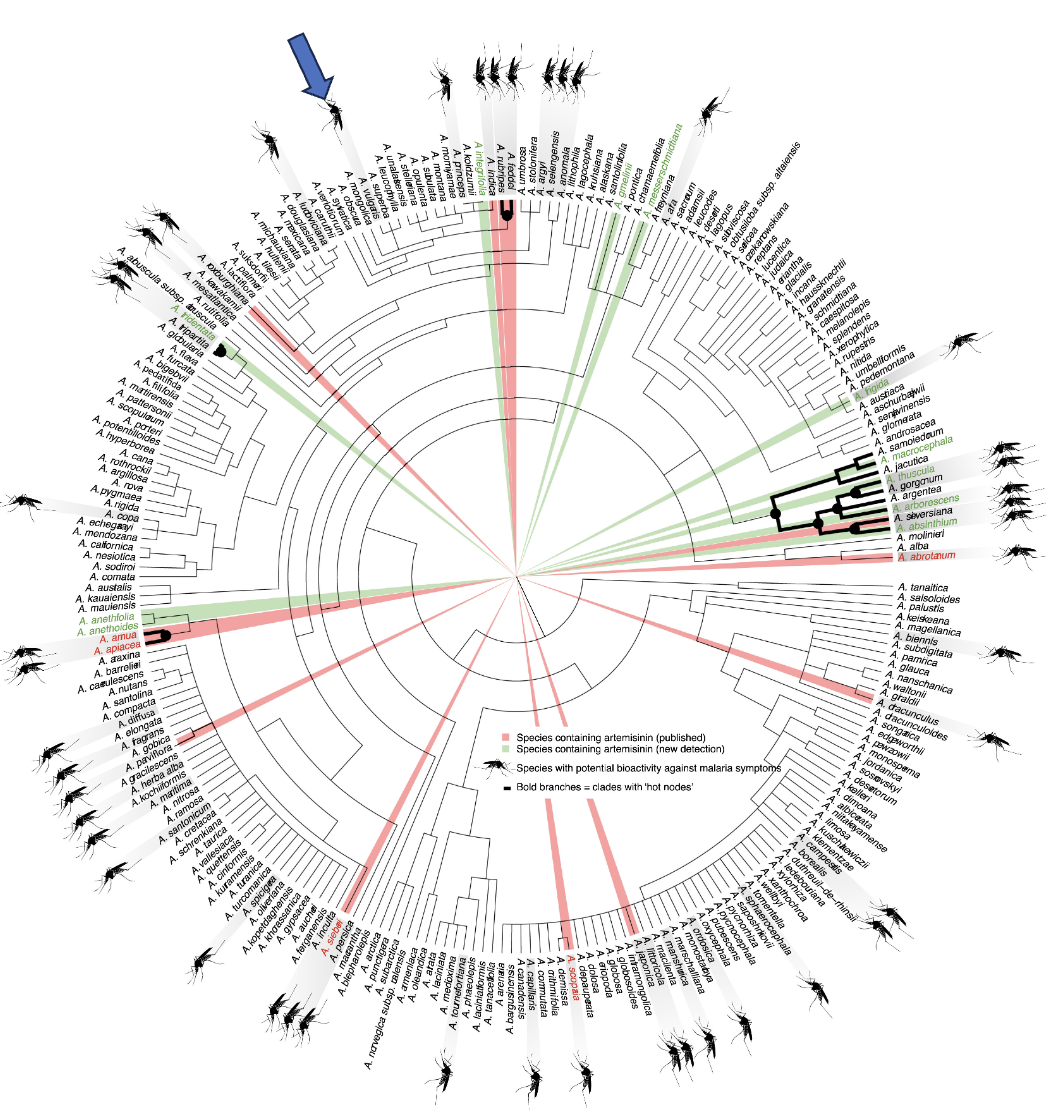
Evolutionary tree of Artemisia, used by Pellicer et al (2018) to identify ‘hot nodes’ where Artemisin and other anti-malarials might be found. The mosquito silhouettes label those species suspected or proved to have antimalarial action. I have marked the location of A. vulgaris with a blue arrow. A high resolution image (more readable) of this detailed tree may be downloaded here (this image is covered for non-commercial use by a Creative Commons licence).
In England and the Central Belt of Scotland A. vulgaris is common, but in the north of Britain and Ireland it tends to be near the coast. It tolerates the harsh conditions of the west coast of Scotland and the Hebridean Islands rather well.

A. vulgaris. Distribution in Britain and Ireland. BSBI/Maps.
Its extreme tolerance of climatic conditions is emphasised by its wide global distribution, which includes tropical and subtropical regions as well as the Arctic Circle. Fernald (1900) blamed Jesuit missionaries from France for introducing it to Canada (The Jesuits first came to ‘New France’ as missionaries in 1611 and consciously or unconsciously brought European seeds with them).
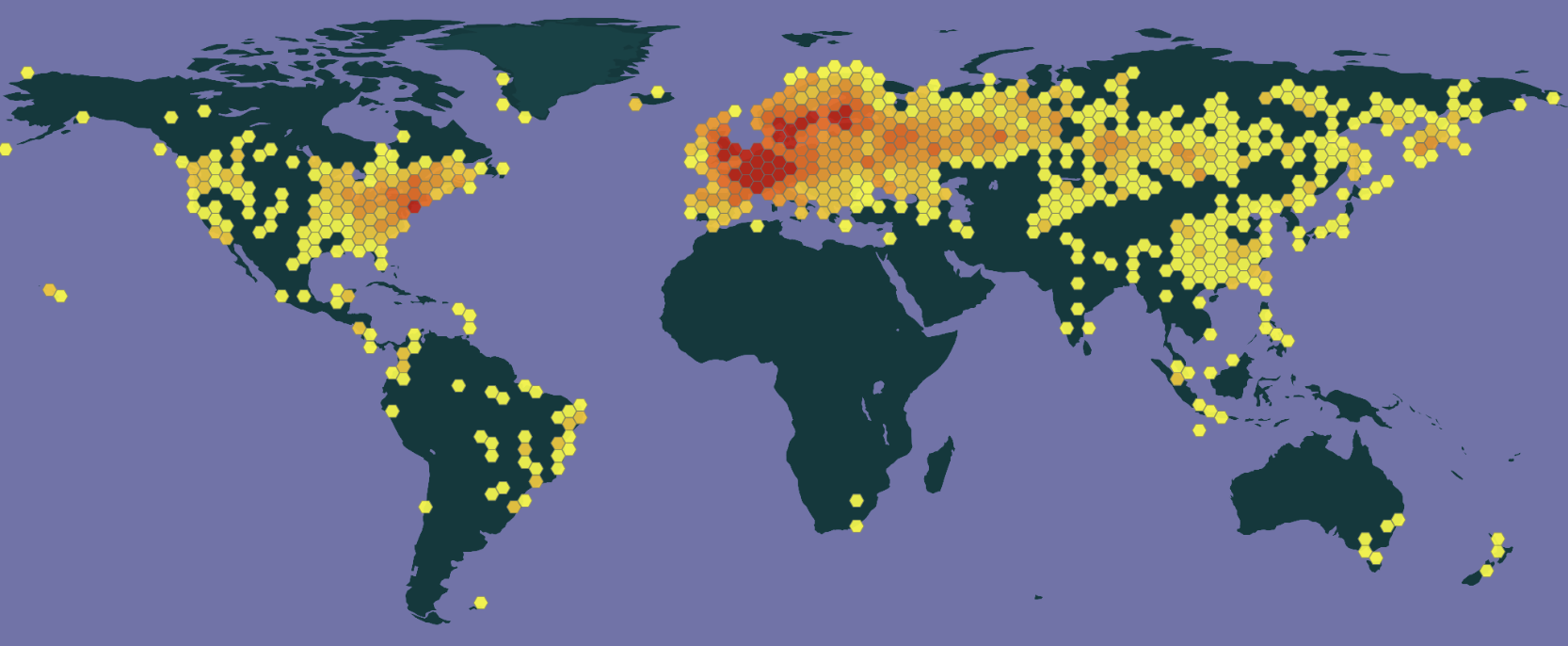
A. vulgaris. Distribution in the world, from GBIF.
We have found this species many times in our Urban Flora project. Its closeness to human occupation may simply be the result of the widespread use of limestone as a building material or it may reflect the pattern of use as a medicinal plant. Even today it commands a strong position in the world of alternative medicine (mugwort tincture is widely available on the internet).
References
Fernald, M. L. (1900) Some Jesuit influences upon our Northeastern Flora. Rhodora 2, 133–142.
Pellicer et al. (2018) A phylogenetic road map to antimalarial Artemisia species. Journal of Ethnopharmacology 225, 1-9.
©John Grace