Polypogon monspeliensis – 18th September 2023 – Annual Beard-grass
When I first saw this grass a few years ago, I thought it was an introduced species that had escaped from someone’s garden. It’s pretty, with fluffy pale-green panicles that earn it the name Annual Beard-grass. However, I discovered this plant to be native, at least in England, where it was first reported at Zout-hamptoniae (Southampton) in 1595, according to Pearman (2017). It is however rare enough to be officially classed as ‘scarce’ (Stewart et al. 1994). In Scotland, it may indeed be a garden escape that has become naturalised as it is widely available on-line and looks lovely in the garden.

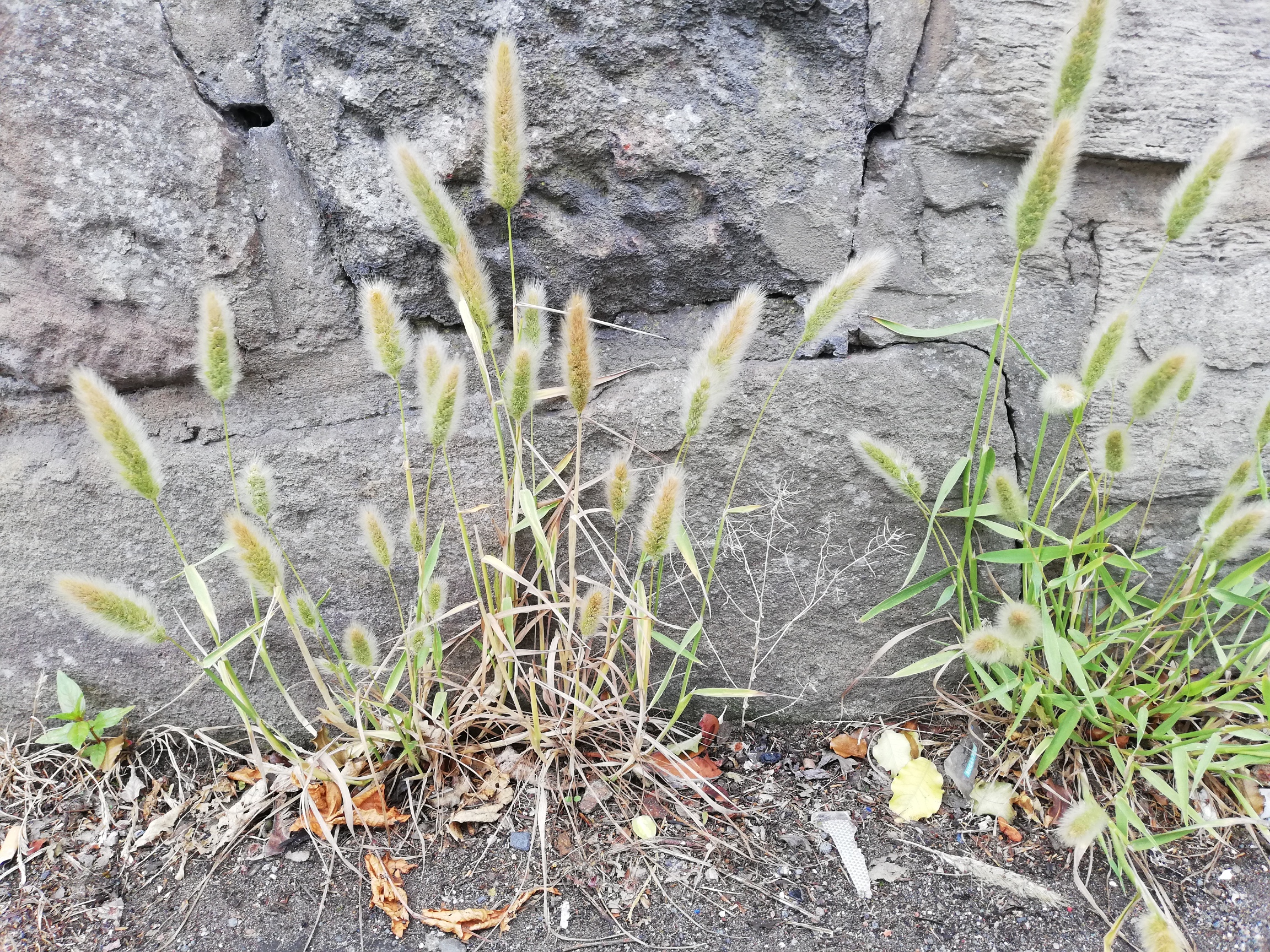
Polypogon monspeliensis in June 2020, Edinburgh. Photo: John Grace.
I found it growing in the crack between pavement and a south-facing wall along the Lanark Road in Edinburgh (see the photo above). I dutifully notified the BSBI Recorder and then quite a few Edinburgh sightings appeared: Eildon Street, Leven Street, Corstophine Road, Comiston Road. Before 2020 there were only eight records for Midlothian, going back to 1991. Now there are 18. To represent Glasgow, I looked at the data from the Vice-County of Lanarkshire. It first appeared in 2017 and now there are seven records.
It’s an annual plant, with a reputation as a coastal species. According to Cope and Gray (2009) its native habitat is along the coasts of southern and eastern England from Dorset to North Norfolk. In the map drawn by Stewart et al. (1994) all the records north of Norfolk (there were only 16 then) show it as ‘introduced’. The remaining records were all in the south-east, and this tallies with the earliest records coming from from the Solent and the Thames estuary. It does tolerate saline conditions and diverse reports from Europe and Asia say it grows well on various polluted soils including those contaminated by heavy metals. Perhaps it will join Cochlearia danica, Puccinellia distans and Spergularia marina as one of the salt-tolerating plants to colonise the edges of our salty roads and pavements.
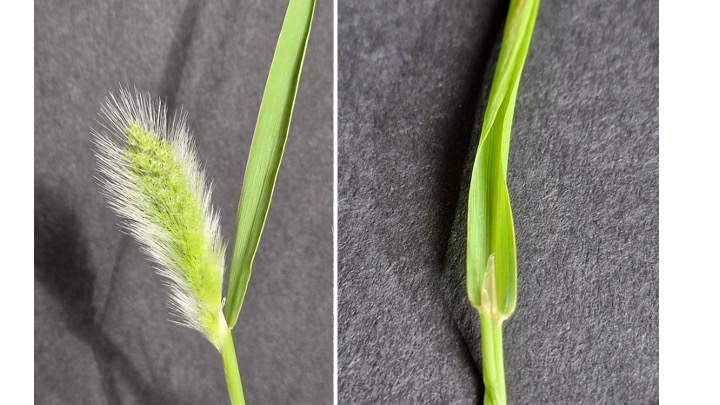
Detail of panicle and leaf insertion. Left: newly emerged panicle; on the right: the ligule is membranous, thin, with a pointed ragged tip; no auricles; sheaths are open. Photos: John Grace.
Gray’s account in the book Scarce Plants in Britain (Stewart et al. 1994) says “The species is probably declining as a result of widespread changes including the conversion of coastal pasture to arable, alterations in the management of remaining pasture and the draining and in-filling of brackish ditches and pools”, but recent recording refutes that. The species has actually increased everywhere (see the maps compiled from BSBI data below). It appears to have a long lived seed-bank and can emerge when soils are disturbed – one example cited in the 2020 Atlas refers to the construction of new sea walls. This may have contributed to a resurgence.
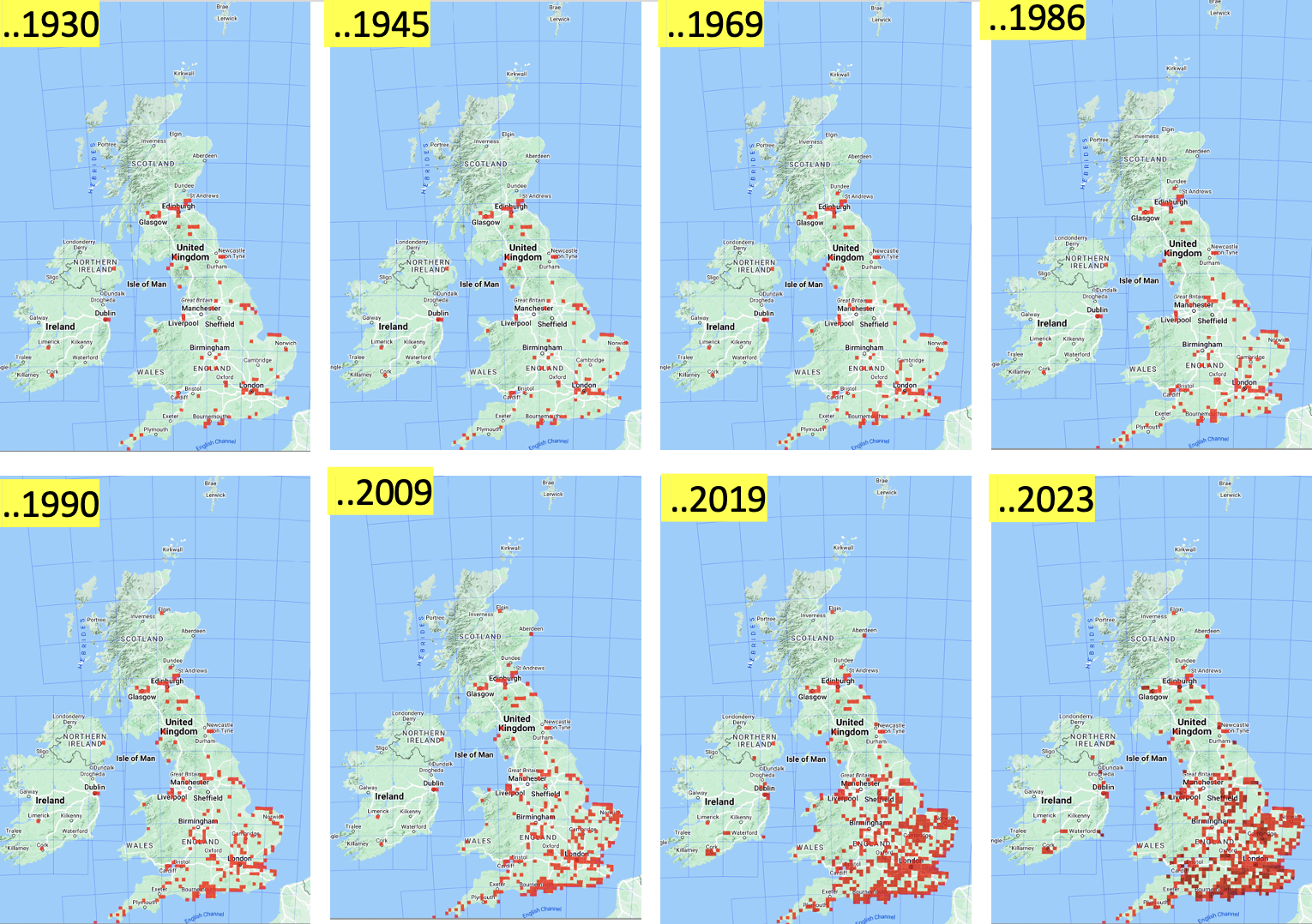
Polypogon monspeliensis from BSBI/Maps. This compilation shows records accumulating from 1930 to the present. It appears to have spread rapidly from its SE England base from 1990. Although it had a foothold in Scotland from the earliest records it did not spread very much.
Another reason for an increase in the species might be climate warming. A glance at the global maps for this species shows that the species is warmth-loving, thriving in a Mediterranean climate. In Britain we are at the northern edge of its distribution and even the small amounts of summer warming since 1990 might have assisted it. I recently compiled data on summer temperatures and it is clear that warming is proceeding at an average rate of about 0.2 oC per decade over much of Britain. Of course, plants do not respond to average temperatures – there is enormous variation between years as any farmer or gardener knows. A succession of warm summers is likely to cause such plants to make a ‘poleward leap’.
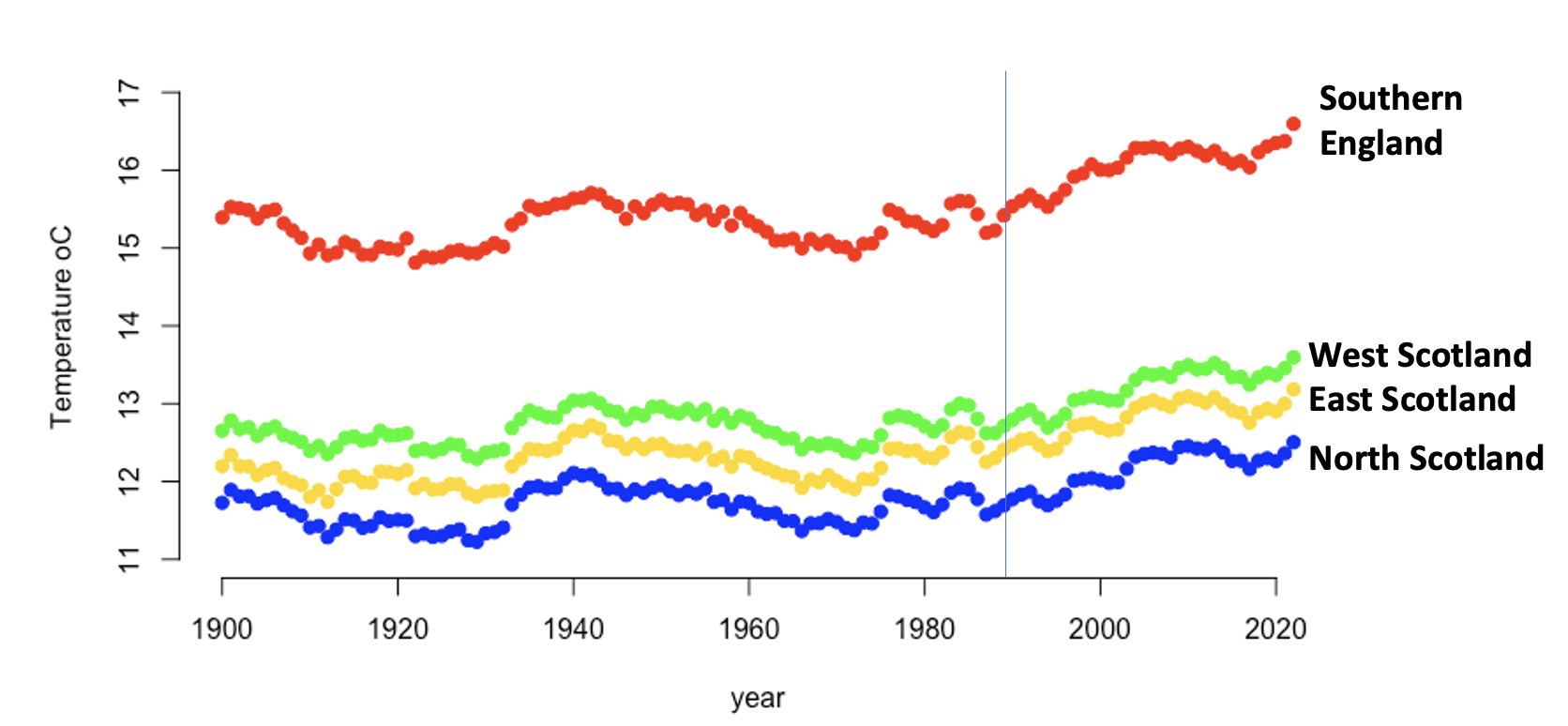
Mean summer air temperatures for four regions of Britain. Data downloaded from the Met Office plotted after smoothing by taking ten-year running means.
Its habitats in Britain include intertidal salt marshes, edges of pools and creeks, rubbish tips, waste ground and around gardens. It needs bare ground to germinate and establish, and does not tolerate much competition from other grasses. Hence, the roadside habitat, especially against a south-facing wall, is ‘just right’.
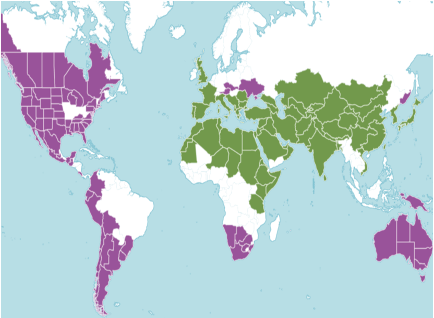
Global distribution of Polypogon monspeliensis. Green: countries and regions where the species is considered native; purple: where it has been introduced and become naturalised. Map is from https://powo.science.kew.org/.
The species has travelled widely, and is found on all continents except Antarctica. It was known in Australia very early, in the 1780s, and it reached North America around 1860 (according to GBIF here). So how did it travel? It isn’t known as a medicinal plant and so it wouldn’t have been taken to Australia or America for the medicine chest. Its seeds are small (0.1 mg) and easily caught up in clothing. Captain Cook’s ship Endeavor reached Australia in 1770, and the colonisation of Australia began in 1787 – that is when the First Fleet departed from Portsmouth, arriving in Botany Bay in January of the following year. There were many passengers (of course, including ‘convicts’) in 11 ships with abundant supplies including 80 Bushels of cereal grain and many baskets of garden seeds. I suppose the cereal grain had many contaminants including wild grass seeds that would probably have originated from South-east England. Many of the “pommy weeds” (which is how one Australian ecologist calls our plant species) must have reached Australia in a similar way. Now it is widespread and described as “a weed of lowland, damp, disturbed sites, often close to water and occasionally submerged”.
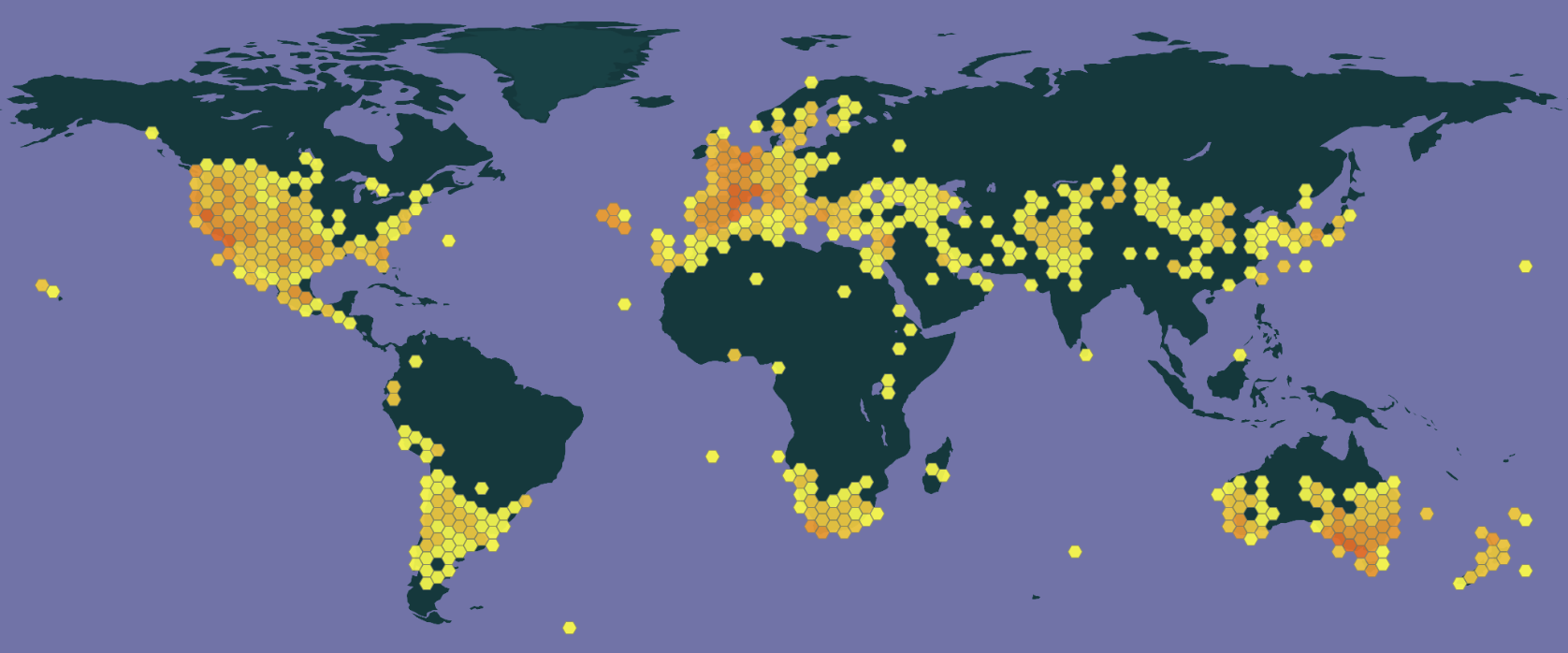
Global distribution of P. monspeliensis according to GBIF.
In North America something similar may have happened. I found that P. monspeliensis is a well-known ‘weed’ there but not a serious one. They call it Rabbit’s-foot grass. One US web site describes it thus: “Each plant may produce over 100 seeds which can be spread by water and wind as well as wildlife – birds consume seed and seed may hitchhike on animal fur. Seeds remain viable in the soil for 1 to 5 years. While it hasn’t yet become highly problematic in Florida, it has been documented in other areas to create dense monotypic stands excluding native vegetation and lowering biodiversity”.
As I researched for details of how this scarce native plant performs in the rest of the world, I found some unexpected characteristics. It is a weed of rice in Spain, where its seeds are dispersed by gulls (Peralta-Sánchez et al 2023). It is linked to the death of sheep in Australia (Finnie 1991). In Oregon, USA, it formed a hybrid with a transgenic form of Agrostis stolonifera, alerting researchers to the possibility of trangenic gene flow in the environment (Zapiola 2017). This story is told on the website GM Watch.
References
Cope T and Gray A (2009) Grasses of the British Isles. BSBI.
Finnie JW (1991) Corynetoxin poisoning in sheep in the south-east of South Australia associated with annual beard grass (Polypogon monspeliensis). Australian Veterinary Journal 68, 370.
Pearman DA (2017) The Discovery of the Native Flora of Britain and Ireland. BSBI.
Peralta-Sánchez JM et al. (2023) Seed Size, Not Dispersal Syndrome, Determines Potential for Spread of Ricefield Weeds by Gulls. Plants 12, 1407 https://doi.org/10.3390/plants12071470.
Stewart A Pearman DA Preston CD (1994) Scarce Plants in Britain. BSBI.
Zapiola ML (2017) Pollen-mediated gene flow from transgenic perennial creeping bentgrass and hybridization at the landscape level. Plos One 12, 10.1371/journal.pone.0173308
©John Grace