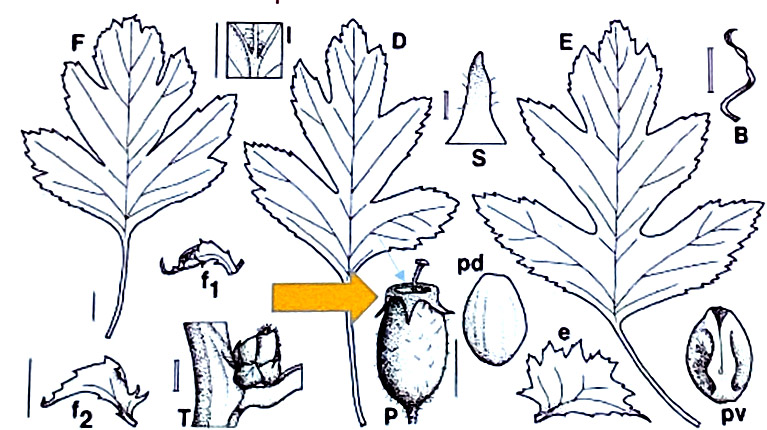
Crataegus x subsphaerica – 11th December 2023 – (a hybrid Hawthorn)
The Story
While out recording with Douglas McKean along the disused railway by the sewage works just south of Hallyards in Midlothian on a glorious autumn day, we came across what seemed to be an unusual hawthorn with large fruits, very large stipules and large open-lobed leaves. It seemed to be rather different from our usual Crataegus monogyna.
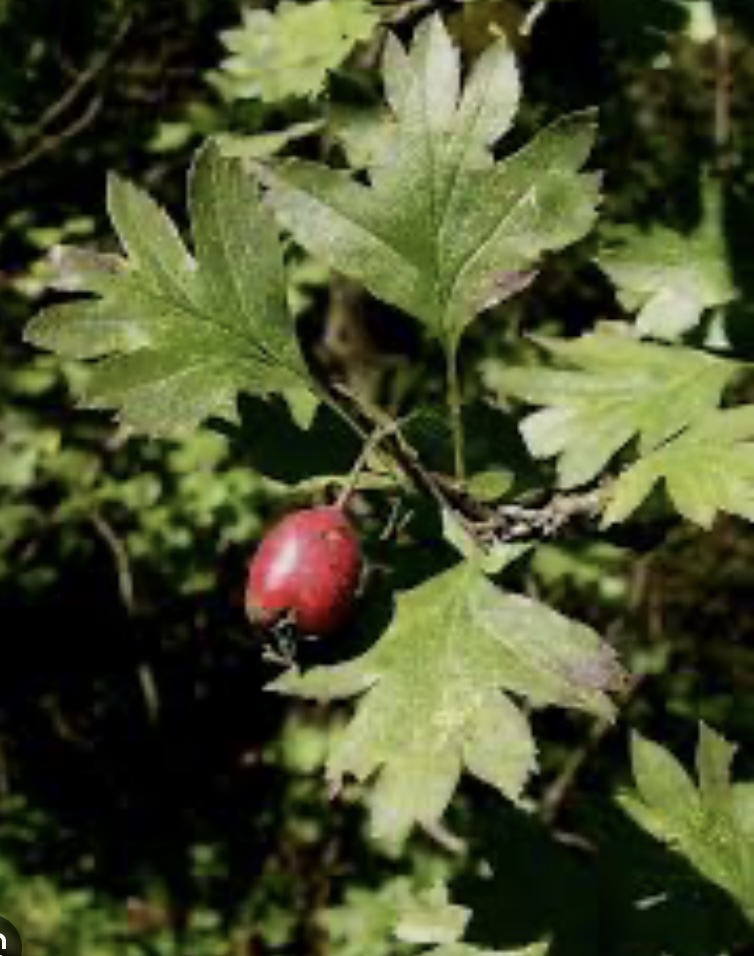
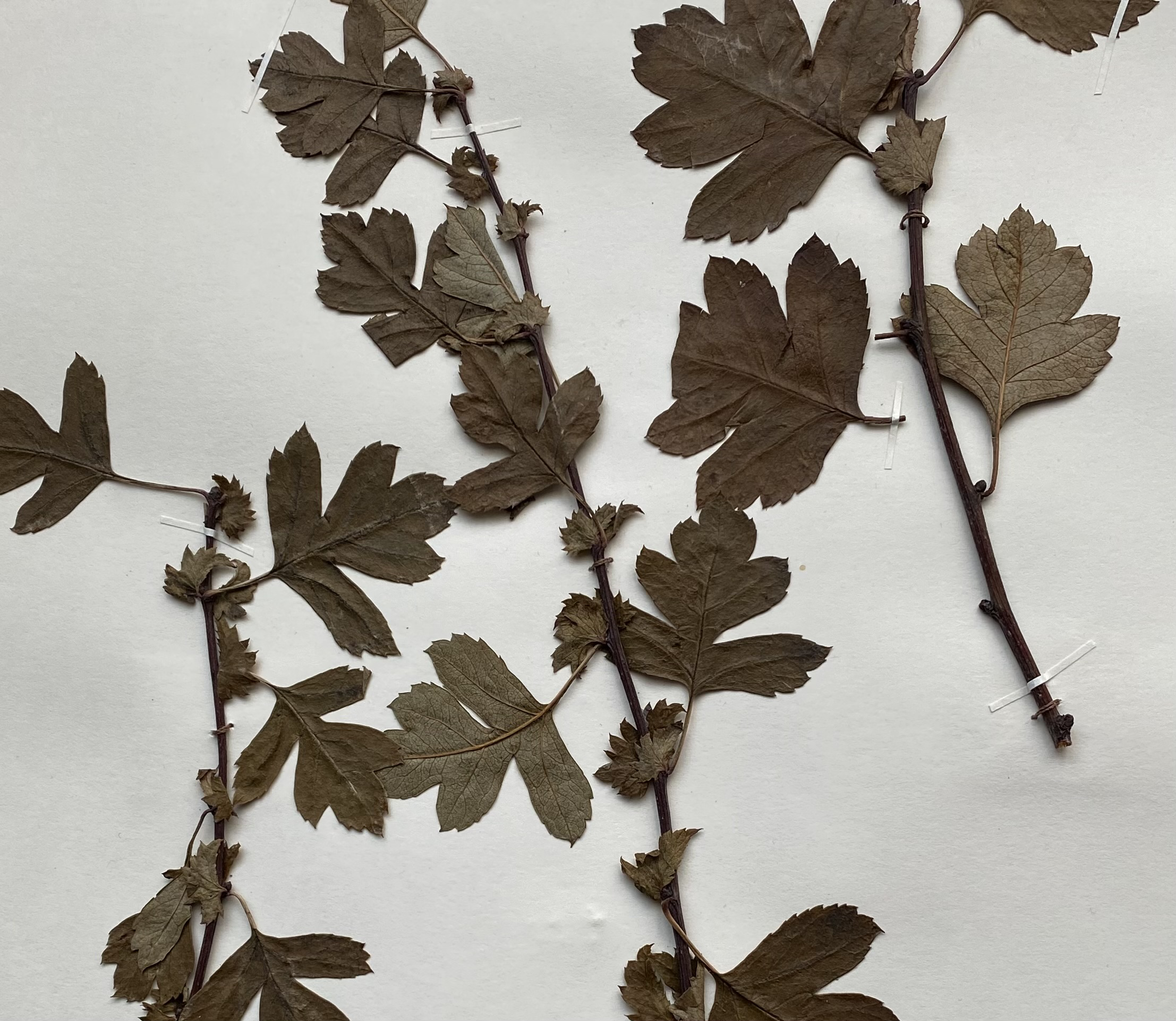
The mysterious Crataegus, Autumn 2023. Left: fruit; right: pressed specimen to show the unusually large stipules and open-lobed leaves. Photos: Sue Jury
Douglas, being a retired referee for Crataegus, put a sample in his bag. Further along the walkway we saw further Hawthorns all looking much the same.
Soon I had an answer: Crataegus x subsphaerica. It was not on the list of current MapMate names to enter into my spreadsheet. I was cautious, possibly not convinced that this was the right answer. I made a note of it and sat on it for a while!
Subsequently we went out on further expeditions and kept seeing the same Hawthorn. It was everywhere! Still not convinced I sent a photo to Mick Crawley. An instant confirmatory response was received.
The information!
Crataegus x subsphaerica. Is a hybrid of:
C. monogyna Common hawthorn. A native of UK, Europe and NW Africa
and
C. rhipidophylla Large Sepalled Hawthorn. Anon-native of the UK. Neophyte and a native of Southern Scandinavia and Central to Eastern Europe.
This taxon seems to have gone by un-noticed by many recorders. There were no records in Scotland. Most of the records were south the border, the first being recorded in 1993 in VC30 Bedfordshire. Most of the records from England seem to be from the Yorkshire Vice Counties and Cambridgeshire, Surrey, and Hertfordshire, with a few others in between.
Wherever landscapers have been: roads, rivers, estates and amenity sites there seem to be plantings. Most of these according to A.O. Chater seem to be from the postwar years. Hybrids seem to have been planted indiscriminately as “hawthorn” along with parent species. The hybrids appear to be fertile.
We have also found saplings this year in Midlothian, which are probably self-seeded or bird sown.

Distribution and identification, from P.A. Schmidt. Leaves – In Crataegus x subsphaerica the leaves are large in size, openly lobed and saw-toothed as in C. rhipidophylla, or C. monogyna like. Usually a mixture of leaf varieties on a single plant. Fruits – The ripe fruits are large and a deep red. Stipules – Present, broad and toothed. See also the Kew database and the map and images at GBIF.
References
Broughton D, the blog of the County Recorder – https://bsbi.org/mid-west-yorkshire
Sell P (2007) comments that he had found the above in Cambridgeshire planting schemes and says it is visually obvious that genotypes are now being found. Crataegus is also a taxonomically difficult genus.
Stace CA, Crawley MJ (2015) Alien Plants. Collins, The New Naturalist series. The authors comment on the widespread plantings that have come from the Continent. Many of the plantings from Europe come under C. rhipidophylla.
Stace CA, Preston CD and Pearman DA (2015).The Hybrid Flora of the British Isles. BSBI. This refers to C x subsphaerica as being more common than C. rhipidophylla (A.O. Chater pers. comm.), and this might well be the situation for rest of the country.
Stace CA (2019) New Flora of the British Isles – 4th Edition. C&A Floristics. He describes it as the likely identity of intermediates between the two species.
Stroh PA et al. (2020) Plant Atlas 2020, Princeton University Press, and the BSBI on-line version here. There are no records for the Hybrid. BSBI Volume 1, 2023. C. rhipidophylla is listed and with that there are notes in the trends section referring to the fact that some of the records may refer to the hybrids. It also states that the hybrids are generally under-recorded.
©Sue Jury