Trifolium arvense – August 5th 2024 – (Hare’s-foot clover)
This week’s plant is a small annual clover, soft and hairy, and easily overlooked. It was first described by William Turner in 1548, completely ignored by Gerard in his Herbal of 1597, but given its current Latin name in 1753 by ‘the father of modern taxonomy’, Carl Linneaus. The English name, Hare’s-foot Clover, comes from the resemblance of the flower heads to the foot of a hare (for me, it’s more like the tail of a rabbit, round and fluffy).

Old botanical illustration of Trifolium arvense. Attribution: Jan Kops, Public domain, via Wikimedia Commons. Jan Kops (1765 Amsterdam – 1849 Utrecht) was an Dutch agronomist and botanist. His most notable contribution to botany was the founding of the long-lived journal Flora Batava in 1800 and contributing text for the first 10 volumes.
At first glance, you might not realise this plant is a clover. Clovers have trifoliate leaves, hence their name Trifolium. In T. arvense the three leaflets are quite narrow and they do not display as they do in nearly all clovers. When I encounter this plant every summer, it is the fluffy flower heads that first attract my attention.
These flower heads are also attractive to bees, and as they fumble with their tongues for rewards of nectar and pollen, they inadvertently carry out pollination. The flowers can be found from mid-spring to late summer, and the fruit is a tiny pod containing a single seed. There is some evidence that the seeds are dispersed when livestock graze the sward, following passage through the intestine and perhaps ‘primed’ to germinate by the acids of the stomach acting to soften the seed’s coat (Weaver and Adams 1996).

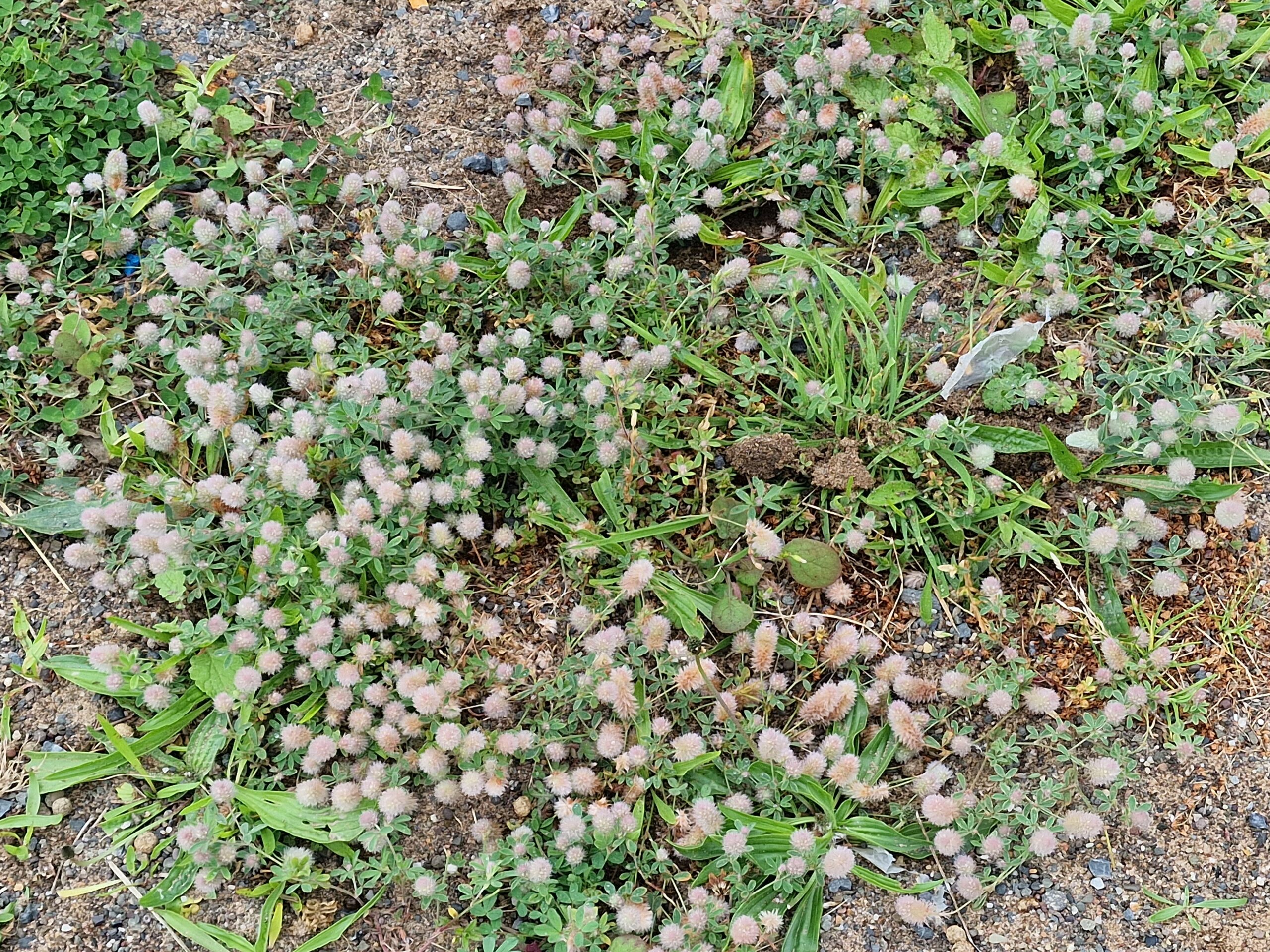
T. arvense by a coastal track at Ballantrae, South Ayrshire. White clover (T. repens) is present too and a few of its leaves are visible in this image. The T. arvense leaves are smaller and their leaflets are narrower. Image: John Grace.
In one study it was found that 82-91 percent of all the nitrogen in Hare’s-foot Clover plants came from the atmosphere. Thus, T. arvense can grow on extremely poor soils where other plants cannot, for example on larval flows on Mount Etna and on bare surfaces that have almost no soil at all. For this reason, T. arvense is also suggested as a component of ‘green roofs’ (Bates et al 2013), being not only a nitrogen fixer but also quite able to resist drought (in the data base PLANTATT it has some of the lowest scores for nitrogen requirement and water). It also has some degree of salt tolerance, and I have seen it in Ayrshire growing alongside a coastal track, exposed to salt spray during stormy weather. Moreover, it is listed in Brian Ballinger’s Checklist of the Urban Flora of Scotland as ‘often found on the coast’. The BSBI’s Atlas 2020 describes its habitats as:
“…open rocky or sandy habitats, such as acidic heathlands, sea-cliffs and sand dunes; also on railway ballast and waste ground inland and in disturbed grassland and set-aside fields on light, sandy soils. It is occasionally introduced in seed mixtures including those used for ‘green roofs’, and also unintentionally imported in sands and gravels by developers”.
The Atlas also notes a decline of this native plant:
“There has been widespread decline in south-eastern England since the 1960s, presumably due to habitat loss and the intensification of arable cropping, and in the last 20 years further losses have taken place in the English Midlands and elsewhere”.

T. arvense showing the narrow leaflets and the ovoid inflorescences. Flowering is usually prolific, as it is here. Image: Chris Jeffree.
As with most members of the bean Family (Fabaceae) the roots of this plant become infected with nitrogen-fixing bacteria of the genus Rhizobium1 . Through the action of these bacteria, nitrogen gas from the atmosphere (N2) is ‘fixed’ as ammonia (NH3) which is then converted into proteins and other nitrogen-containing compounds within the plant. When the plant dies and decomposes, the nitrogen is released into the soil in ionic form and becomes availably for other species. Globally, this symbiotic process is replicated by trillions of plants in the Fabaceae2, and forms part of the global nitrogen cycle. Locally, it is the main reason for including clovers in agricultural systems – they produce ‘free’ nitrogen and the farmer doesn’t have to buy as many bags of expensive chemical fertilizer.

Detail of the inflorescence. The pale-pink individual pea-like flowers can be seen clearly in the right-hand example, nestling between very hairy bracts. Note also the hairiness of the whole plant. The flowers open from the base upwards over a period of a few weeks. Image: Chris Jeffree.
I wondered about habitat loss in Scotland, and so I referred to Sonntag’s Pocket Flora of Edinburgh and the Surrounding District published in 1894. For ‘habitat’, it says “in cornfields and sandy pastures; frequent”. Since the 1950s, our British cornfields have been much ‘improved’ and we have only fragments of anything like a sandy pasture. The BSBI database shows that recent Midlothian records are from areas of waste ground, including bings, derelict ground at Millerhill, Granton Harbour and Arthur’s Seat. No records suggest cornfields. Its specific name ‘arvensis’ means “growing in or pertaining to cultivated fields” but alas there are none suitable.

Prolific flowering at Leith sewage works. Image: Chris Jeffree.
In Britain, there has been rather little work on this plant. Most of the research we can find is from North America (where it is considered to be a weed) and New Zealand where it was first recorded in the wild in 1880. Researchers in New Zealand have found important uses for it, to ‘improve’ other clovers.

T. arvense, fragment of root system showing nitrogen-fixing nodule, about 2 mm in diameter, and tinged with pink. Root nodules are pink due to the presence of leghaemoglobin which captures oxygen (like haemoglobin does) . This is important because oxygen inhibits the enzyme nitrogenase which needs to be active to fix nitrogen. Image: John Grace.
Unlike other clovers, T. arvense is rich in a class of compounds called proanthocyanidins. These compounds are found in apples, cocoa beans, cinnamon, cranberries, blueberries, strawberries and grapes (especially red grape seeds and skins). In plants, they form the pigments called anthocyanin which are the red and purple compounds of fruit and coloured leaves. In evolutionary terms they are part of the plant’s defence system, protecting against attack by micro-organisms. In the human diet they have wide-ranging health benefits such as reducing the risk of cancer, heart disease and stroke (Beecher 2004, Cosme et al. 2022).

A large population of T. arvense growing in nitrogen-deficient soil at Salamander Street, Leith. Note the yellowing of the Buddleja davidii and the paucity of the grass in the foreground. Image: Chris Jeffree.
The same health benefits are presumed to occur for non-human mammals. New Zealand is a small country but it is the seventh biggest exporter of beef, the third biggest exporter of wool, the second biggest exporter of sheep flesh and the biggest exporter of dairy products in the world. Next to tourism, agriculture is the largest income-generator and so agricultural research is important. Researchers at AgResearch Ltd. in New Zealand’s Palmerston North have identified the genes in T. arvense that code for proanthocyanidins and transferred these genes to one of the most important fodder plants, the common White Clover Trifolium repens, thus improving its quality as a herbage species. Not only that, there is evidence that animals feeding on the genetically-modified white clover may produce less methane (Roldan et al 2022). Methane (CH4) is one of the strongest greenhouse gases, and so this is an example of how a small and somewhat inconspicuous clover might make a contribution to reducing global warming3.

British distribution of Trifolium arvense, Note the many pale squares, indicating the species can no longer be found in areas where it was previously recorded. Also note the tendency for coastal location. Data from BSBI/Maps.
Notes
1Trifolium and other members of the Fabaceae have swellings on their roots, ‘nodules’ , from which the N-fixing Rhizobium can be isolated. Usually, the nodules are more or less spherical. Those I found when I lifted an individual T. arvense were strangely finger-like. Are these normal for the species? I don’t know and so I have included an image in this article in the hope that a specialist in the subject may be able to enlighten me.
2Biological nitrogen fixation also occurs in other organisms, especially in cyanobacteria, lichens and in a few vascular plants. See https://en.wikipedia.org/wiki/Nitrogen_fixation.
3However, GM crops are currently banned in New Zealand, as they are in the UK.
References
Bates AJ et al. (2013) Vegetation development over four years on two green roofs in the UK. Urban forestry & urban greening 12, 98-108
Beecher, G. R. (2004). Proanthocyanidins: Biological Activities Associated with Human Health. Pharmaceutical Biology, 42(sup1), 2–20. https://doi.org/10.3109/13880200490893474
Boswell, C. C et al. (2007). Symbiotic nitrogen fixation by Trifolium arvense in semi‐arid short tussock grasslands. New Zealand Journal of Agricultural Research, 50, 511–521. https://doi.org/10.1080/00288230709510319
Cosme F et al. (2022) Red Fruits Composition and Their Health Benefits-A Review. Foods. 2022 Feb 23;11(5):644. doi: 10.3390/foods11050644. PMID: 35267278; PMCID: PMC8909293.
Schulz S et al 2013. Diversity pattern of nitrogen fixing microbes in nodules of Trifolium arvense (L.) at different initial stages of ecosystem development, Biogeosciences, 10, 1183–1192, https://doi.org/10.5194/bg-10-1183-2013, 2013.
Sprent JI 2008. 60Ma of legume nodulation. What’s new? What’s changing?, Journal of Experimental Botany, 59, 1081–1084. https://doi.org/10.1093/jxb/erm286
Weaver V and Adams R (1996) Horses as vectors in the dispersal of weeds into native vegetation. Eleventh Australian Weeds Conference Proceedings, 383-387.https://caws.org.nz/old-site/awc/1996/awc199613831.pdf
©John Grace