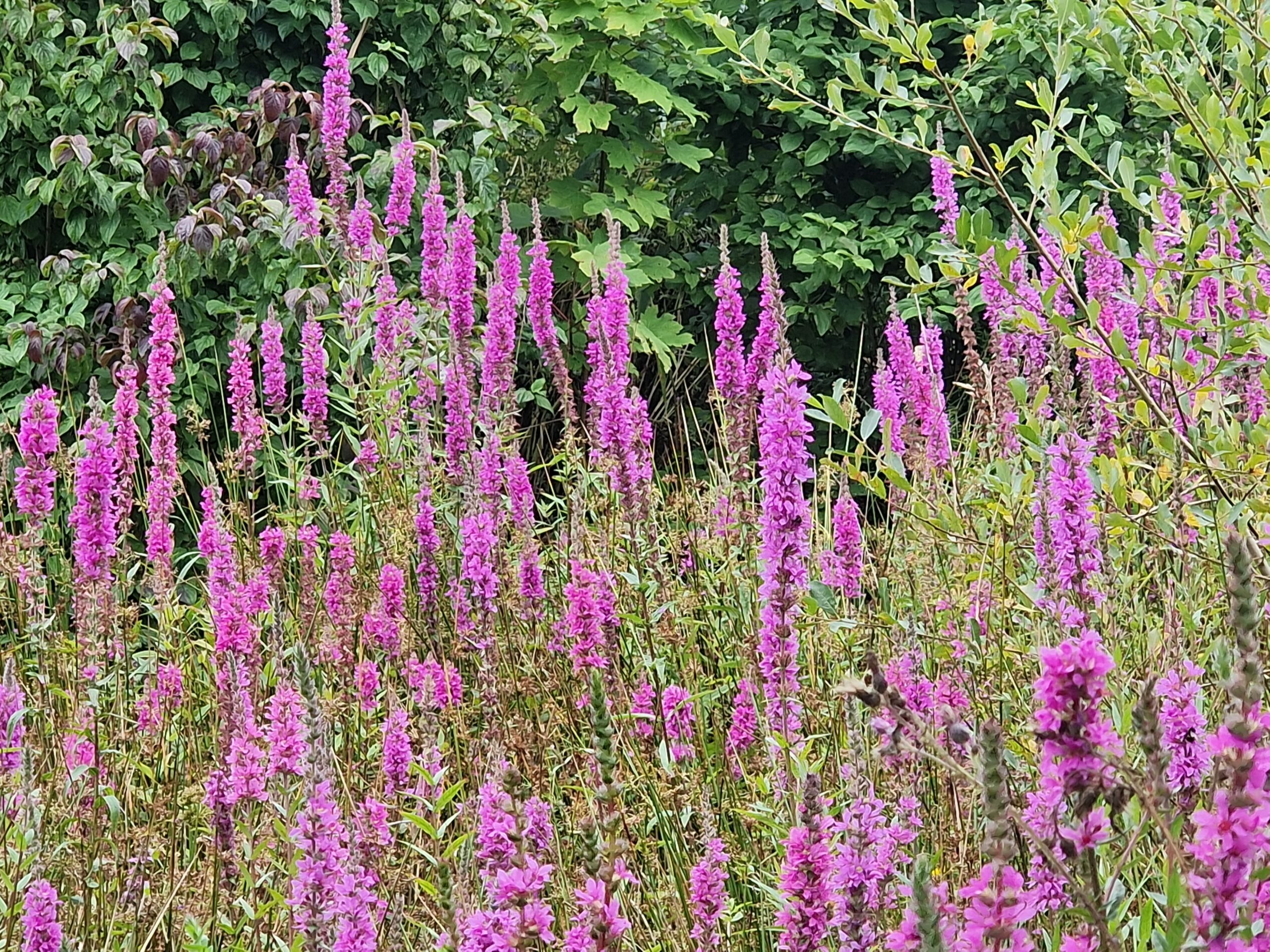
Lythrum salicaria – August 12th 2024 – (Purple Loosestrife)
This is a truly magnificent perennial plant, blooming now (early August) with flowering spikes on display around the margins of lakes, canals and other wet places in the lowlands. It is an example of a native plant that is not in decline, perhaps aided by local authorities who sometimes use it to decorate and beautify newly-created townscapes.
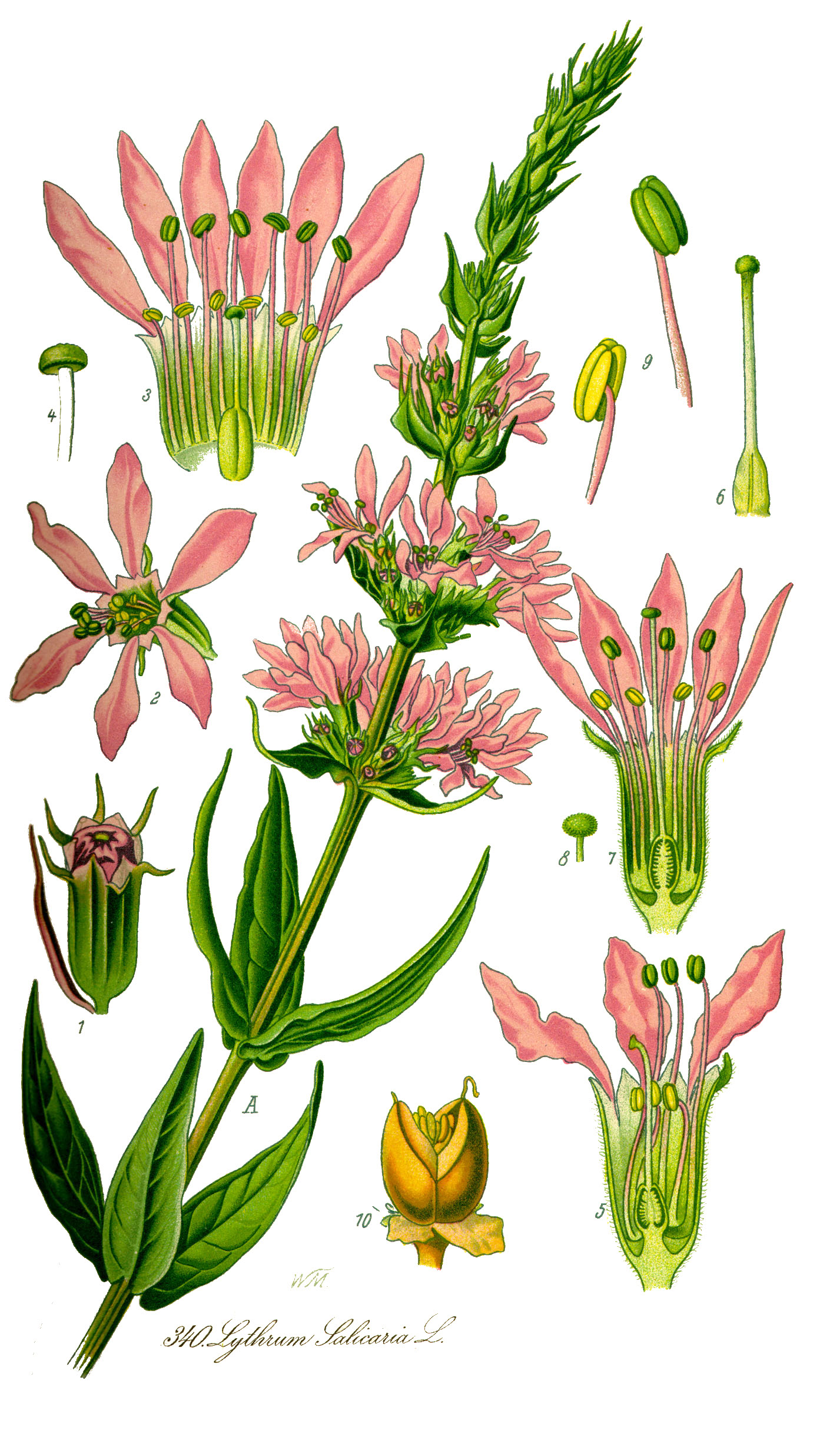
Illustration by Otto Wilhelm Thomé (1840–1925), German botanist and botanical artist who created illustrations for Flora von Deutschland, Österreich und der Schweiz in Wort und Bild für Schule und Haus (translated: Flora of Germany, Austria and Switzerland in Word and Picture for School and Home). Public domain, via Wikimedia Commons.
It appears around April, when the shoots spring forth from an extensive underground root system, utilising stored food for rapid extension growth (1 cm per day). It does not mind flooding. The roots and stems have an outer corky layer with air spaces for diffusion of oxygen from the aerial parts of the plant (Stevens et al 2002). Flowering is triggered when the daylength exceeds 13 hours. Every aerial shoot bears flowers.
The colour of the flowers is not exactly purple, but magenta (purplish-red). In the antique illustration by Thomé, reproduced above, the colours have apparently faded. The petal surfaces are somewhat glossy and in sunlight they can appear pinkish.

Lythrum salicaria, Blackford Pond in south Edinburgh. The tallest spikes are 1.5 metres. Photo: John Grace
In Europe, 64 insect species have been recorded as floral visitors (Batra et al 1986). Insects need a long tongue (6 mm) to reach the nectar, and bees predominate. In North America, 16 floral visitors have been recorded, five of them being bumble-bees (Anderson 1995).
There are three sorts of flowers, based on the length of the style. This queer arrangement discourages self-pollination, rather like pin-eye and thrum-eye versions of Primula but more complicated. Charles Darwin was clearly fascinated by this, and described his own experiments on Lythrum in a classic paper (Darwin 1864). Later, one of the greatest figures in quantitative biology, R.A. Fisher, took the topic further (Fisher and Mather 1943).

Darwin CR (1864) On the sexual relations of the three forms of Lythrum salicaria. Journal of the Linnean Society of London (Botany) 8, 169-196. Online version at https://darwin-online.org.uk/content/frameset?itemID=F1731&viewtype=text&pageseq=1
The species appeared in North America in the 1800s, arriving from Europe in the ballast of sailing ships. It has since gained ground and is now widely considered to be an ‘invasive alien’ in North America. By extending its root system it forms clonal monocultures that can exclude native species. Much effort and money has been spent trying to control it by chopping, burning, flooding, herbicide-spraying and biological control. The full story up to 1992 is told by researchers from the University of Windsor in Ontario (Mal et al 1992). These authors also provide far more detail about the biology of the species than I can possibly cover in a short blog.

Close up image of flowers. They are clustered in distinct whorls, a feature that helps to distinguish this plant from Lythrum virgatum, a similar species originating from wet areas of the Eurasian steppes, widely available from horticultural suppliers in UK. Image: John Grace.
However, as with many alien species, it seems that the hazards of this species have been exaggerated. A more balanced view of this particular invasive alien is presented by Mark Anderson from the University of New Hampshire. He cites one claim of lost revenue (“a total of 45.9 million dollars lost annually from a combination of declines in the muskrat fur industry, declines in money spent on wildlife observation and photography, and declines in bird hunting expeditions”). He is critical of those referring to loosestrife with highly loaded language such as “aggressive alien invader” when there is only scant evidence of any real ecological damage, and he emphasises the need for more data (Anderson 1995).

In full flower, early August 2024, Aldouran Wetland near Stranraer in SW Scotland. Image: John Grace.
It is undoubtedly true that species are often vigorous and may be invasive when placed on a new continent, away from their natural enemies. One obvious (though risky) approach to control is therefore to bring some of the natural enemies to the new continent. European beetles Neogalerucella calmariensis and N. pusilla were therefore released in Ontario. The adults and larvae both feed on purple loosestrife in Europe. Twenty years after release, researchers found the beetles were thriving and definitely damaging the purple loosestrife flowers (St. Louis et al 2020). However, there was no detectable effect on plant density, biomass, fruit production or recovery of native species richness.

Global distribution of Lythrum salicaria. The upper image shows records up to 1900, and the lower is from 1900 to 2024. Note the presence of the species in Australia and New Zealand as well as North America. The apparent spread in Europe and Asia may reflect an increase in recording intensity. Images from GBIF.
It seems that Lythrum salicaria has settled in North America, just as the human colonists from Europe did. It continues to attract attention, and a recent paper in Scientific Reports (published by Springer-Nature) even refers to it as the “purple menace”. Oh dear; scientists should not be the ones to make sensational value judgements like that, especially in the titles of their papers. We leave that to the tabloid journalists.

British and Irish distribution of Lythrum salicaria, from BSBI/Maps.
References consulted
Batra SWT et al (1986) Insects associated with purple loosestrife (Lythrum salicaria L.) in Europe. Proceedings of the Entomological Society of Washington 88, 748-759. https://www.biodiversitylibrary.org/page/16265461#page/776/mode/1up
Darwin CR (1864) On the sexual relations of the three forms of Lythrum salicaria. Journal of the Linnean Society of London (Botany) 8, 169-196.https://darwin-online.org.uk/content/frameset?itemID=F1731&viewtype=text&pageseq=1
Farnsworth EJ and Ellis DR (2001) Is purple loosestrife (Lythrum salicaria) an invasive threat to freshwater wetlands? Conflicting evidence from several ecological metrics. Wetlands 21, 199–209. https://doi.org/10.1672/0277-5212(2001)021[0199:IPLLSA]2.0.CO;2
Fisher RA and Mather K (1943) The inheritance of style length in Lythrum salicaria. Annals of Eugenics L2,1-23.
Mal TK, Lovett-Doust J, Lovett-Doust, L et al. 1992. The biology of Canadian weeds. 100. Lythrum salicaria. Canadian Journal of Plant Science 72, 1305–1330 doi:10.4141/cjps92-164 Note: this paper is a ‘must-read’ for anyone wishing to find out more.
Preston CD (2009). The terms ‘native’ and ‘alien’ — a biogeographical perspective. Progress in Human Geography, 33(5), 702-711. https://doi.org/10.1177/0309132508105002
Rogers J et al (2022) Mapping the purple menace: spatiotemporal distribution of purple loosestrife (Lythrum salicaria) along roadsides in northern New York State. Scientific Reports 12, 5270. https://doi.org/10.1038/s41598-022-09194-w
St. Louis et al (2020) The impacts of biological control on the performance of Lythrum salicaria 20 years post-release. Biological Control 140, https://doi.org/10.1016/j.biocontrol.2019.104123
©John Grace