Linnaea borealis – December 2nd 2024 – Twinflower
This small creeping perennial shrub belongs to the Honeysuckle Family, the Caprifoliaceae. Its home is a circumpolar belt in the Northern Hemisphere, including parts of northern Europe, Asia, China and North America. It is believed to be a late-glacial relict, now reaching its southern limit in Poland.
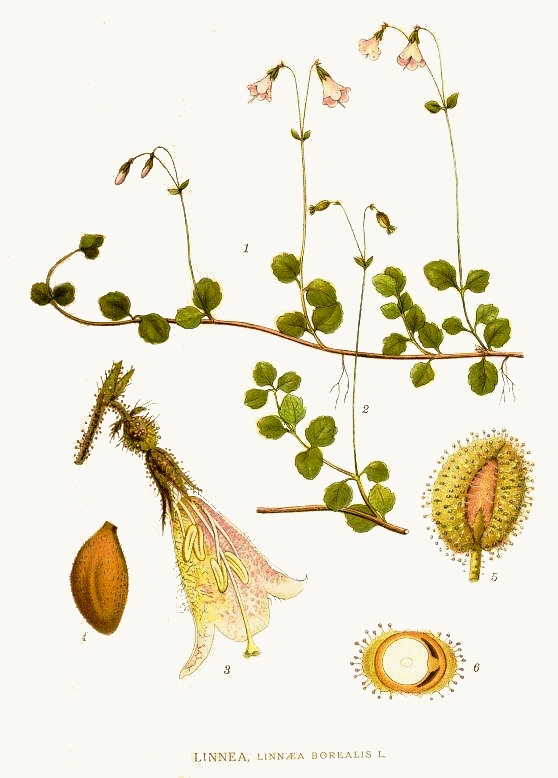
Old illustration of Linnaea borealis showing floral parts. Attribution: Carl Axel Magnus Lindman, Public domain, via Wikimedia Commons. Notes: flowers are seen between June and August. The leaves are in pairs. The mode of extension is to form a patch using the sometimes-branching woody stolons from which flower-stalks sprout. The leaves are evergreen.
Linnaea borealis was first described and named by the ‘father of modern taxonomy’ Carl Linnaeus in his most celebrated work Species Plantarum in 1753. He found it on a journey to Lapland in 1732, but then he called it Campanula serpyllifolia. However, his friend Jan Frederik Gronovious renamed it Linnaea borealis in honour of Linnaeus. When Linnaeus wrote the full description in 1753 he decided to use the name Linnaea borealis telling people that this was his favourite plant. He used it on his coat-of-arms.

Linnaea flowering among cowberry, Saaremaa, Estonia, portrait. Image: Chris Jeffree
In Britain, it was not discovered until 1795 by James Beattie of Aberdeen, who had been collecting plants “in an old fir wood at Mearns near Aberdeen”.
The flowers, almost always appearing as ‘twins’ at the top of a slender stalk, do have a delicate and simple charm, and unsurprisingly their image has appeared on postage stamps in Sweden and Finland as well as in decorative artwork including tableware and jewellery. It is the provincial flower of Småland in southern Sweden where Linnaeus was born; closer to home it is the county flower of Inverness-shire.

This seems to be Linnaeas’s own drawing, coloured in later. Attribution: Carl von Linné. 1745. From“Flora Svecica-Linnaea Borealis.” Special Collections,USDA National Agricultural Library. Accessed October 21, 2024, https://www.nal.usda.gov/exhibits/speccoll/items/show/1042.
The species is scarce in the UK, but can be found in the Cairngorm mountains and parts of north-east Scotland, usually associated with pine forests, both native and planted. The rediscovery of Twinflower in Easter Ross in 2007 after an absence of many years, and its subsequent appearance at several sites, is reported in Brian Ballinger’s Lost and Found article in the newsletter of the BSS (Ballinger 2017).
There are a few records from England. Throughout Britain the species has suffered from habitat fragmentation associated with ‘sexual failure’. What does ‘sexual failure’ mean? Linnaea borealis has hermaphrodite flowers but is highly self-incompatible and so breeding failure is inevitable when pollinating insects forage only short distances, always visiting flowers belonging to the same clone. In this species, cross-pollination is definitely required for seed formation. Experimentally, breeding success has been obtained by using pollen from distant sources, although some conservationists are opposed to translocation of plants from different parts of the country.

.Linnaea flowering among cowberry, Saaremaa, Estona. Image: Chris Jeffree
Some translocation may have happened historically. David Welch suggested that populations of Linnaea borealis in pine plantations may be derived accidentally from native pine forest in the Highlands when seedlings were brought to the lowlands to create new plantations. He points out that in the hundred years from 1750 to 1850 many thousands of hectares of Scots Pine were planted in Aberdeenshire. However, in plantations the trees were set very close together, and as they grew they began to cast a dense shade, which Linnaea could not tolerate.

Distribution of Linnaea borealis in the British Isles (from BSBI/Maps) and the world (from GBIF).
Recently, the theme of sexual failure was taken up a research group from the University of Edinburgh. By extracting DNA from very many single leaves of Linnaea borealis they were able to map the distribution of clones. Their results confirm that populations from the Highlands are clonal and that compatible sources of pollen are far away (pollen dispersal distance is only about 30 metres). They call for a programme of ‘genetic rescue’ to save the species from local extinction, and so translocation of plant material seems necessary.
Can any species survive long-term without sexual reproduction? It is the means by which species evolve and adapt to new environmental challenges. Without sex, it is widely considered that any species is doomed. Yet there are many examples where vegetative reproduction seems to have been sufficient to ensure long-term survival. A recent paper from the Charles University in Prague (Mráz et al. 2024) describes the case of a rare species of daisy from the Carpathians in Romania called Andryala laevitomentosa. They conclude “The genets of A. laevitomentosa are amongst the oldest clones ever documented in angiosperms. The persistence of these clones in situ for tens of thousands of years suggests an exceptional ability of this species to adapt to major climatic oscillations throughout the Pleistocene and Holocene and challenge our perception of the extent of resilience in plants”.

Bowl by the Swedish Company Orrefors, purchased in Uppsala. Image: Chris Jeffree.
A recent paper has reviewed the “very sparse knowledge on twinflower”, with emphasis on possible medical uses (Thiem and Buk-Berg 2017). The authors highlight its use in traditional Nordic cures for shingles, rash, eczema, measles, hives, ringworm, scabies, water blisters, rheumatism and finger infections. They also mention its use by indigenous people of North America.
For those who want it in their rockery, the Royal Horticultural Society list a small handful of suppliers. Plants require moderate shade and a lime-free soil. They tolerate quite acidic soils.
References consulted
Ballinger B (2017) Lost and found – Linneae borealis (Twinflower) in Easter Ross. BSS News, 108, 27. This article can be found on our BSS website, it’s page 27 of this issue: https://botsoc.scot/wp-content/uploads/2023/10/bss-news-108.pdf.pdf and Brian Ballinger has reminded me of his earlier blog from 2021:https://botsocscot.wordpress.com/2021/03/28/plant-of-the-week-29th-march-2021-twinflower-linnaea-borealis/
Kohn, D., & Lusby, P. (2004). Translocation of twinflower (Linnaea borealis L.) in the Scottish Borders. Botanical Journal of Scotland, 56(1), 25–37. https://doi.org/10.1080/03746600408685065
Thiem B and Buk-Berge E (2017) Twinflower (Linnaea borealis L.)–plant species of potential medicinal properties. Herba Polonica 63.3, 56-64.
Welch D (2003) A reconsideration of the native status of Linnaea borealis L. (Caprifoliaceae) in lowland Scotland. Watsonia 24, 427–432.
Wiberg RAW (2016)The genetic consequences of long term habitat fragmentation on a selfincompatible clonal plant, Linnaea borealis L. Biological Conservation 201, 405-413. https://www.sciencedirect.com/science/article/pii/S0006320716302993
©John Grace