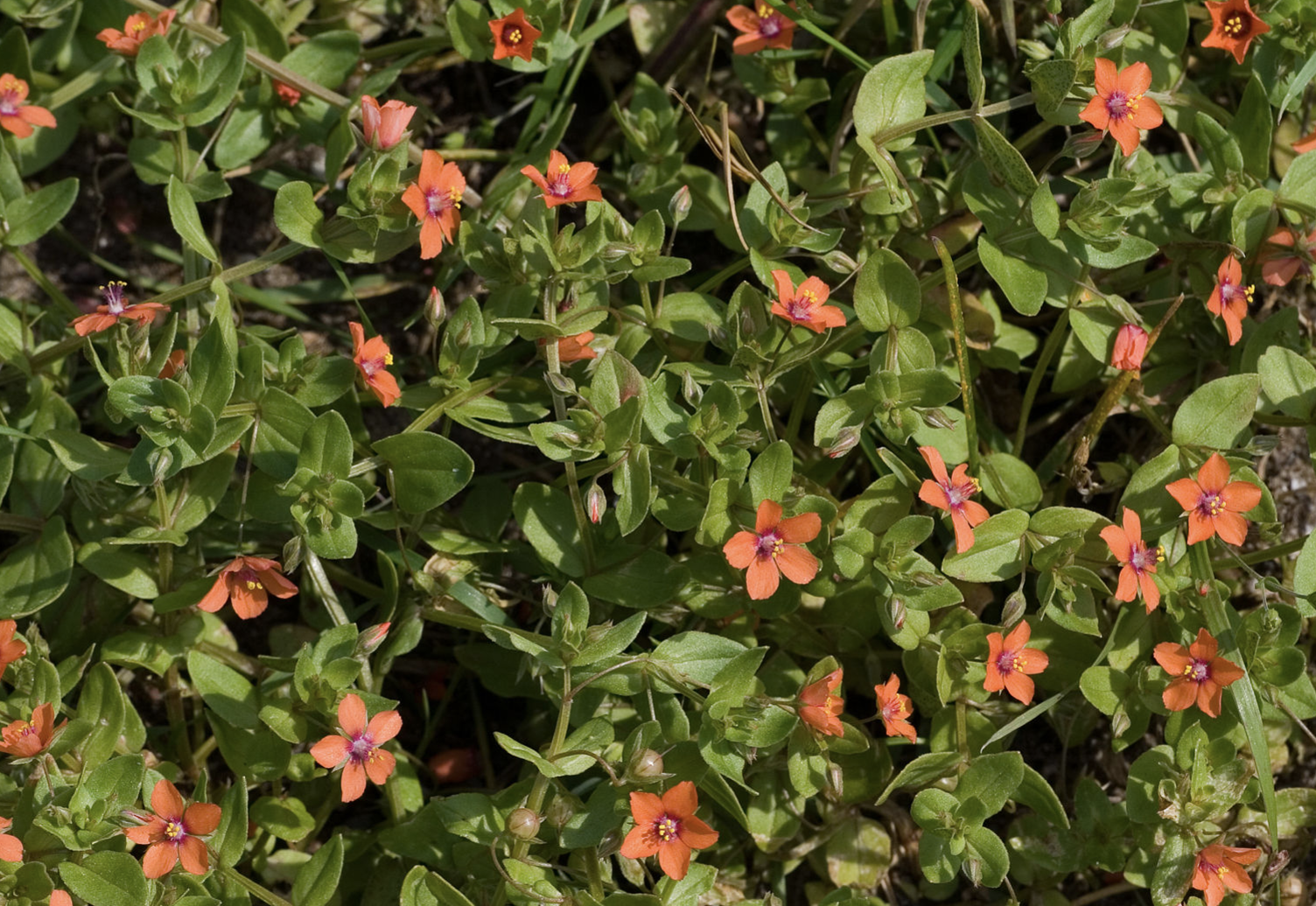
Lysimachia arvensis – December 9th 2024 – Scarlet Pimpernel
This pretty annual plant was known as the “poor man’s weather glass” because its flowers close when bad weather approaches. It is a European native, but it has spread to all parts of the world that have been colonised by Europeans, even some parts of the tropics.

Lysimachia arvensis, also known as Anagallis arvensis, by Johann Georg Sturm (Painter: Jacob Sturm), Public domain, via Wikimedia Commons
In Britain it was first described by William Turner in 1548. Turner is known as “the father of English botany” and Scarlet Pimpernel was one of the many species he described. He wrote: “It groweth commonly amonge the corne. The male hath a crimsin floure, & the female hath a blewe floure”. He was however wrong about the sex of crimson versus blue flowers, and unfortunately his mistake was copied by others (including John Gerard in his Herbal of 1597).
Scarlet Pimpernel was known by everyone as Anagallis arvensis until 2009, when it was moved to the genus Lysimachia alongside Creeping Jenny (L. nummularia) and Yellow Loosestrife (L. vulgaris).

Lysimachia arvensis, to show the sprawling growth form, with trailing stems . Image: Chris Jeffree
I was surprised to see Scarlet Pimpernel featured in a book called The World’s Worst Weeds. The American authors devote over six pages to it; evidently our pretty little flower is a weed of 22 crops in 39 countries. I had never thought of this rather humble plant as a serious weed. In gardens it is so easily plucked from the soil. Perhaps it is more of a challenge in a field of cereals, and perhaps the tendency to infest is stronger when abroad, away from natural enemies. In Britain it seems to have been less of a problem: Winifred Brenchley, in her book Weeds of Farm Land simply says “it is one of the more insignificant weeds which are fairly widespread but rarely occur in any quantity” (Brenchley 1920). Many weeds of agriculture were once common but since the large-scale introduction of herbicides (from the 1960s) they have become less frequent or even eliminated altogether. On allotments Lysimachia arvensis is often seen, as plot-holders are mostly plant-friendly, avoiding herbicides; many of these urban gardeners are charmed by the red flowers.

‘Lysimachia arvensis, showing the open flowers. Note the sepals. Image: Chris Jeffree.
The plant forms a trailing stem (up to 40 cm long), with flowers produced as singles in the axils of leaves. Long days are needed to trigger flower production. In British conditions flowers are produced from June to August and seed is formed from July to October. One plant produces less than 1000 seeds, fewer than for many arable weeds, and they become stored in the soil as a ‘seed bank’, requiring light for germination. Germination can occur at low temperatures, ensuring a ‘good start’ in the early spring. Cultivation may spread the seeds and it has been shown that seeds survive ingestion by birds. Bird dispersal may account for its appearance on walls, roadsides and derelict land.

Close-up of flowers (4-7 mm across). Image: Chris Jeffree.
Lysimachia arvensis contains several bioactive compounds and it has sometimes been blamed for the death of livestock. In humans, it may cause dermatitis when handled. However, as with many poisonous plants, it also has useful pharmacological properties (Saleem et al. 2023). The compounds mentioned in Saleem’s review are flavonoids, terpenoids, triterpenoid glycosides and phytosterols. The disorders for which it has been used are wounds, lung problems, kidney stones, urinary tract infections, gout and rheumatic conditions. From Saleem I learn that, in Asia, a slurry of leaf material is used for removing the leeches from cattle’s nostrils; in Nepal it has been used to kill (catch?) fish.

Blue form of Lysimachia arvensis. Image: Chris Jeffree.
The flower colour is generally crimson, but blue flowers are also seen (more commonly near the Mediterranean, Grime et al. 1988). Rarely, flowers may be pink, salmon or lilac. Blue-flowered plants may be a form of L. arvensis or a completely different species – the much rarer Blue Pimpernel called L. foemina (Manns and Anderberg 2007). Early botanists like Turner and Gerard were quite wrong in thinking the reds were male and the blues were female. I haven’t been able to track down the eagle-eyed botanist who proved that both reds and blues are hermaphrodite.

Lysimachia arvensis distribution in (left) Britain and Ireland from BSBI/Maps and (right) the world from Plants of the World Online where the native range is shown as green.
The difference between the two species is illustrated in Stace (2019). A powerful hand lens or a microscope is needed to count the number of cells in the sparse glandular hairs at the edge of petals. In former times, these two species were considered as subspecies but now they are separated.
Scarlet Pimpernel is also a book by the Hungarian-born English woman Baroness Orczy published in 1905, and later made into a film. The book is a historical novel set in the period of the French Revolution when nobility were being sent to the guillotine. Many were rescued by a young English gentleman of unparalleled daring and a master of disguise who risked his life to save aristocrats by transporting them to the safety of England. He was called Scarlet Pimpernel because he always left an imprint of that flower to annoy those who sought him:
“They seek him here, they seek him there
Those Frenchies seek him everywhere
Is he in heaven or is he in hell?
That demned elusive Pimpernel”

There are many editions of the book. This one from Signet Classics (an imprint of Penguin Books) has arather accurate artwork. The text is copied from my Kindle.
Attribution for top picture: I, Svdmolen, CC BY-SA 3.0 via Wikimedia Commons
References Consulted
Brenchley WE (1920) Weeds of Farm Land. Longmans, London and New York.
Grime JP et al. (1988) Comparative Plant Ecology. Unwin, London.
Holm LG et al. 1991 The World’s Worst Weeds. Kreiger, Florida.
Manns U and Anderberg AA (2007) Relationships of Anagallis foemina and A. arvensis (Myrsinaceae): New insights inferred from DNA sequence data. Molecular Phylogenetics and Evolution 45, 971-980.
Manns U and Anderberg AA (2009) New combinations and names in Lysimachia (Myrsinaceae) for species of Anagallis, Pelletiera and Trientalis. Willdenowia 39, 49-54. https://doi.org/10.3372/wi.39.39103
Saleem H et al (2023) A comprehensive review on the botany, traditional uses, phytochemistry, pharmacology and toxicity of Anagallis arvensis (L).: A wild edible medicinal food plant. Food Bioscience 52, 102328.
https://www.sciencedirect.com/science/article/pii/S2212429222007878
Stace CA (2019) New Flora of the British Isles. C&A Floristics.
©John Grace