Vaccinium oxycoccos – December 16th 2024 – Cranberry
Every Christmas we buy cranberries to make the much-loved cranberry sauce. I have always wondered where these berries come from, as they are bigger than the cranberries we know in Britain. Ours are found on diminutive trailing plants in Sphagnum bogs. Harvesting such small berries in their difficult terrain would be troublesome and expensive. So this year I decided to find out more about cranberries.

Single flower of Vaccinium oxycoccos. Size: petals about 6 mm, stamens about 5 mm, flower stalks 13-30 mm. Image: Chris Jeffree.
Our native cranberry, Vaccinium oxycoccos, is a dwarf, creeping evergreen shrub with overwintering red berries 6-8 mm. The first known account appears in Gerard’s 1597 Herbal, under the entry ’Marsh Whortleberry or Fen-Berry’. Later, the species was fully described and named by Linnaeus (1735). It grows in lowland bogs and wet heaths, but these habitats have often been drained for agriculture or harvested for peat and so the species has declined in Britain. In the world as a whole V. oxycoccos thrives as a native plant in many northern regions, with a circumpolar distribution mostly between latitudes 45 and 65 degrees north.

V. oxycoccos in flower.Image: Chris Jeffree.
The berries we use to make cranberry sauce come from Vaccinium macrocarpon, a closely-related species native to Canada and USA (‘American Cranberry’). The supermarket cranberries I’ve just bought measure 18-21 mm, over twice the size of the berries of our own V. oxycoccos. The cranberry of commerce has been produced from repeated selections of wild plants, the first parent plants being taken from wetlands in Harwich, Massachusetts around 1852. Commercial planting was established soon after. Somewhat ironically, the American Cranberry was first properly described by a botanist from Hamilton in Scotland, William Ailton, in the book Hortus Kewensis, dated 1789. Evidently, Vaccinium macrocarpon was one of the many plants being cultivated by the horticulturalists of Kew Gardens. Of course, the plant had been known much earlier by Indigenous Americans who used cranberries for food and dye; there are records of them gifting cranberries to the early colonists who, in turn, are said to have sent some home as gifts.

V. oxycoccos fruiting, in its native habitat on peatland with Sphagnum and sundews. Image: Chris Jeffree.
Vaccinium is a genus within the Family Ericaceae, and as every gardener knows almost all ericaceous species thrive on acid, nutrient poor soils. The most often-seen members of Vaccinium in Britain all natives:
Vaccinium myrtillis (Bilberry, very common),
Vaccinium vitis-idaea (Cowberry or Lingonberry, very common),
Vaccinium uliginosum (Bog Bilberry, rather uncommon)
Vaccinium microcarpon (Small Cranberry, frequently recorded in the north of Scotland)
Vaccinium oxycoccos (Cranberry, uncommon in the north, see map below)
Within the Vaccinium genus it seems likely that V. oxycoccos has the most extreme tolerance of acidity, low nutrients, and wetness. All these ericaceous species owe their success to a type of symbiotic relationship with various Ascomycete fungi which enhances the uptake of nitrogen, phosphorus and other minerals via an extensive weft of hyphae that penetrates the roots and forms coils within the cells. This ‘ericoid mycorrhiza’ is a completely different structure from the mycorrhizas in other groups of plants.
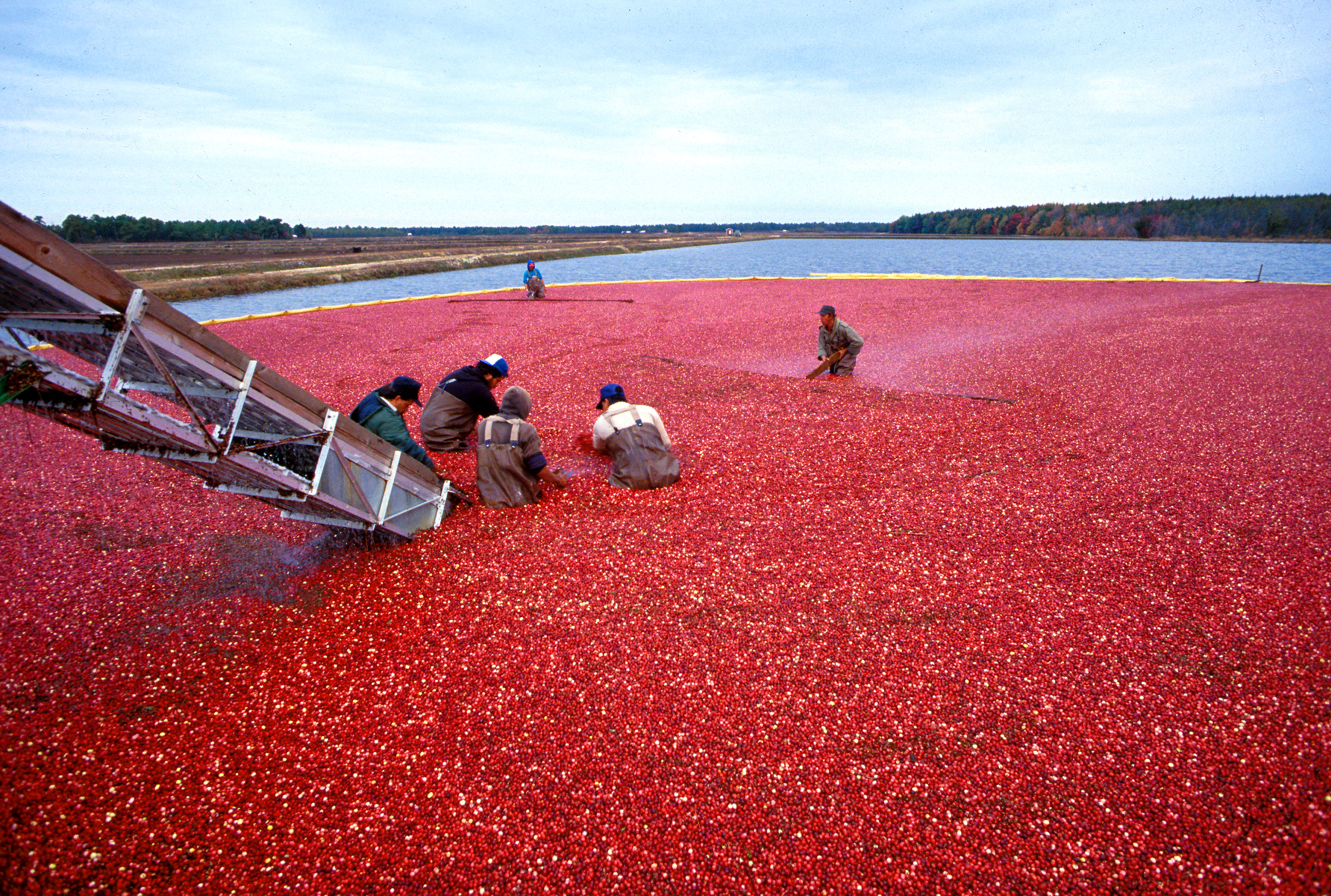
Harvesting Vaccinium macrocarpon. Image: Keith Weller, USDA-ARS, Public domain, via Wikimedia Commons
Most of the commercial cranberry crop is grown in USA and Canada (some in Chile). Top-soil is cleared away and used to make a dyke around the field. Then a 10-20 cm layer of sand is added. The bed is accurately levelled (using a laser beam) and irrigated to make a uniformly moist substrate for planting. Pieces of cranberry ‘vine’ from an established crop are put down, kept in place with special disks, and left to form roots, then shoots and eventually flowers. Dressings of nitrogen fertilizer are added during establishment. Flowering occurs from June to August. For reliable fruiting, cross-pollination is required and nowadays farmers must bring in beehives to ensure good pollination. For harvesting the crop, an unusual process called wet-picking’ is generally employed, as shown in this 10-minutes You Tube movie. Wet-picking entails flooding the crop, before lightweight machinery looking like an early combine harvester plucks the fruit from the vine. The floating berries can be sucked up.

British distribution of Vaccinium oxycoccos (left) and V. macrocarpon (right). Data from BSBI/Maps
World production of cranberries in 2022 was 582,924 tonnes. Supply now exceeds demand, partly due to the trade war between USA and China. The cost of my 250g punnet of cranberries was a mere £2. Good value, I say.

Global distribution of Vaccinium oxycoccos (left) and V. macrocarpon (right). The native distribution of V. macrocarpon is in North America but it is sometimes recorded as a casual (alien) in Europe.
Cranberries are rich in vitamin C and various medicinal compounds (see Nemzer et al 2022) and the fruits are often hailed as a ‘superfood’ whether fresh or in sauce or juice. In recent years they have attracted the attention of dental researchers (benefits to dental health have been claimed).

Flowers of the American Cranberry V. macrocarpon are very similar to our native V. oxycoccos. It is thought to have entered Europe in bird seed. Image: aarongunnar, CC BY 4.0 https://creativecommons.org/licenses/by/4.0, via Wikimedia Commons
The name ‘cranberry’ is said to have been given by German and Dutch colonists of New England who thought the flower resembled the neck, head and bill of a crane.

Finally, enjoy your cranberries (Vaccinium macrocarpon) this Christmas. They’ve come all the way from the USA – they’ve been plucked, flooded, washed, packaged, transported across the Atlantic, sold to the supermarket and then sold to you at a price that seems cheap in relation to the effort of bringing them to market.
References Consulted
Broussard M et al (2011). Native Bees, Honeybees, and Pollination in Oregon Cranberries. HortScience horts, 46, 885-888. https://doi.org/10.21273/HORTSCI.46.6.885
Nemzer BV et al (2022) Cranberry: Chemical Composition, Antioxidant Activity and Impact on Human Health: Overview. Molecules 27, 1503. https://doi.org/10.3390/molecules27051503
Read DJ. 1983. The biology of mycorrhiza in the Ericales. Canadian Journal of Botany 61: 985–1004
Vorsa N and Zalapa J (2019) Domestication, genetics, and genomics of the American cranberry. Plant breeding reviews 43, 279-315.
© John Grace