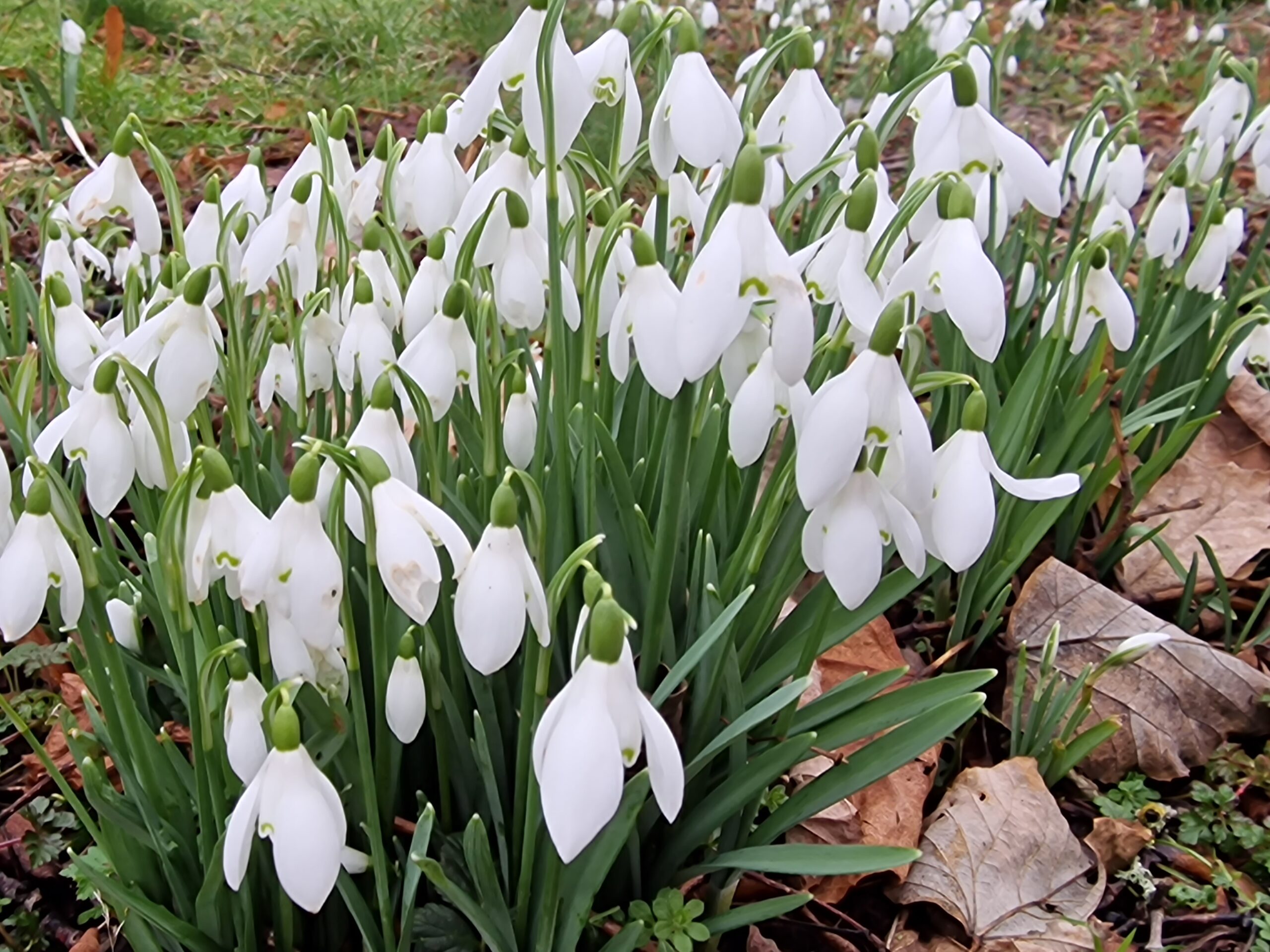
Galanthus nivalis – February 17th 2025 – Snowdrop
This week I’ve been seeing Snowdrops everywhere in people’s gardens. They are always a delight, bringing joy when the weather is joyless and evoking much-needed hope of spring.

Snowdrops in full flower at Ormiston, East Lothian. The clumps are formed from repeated divisions of the bulb. Photo: Chris Jeffree.
Most people imagine snowdrops to be native here, but they are not. The snowdrop genus has its headquarters in Eastern Europe and the Middle East, and there are at least 20 species (see the map below). The common wild one we have in Britain, Galanthus nivalis, occupies a large area of Europe, extending to France but its native range stops abruptly at the English Channel. It has a simple beauty and purity, hence its appeal. It is thought to have been introduced into Britain by monks, as many of the wild populations are near monasteries (Coats 1968). In Gerard’s 1597 Herbal it is called the ‘timely flowering bulbus violet’ but in the 1663 edition we read “some call them snowe droppes”. Linnaeus named the plant Galanthus nivalis in 1753. William Wordsworth wrote a sonnet about the snowdrop somewhat later, 1819 (not one of his best works I reckon, but you can judge for yourself by clicking here).
Of course, many other species, subspecies, hybrids and varieties of Galanthus are known in horticulture and some of them are naturalised. Double flowered types are readily available and so in future we may expect to see more of them in the wild. Mick Crawley has helpfully written a key that includes horticultural variants:
https://bsbi.org/wp-content/uploads/dlm_uploads/Snowdrop_identification.pdf.

Two varieties of G. nivalis. On the left, ‘Magnet’ (close to the wild type), on the right ‘Flore pleno’ (a ‘double’ with many extra tepals). Photos: Chris Jeffree.
The precise status G. nivalis in British Isles is not clear. Do all snowdrops in these Islands originate from planting bulbs, or are some of them derived from seed (dispersed by ants, I’ve heard)? Most reproduction is certainly by division of the bulbs to form clumps, but flowers are attractive to pollinators in warm weather and seeds are sometimes formed. Many of the finest stands of snowdrop are in the woodlands of large estates and there are a long continuous records of some of the most remarkable displays (those at Arniston Woods near Gorebridge have been there for at least 200 years; other fine displays are at monasteries). In these cases, gardeners and monks presumably planted a few bulbs a long time ago. I haven’t been able to find mention of snowdrops forming part of the ground flora in published accounts of native woodlands, and my best guess is that the great majority of snowdrops are not from seeds but from planted bulbs.
New snowdrop species are still being discovered in Eurasia, and the rarer ones may be threatened by collecting and land-use change. Galanthus is listed in Appendix II of CITES, making it illegal to export wild-collected specimens.
Galanthus belongs to the family Amaryllidaceae, which contains many species known for their fine flowers, including Amaryllis, Agapanthus and Narcissus, as well as Allium. Galanthus has highly distinctive flowers, with two whorls of three tepals, and like most of its family, the plant spends a considerable part of the year as a subterranean bulb.

Snowdrop flower exposed to show the floral structure. Note the central style and the conspicuous orange anthers. The green stripes on the tepals may have a role in attracting pollinators as well as providing additional photosynthesis. The nectaries are at the base of the style (ovary inferior). Photo: Chris Jeffree.
Snowdrops burst into flower in the coldest part of the year – an extraordinary feat made possible by cold-adapted enzymes. This cannot be the whole explanation, as mitosis is highly temperature sensitive and is severely reduced by freezing conditions. It turns out that many spring-flowering bulbs (‘geophytes’) have large genomes and Galanthus is no exception (Zonneveld et al. 2003). Philip Grime and colleagues at Sheffield University (Grime and Mowforth 1982) developed the idea that genome size has ecological and evolutionary implications, and speculated that geophytes are able to develop much of their foliage and floral parts within the bulb in the previous year. When the spring comes, the cells are merely inflated with water – no mitosis needed. A fuller account of the implications of genome size is given by Dodsworth et al. (2015) and can be accessed here: https://doi.org/10.1016/j.gde.2015.10.006

Native ranges of 20 Galanthus species. Image: Nalagtus – own work underlaying map was created using QGIS Development Team, 2013. QGIS Geographic Information System. Open Source Geospatial Foundation Project. http://www.qgis.org/ References: Aaron P. Davis: The Genus Galanthus. A Botanical Magazine Monograph. Royal Botanical Gardens, Kew 1999, ISBN 0-88192-431-8.
Not surprisingly, G. nivalis has been a favourite of phenological recorders, with reports going back many years (see Sparks & Carey 1995, Fitter et al. 1995, Sparks, Jeffree and Jeffree 2000). One imagines that a certain threshold of temperature stimulates the onset of growth, but my brief reading of this work suggests a more complicated story (correlations between flowering date and temperature for snowdrop are weak, unlike the flowering of many temperate species and the leaf-out of most trees).

They favour damp habitats. This image from Dawyck, Peebleshire. Image: Chris Jeffree.
Research on Galanthus is often focussed on the phylogeny of the genus, but there are equally many papers on the identification and extraction of biologically active compounds. Lectin from snowdrop is an insecticide used to control beetles and other bugs, and in the future snowdrop genes might be incorporated into genetically-engineered crops to reduce insect damage. The alkaloid galanthamine derived from Galanthus is approved in the USA and other countries as a treatment for dementia and Alzheimer’s disease. Don’t forget they are poisonous plants.
I was intrigued to discover a well-cited paper from China reporting an antiviral effect of compounds from G. nivalis on feline coronavirus (Hsieh et al. 2010).
For more snowdrop data, please go to http://ecoflora.org.uk/search_species2.php?plant_no=1850040010
References
Coats AM (1968) Flowers and their histories. Black, London.
Dodsworth S, Leitch AR and Leitch JL (2015) Genome size diversity in Angiosperms and its influence on gene space. Current Opinion in Genetics and Development 35, 73-78.
Fitter AH, Fitter RSR, Harris ITB, Williamson MH (1995) Relationships between first flowering date and temperature in the flora of a locality in central England. Functional Ecology 9, 55–60.
Grime JP and Mowforth MA (1982) Variation in genome size – an ecological interpretation. Nature 299, 151-153.
Hsieh LE et al. (2010) Synergistic antiviral effect of Galanthus nivalis agglutinin and nelfinavir against feline coronavirus. Antiviral Research 88, 25-30. 10.1016/j.antiviral.2010.06.010
Sparks TH, Carey PD (1995) The responses of species to climate over two centuries: An analysis of the Marsham phenological record, 1736–1947. Journal of Ecology 83, 321–329.
Sparks TH, Jeffree EP, Jeffree CE (2000) An examination of the relationship between flowering times and temperature at the national scale using long-term phenological records from the UK. International Journal of Biometeorology. 44 (2): 82–87. doi:10.1007/s004840000049
Zonneveld BJM, Grimshaw JM and Davis AP (2003) The systematic value of nuclear DNA content in Galanthus. Plant Systematics and Evolution 241, 89–102. DOI 10.1007/s00606-003-0016-z
©John Grace