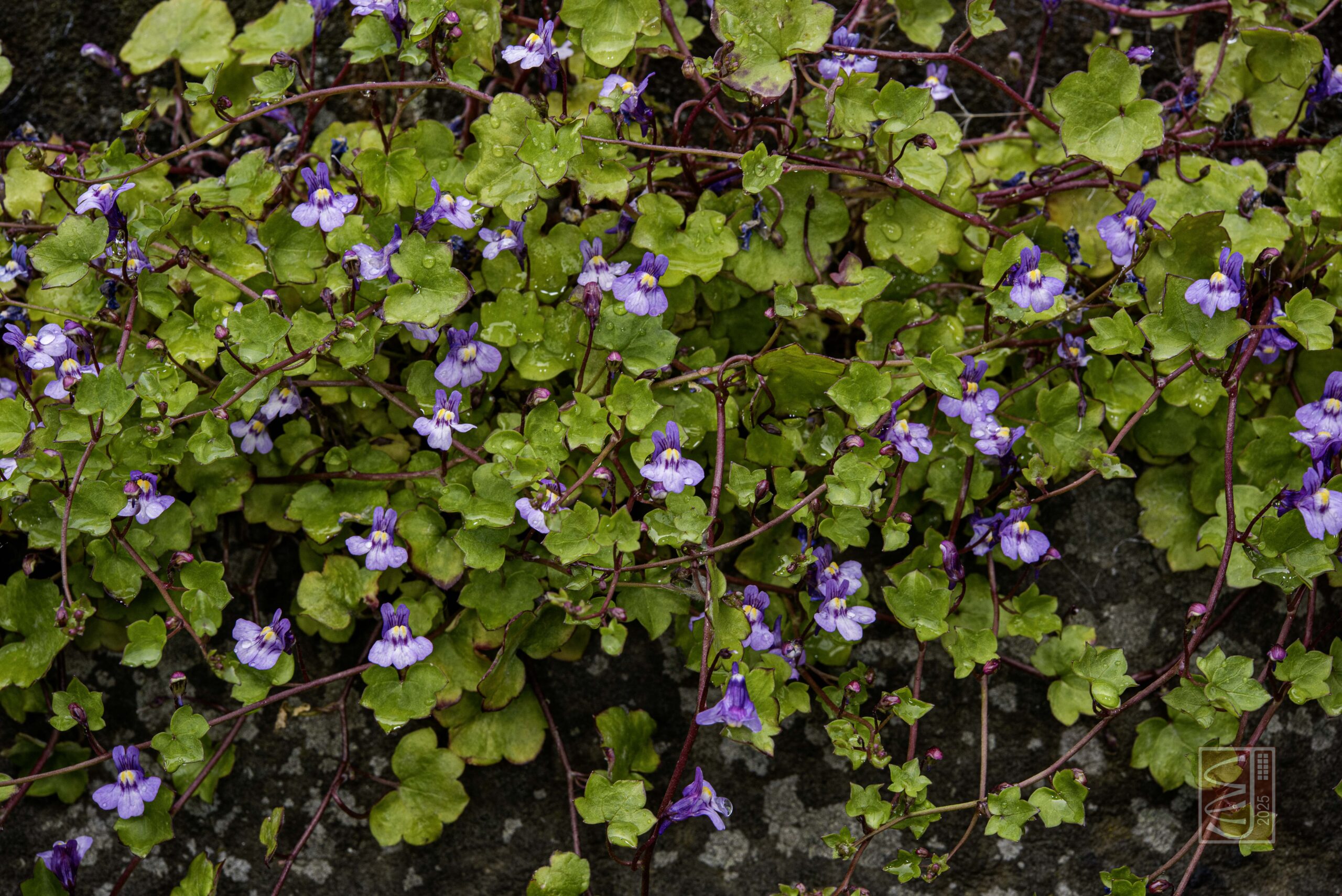
Cymbalaria muralis – February 24th 2025 – Ivy-leaved toadflax
This little plant comes from the Mediterranean region, but somehow it has migrated to much of the temperate world including North America and Australasia. It was once called Oxford Weed as people thought it had escaped (in 1648) from the Oxford Botanic Garden. However, it had been recorded earlier (1640) by none other than John Parkinson, the botanist to King Charles I. He reports its occurrence “upon the thatched houses in North parts”. (Did he mean northern Britain or north London, we don’t know). Perhaps it came with stonework brought from Italy.

The bright yellow markings at the centre of the flower guides small bees and hover-flies to sip from the the spur-like nectaries at the rear of the flower. Image: Chris Jeffree.
The plant took some time to reach Scotland: the first record was by Thomas Hopkirk in 1813-“at Bothwell Castle on the Clyde”. It may have been brought by gardeners, keen to have it in their rockeries. It spread rapidly as recounted by Watt (1929). His short but very informative paper is conveniently archived by the BSBI; you may download it here.

Rooted in the mortar of a wall, stems trailing and a mass of flowers, Musselburgh. Image: Chris Jeffree.
The flower looks like a miniature Antirrhinum (snapdragon) and so Linnaeus named the plant Antirrhinum cymbalaria in his great work of 1753, Species Plantarum. The name cymbalaria may come from the faint resemblance of the leaves to cymbals. But in 1768 it was renamed Linaria cymbalaria as it also looks like members of the toadflax genus Linaria. Finally, in the year 1800, taxonomists made up their minds and it became Cymbalaria muralis. As these three genera are closely related and in the family Plantaginaceae (the veronica and foxglove family) the historic changes are of little consequence. The common name ‘Ivy-leaved toadflax’ is apt; the shape of the leaves resemble those of ivy (although much smaller).

After fertilization the stems bend back and many seed heads will thus be ‘planted’ in crevices. Image: Chris Jeffree.
The plant grows on walls, just as its species name muralis suggests. Old walls with crevices are preferred, especially on ruined castles and ancient bridges. It inhabits the walls of cities throughout Europe. Its liking for walls is explained by a curious reproductive behaviour. When it flowers, it adjusts the flower stalks so that the flowers face outwards, warming in the sun and attracting pollinators (often small bees). But after fertilization the stalks re-align and face the wall, thus poking the precious cargo of seeds into cracks where debris and blown silt form a suitable germination bed. The roots are fibrous, adapted to finding resources in the narrowest fissures – they do not become swollen and woody like ivy and the butterfly plant Buddleja and so they will not destroy the wall.

Cymbalaria muralis (left) often occurs with the Fairy Foxglove Erinus alpinus (right), pictured here in a cemetery, Irvine. Image: Chris Jeffree.
In the distant past, before there were such things as walls to grow on, back in its native range of the southern Alps and Italy, this plant would have grown on rubble and scree. We may explore the expansion of its range through the Global Biodiversity Information Facility (GBIF). The maps below show how its spread from Europe to the rest of the world more-or-less follows the pattern of European colonisation. I was especially interested in its early appearance in Tasmania which was settled by Europeans in 1803. Cultivation of apples and pears for the lucrative European market was mostly on large estates. The labour force consisted of convicts from England, and the estate owners became wealthy and interested in gardening. They would have brought their much-loved flowering plants from home.

The spread of Cymbalaria muralis. Note the single Australasian record in 1898 was from Tasmania. Image compiled from GBIF.
Cymbalaria muralis is especially adapted to urban habitats. A group of researchers in France collected seed of four species from urban and rural landscapes, and grew them in urban and rural locations, observing flowering and pollination. Cymbalaria muralis plants grown from seeds collected in urban ‘natural populations’ received more pollinator visits and tended to produce more flowers than plants grown from rural populations. The authors do not speculate on possible reasons, but one suggestion is that there has been a stronger selection pressure for vigour in the urban setting and thus an urban ecotype has evolved. This deserves further investigation.

A much rarer species, Cymbalaria pallida (Italian toadflax) recorded in locations from Birmingham to Edinburgh/Glasgow. Image: Chris Jeffree.
We also know that Cymbalaria muralis is warmth-loving and so may benefit from the Urban Heat Island. Fitter and Fitter (2002) compared flowering dates of 385 British plant species growing in south-central England, recorded from 1954 to 1990 and again 1991-2000. Most of them flowered earlier in the more recent (warmer) decade but one of the most striking results was that of Cymbalaria muralis, where the flowering advanced by over a month from 15th April to 17th March.
References consulted
Desaegher, J., Nadot, S., Dajoz, I., & Colas, B. (2017). Buzz in Paris: flower production and plant–pollinator interactions in plants from contrasted urban and rural origins. Genetica, 145, 513-523.
Fitter AH and Fitter RSR 2002. Rapid changes in flowering time in British plants. Science 296: 1689-1691.
Hruška, K. (1987). Syntaxonomical study of Italian wall vegetation. Vegetatio, 73, 13-20.
Lewandowski, D., Robain, H., Clergeau, P., & Le Roy, R. (2023). Bioreceptivity of living walls: Interactions between building materials and substrates, and effect on plant growth. Urban Forestry & Urban Greening, 83, 127912.
Lubelli, B., Moerman, J., Esposito, R., & Mulder, K. (2021). Influence of brick and mortar properties on bioreceptivity of masonry–Results from experimental research. Construction and Building Materials, 266, 121036.
Pearson, M. (2017). A survey of the flowering plants found on drystone walls in the Yorkshire Dales. The Naturalist, 142(1096), 191.
Shimwell, D. W. (2009). Studies in the floristic diversity of Durham walls, 1959-2008. Watsonia, 27(4), 323.
Watt, H. B. (1929, January). Notes on the Introduction and Distribution of the Ivy-leaved Toad-Flax (Linaria cymbalaria Mill.) in Scotland. In Transactions of the Botanical Society of Edinburgh (Vol. 30, No. 2, pp. 123-126). Taylor & Francis Group. https://archive.bsbi.org.uk/Proc2p123.pdf
©John Grace