Reseda luteola – April 28th 2025 – Weld
Weld was traditionally used as a source of yellow dye, perhaps as early as neolithic times. In Ancient Rome it was reputedly used to colour the robes of the Vestal Virgins and priestesses. In medieval England, the dyers in the town of Lincoln made the colour ‘Lincoln Green’, featured in the stories of Robin Hood and his Merry Men (13th/14th century). They first dyed their fabrics with woad (Isatis tinctoria) to create blue, then over-dyed their blue wool with Yellow Weld to make green. Weld was widely used in 18th Century France, as proved from the recipes of Master Dyers Antoine Janot and Paul Gout (Santo et al. 2023). However, in the 19th Century, it was discovered that dyes can be isolated from coal tar, and later they were synthesised relatively cheaply from petrochemicals.
An alternative name for Weld is Dyers’ Rocket, reflecting its widespread use for colouring textiles.

Reseda luteola in full flower, Inveresk (East Lothian). The long slender flowering spikes are up to 1.5 metres tall. Image: Chris Jeffree.
The dye is a flavonoid, luteolin, a yellow crystalline substance found in many plant species, also known to have health benefits. Preclinical studies have shown that this flavone possesses a variety of pharmacological activities, including antioxidant, anti-inflammatory, antimicrobial and anticancer. Pills are widely available on Amazon.com.
Is the plant making a ‘come-back’? Perhaps it is, as the modern textile dye industry produces harmful effluents, and luteolin from R. luteola represents an ecologically ‘friendly’ option. Moreover, some synthetic dyes produce skin irritation but the more natural luteolin is said to be safer, especially for infants. The plant is also widely grown for the flower- garden, valued for its striking spire-like appearance and as a source of nectar and pollen for insects.

Young plant of R. luteola. Note the strap-like glabrous leaves, 5-8 cm long. Image: Chris Jeffree.
Trials to determine commercial possibilities were made in Italy (Angelini et al. 2003). Under cultivation Weld can be grown as an annual crop although in the wild it normally takes two years to complete its life cycle. Its leaves and flowers yielded about 2 per cent of pure luteolin. The process of growing, extracting and dyeing at home is nicely shown in this movie. At the end of the movie, we are told how to obtain another colour (greenish-yellow) by adding copper sulphate. If you are really interested in dyeing, then you might like to find out how to increase colour-fastness using various salts (Safapour et al. 2023).

R. luteola, detail of flowering spike. Image: Chris Jeffree.
Weld was formerly grown commercially in France and Italy and much of it was exported. It seems to have been an important commodity in Renaissance agriculture and commerce during the 15th and 16th Centuries.
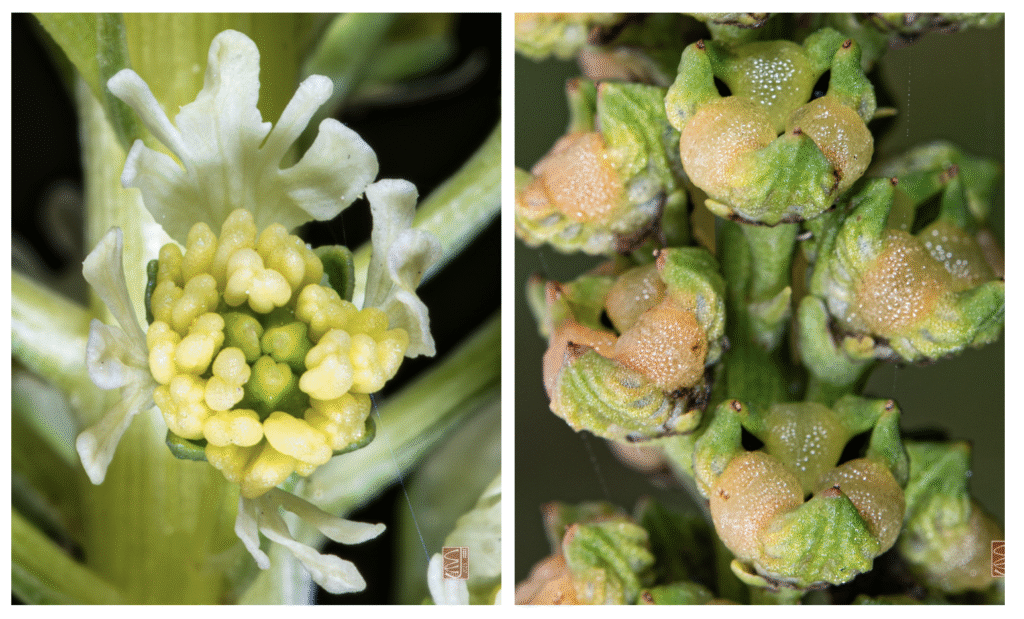
R.luteola flower (left) and fruits (right). The flowers are bilaterally symmetrical, with 4 petals, pollinated by small bees and also self-pollinated. The fruit is a capsule with 3 lobes and the seeds are 0.8-1.0 mm, brown and shiny. Images: Chris Jeffree.
The plant belongs to the Resedaceae, a rather small family with only 107 known species world-wide. Weld is generally considered to be a native plant, although there may have been intentional and accidental introductions from other parts of Europe. It grows in open conditions, forming a rosette of hairless crinkled leaves, and then a stiff spire, bearing many small yellow flowers, up to 1.5 metres tall. It is moderately drought tolerant. Its seeds are known to be dispersed by ants and birds. The distribution in Britain is predominantly lowland and southern, and its preferred habitats according to the BSBI Atlas 2020 are:
“…neutral or base-rich soils on roadsides, waste ground and marginal land, in brick yards, gravel-pits and urban demolition sites, and, less commonly, arable or grassy areas”.

The related species, Reseda lutea (Wild Mignonette. Note the difference in the two species: in R. lutea the spikes are not as tall as R. luteola and they are broader. The leaves of R. lutea are lobed or divided, quite different from the simple leaves of R. luteola. Images: Chris Jeffree.
In our Urban Flora of Scotland project (2015-2024) we have found Weld on 102 occasions in widely dispersed locations, including the Edinburgh tramline, Arthurs Seat, Tweedbank and Bo’ness.
There is a closely related species, Reseda lutea, the Wild Mignonette. It is found in rather similar habitats to those of R. luteola, but it is more bushy and its leaves are quite different : they are pinnately lobed. The Wild Mignonette has also been used for its yellow dye, but not as often as Weld.
Reseda luteola has found its way across the world, to North America and the Southern Hemisphere. In the state of Victoria, Australia it is considered to be ‘a noxious weed’.


Top: British and Irish distribution, from the BSBI; Bottom: global distribution, from GBIF.
References consulted
Angelini LG, Bertoli A, Rolandelli S & Pistelli, L (2003). Agronomic potential of Reseda luteola L. as new crop for natural dyes in textiles production. Industrial crops and products, 17(3), 199-207.
Bosi G, Rinaldi R, & Mazzanti M B (2011). Flax and weld: archaeobotanical records from Mutina (Emilia Romagna, Northern Italy), dated to the Imperial Age, first half 1st century AD. Vegetation history and archaeobotany, 20, 543-548.
Imani H, Gharanjig, K. & Saadati, SHS (2024). A cost-effective, efficient, and environmentally-safe method for deep shade dyeing of wool with extracted dye from Reseda luteola L.: Laboratory and industrial scales. Sustainable Chemistry and Pharmacy, 40, 101636.
Pereira L, Mondal PK and Alves M (2015). Aromatic amines sources, environmental impact and remediation. Pollutants in buildings, water and living organisms, pp.297-346. In: Lichtfouse, E et al. (eds) Pollutants in Buildings, Water and Living Organisms. Environmental Chemistry for a Sustainable World, vol 7. Springer, Cham. https://doi.org/10.1007/978-3-319-19276-5_7
Safapour S, Mazhar M, and Abedinpour S. (2023) Color shade extension of Reseda luteola L. natural colorant on wool textiles via binary combination of metal salts: colorimetric and fastness studies. Fibers and Polymers 24, 3221-3233.
Santo M, Cardon D, Teixeira, N and Nabais P (2023) Yellow Dyes of Historical Importance: A Handful of Weld Yellows from the 18th-Century Recipe Books of French Master Dyers Antoine Janot and Paul Gout.” Heritage 6, no. 12 (2023): 7466-7481.
Attribution of image at the top of the page: AnRo0002, CC0, via Wikimedia Commons.
©John Grace