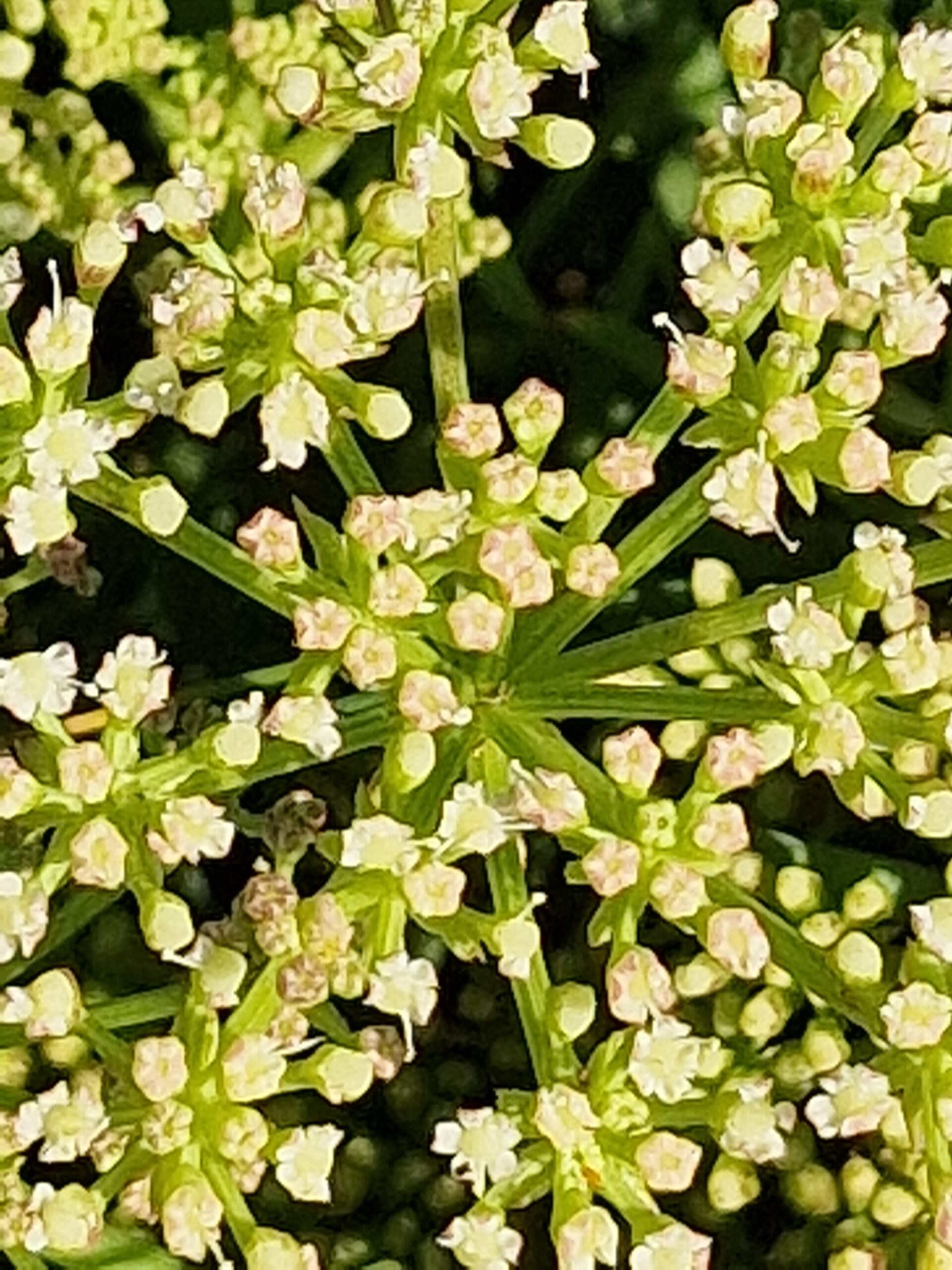
Crithmum maritimum- August 25th 2025 – Rock Samphire
Last week I visited one of Scotland’s most southerly villages, The Isle of Whithorn, famous for its association with St Ninian, the early missionary from Rome who (allegedly) first brought Christianity to Scotland. The place is no longer an island although dominated by the sea and a rocky shore. I was excited to find Crithmum maritimum rooted in cracks on the rocks of the upper shoreline. I knew it from seaside trips to the south coast of England, but I can’t remember seeing it in Scotland. It does however occur on the west coast, and now has been recorded from the east, but it is never common in Scotland.

Crithmum maritimum at the Isle of Whithorn (Dumfries and Galloway), mid-August 2025. The habitat is typical of the species: plants rooted in a rock crevice just above the high-tide level. Image: John Grace.
This is an unusual and interesting member of the Parsnip and Hogweed Family, the Apiaceae. ‘Unusual’ because it has fleshy leaves and it is a highly salt-tolerant plant, unlike1 most other members of its Family. ‘Interesting’ because it is edible and currently being investigated as a possible crop plant for saline regions of the world. More of that later.

Crithmum maritimum at Bull Island, Dublin, showing the lanceolate leaves with a much-reduced surface area and the many umbels of flowers in various stages of development. Image: Chris Jeffree.
Many salt tolerant plants (‘halophytes’) have fleshy leaves like Crithmum. They are fleshy because the cells within the leaves have vacuoles (membrane-bound compartments) into which the otherwise-toxic salt (NaCl) is secreted, keeping Na+ and Cl– well away from biochemical pathways and photosystems where the too much salt would kill. Another reason for the fleshy appearance is too reduce the area of foliage exposed to salt spray. A familiar example of a fleshy halophyte is Salicornia europaea (marsh samphire, or glasswort) which we can usually buy from fishmongers to sprinkle on fish – it has a pleasantly fresh-salty flavour. There are several other halophytic modifications too which require more investigation for the case of C. maritimum (see the review of Flowers and Colmer 2008).

The effect of salt (NaCl) concentration on the yield of several species2 as reviewed by Flowers and Colmer (2008). The red circles show the data from the new study by Esetlili et al. (2024) for Crithmum maritimum. Sea water is typically 600-700 mM sodium chloride.
Esetlili et al (2024) grew Crithmum maritimum in nutrient solutions at a range of salt concentrations. Several researchers have done this with other species, and I’ve added Estelli’s data to theirs (see the Figure above). The salt concentrations are stated as mM (milli-molar); sea water is somewhere between 600 and 700 mM. We can see from the graph that C. maritimum is not the most salt-tolerant of all the species tested, but it grows perfectly well up to around 200 mM. For a few species, salt is needed to achieve the highest yields, but not in C. maritimum. This makes me think of the old gardeners who added a sprinkle of salt to their beetroot (a descendent of the wild Beta maritima, another seaside plant which is more common on the west coast than the east).

The umbels are made up of 8 – 36 rays and are 3-6 cm across. The tiny flowers are yellowish-green, sometimes with a pinkish tinge, and in this image they are in various stages of development. Image: Chris Jeffree.
Most halophytes are confined to the coast, with a few records inland from salt-contaminated ground including salt-mines and roadsides. It seems halophytes do not compete well with other species, as salt-tolerance has a ‘cost’ in terms of the energy required to build defences against salt, including all those vacuoles. Confirmation of this effect was obtained many years ago by a PhD researcher at the University of Lancaster (O.T. Okusanya). He set up a series of experiments growing various halophytes in mixed cultures with non-halophytes. When C. maritimum was grown with the ryegrass Lolium perenne under non-saline conditions the Lolium grew faster and overwhelmed the growth of Crithmum.

Crithmum maritimum in Manarolo, northern Italy, growing on a cliff ledge. The stems may be longer here than they are on Scotland’s more exposed west coast. Image: Chris Jeffree.
Okusanya also tested halophytes for frost tolerance by putting them in a deep-freeze cabinet. He showed that most (including Crithmum) did not tolerate freezing below -10 oC, The only one tolerating the most extreme cold treatment was Scots Lovage (Ligusticum scoticum). His rather simple experiments helped to explain why Crithmum and other halophytes are found more on the west coast of Britain (less frost) than the east. He also grew the plants outdoors on a latitudinal gradient at Lancaster, Port Logan (Dumfries and Galloway) and Bearsden (East Dunbartonshire). They barely survived the more northerly (slightly colder) location of Bearsden.
After finishing his PhD in Lancaster (much about maritime cliff species) Okusanya returned to Nigeria and very soon became Nigeria’s first Professor of Halophyte Ecology.
Will Crithmum become a useful food plant? It has already been used for food in certain cultures, and even in Britain it has been gathered and pickled. Plants for a Future say this:
“Rock Samphire is an aromatic coastal plant traditionally used as a food source. The leaves are eaten raw or cooked and are rich in vitamin C. They have a strong, salty, and slightly bitter flavour, somewhat reminiscent of fennel but with a more salty taste. The leaves are used as a seasoning in salads or as a pickle. Young leaves gathered in the spring are sprinkled with salt and boiled to make a flavorful pickle. The seed pods are used to create a warm, aromatic pickle, adding an exciting flavour to meals”.
There is plenty of evidence of its use as food in Britain. Departing from their normal highly technical descriptions, the authors of the Flora of the British Isles wrote of Crithmum maritimum: “Leaves make a good pickle” (Clapham et al. 1987). This may be the only piece of culinary advice in the whole 688-page book. Delving into ancient literature we find further evidence: in Shakespeare’s King Lear, the character Edgar is given these lines about the hazards of cliffs: “Half-way down, hangs one that gathers samphire; dreadful trade!”
But I don’t think it tastes of fennel at all. Moreover, the Apiaceae contain two of the most poisonous plants in the British flora, Hemlock (Conium maculatum) and Hemlock Water-dropwort (Oenanthe crocata), and that knowledge makes me naturally fearful of consuming large quantities. However, the family also contains plants that we all cherish for their strong flavours (carrot, parsnip, celery, parsley, fennel, dill) and so why not add Rock Samphire?

European distribution of Crithmum maritimum according to GBIF. It is rarely seen inland and it is uncommon in the north.
Globally, about 20% of cultivated land has become salinized and this figure is expected to rise especially in countries with an arid climate. In theory, sea water contains all the minerals that plants need (although not enough nitrogen) so why not use it to grow crops? It is of course very difficult to launch ‘new’ vegetables, as eating habitats are developed in childhood, and only a tiny fraction of the public diverge from the traditions of their parents and grandparents. I’m trying to think of new vegetables introduced to Britain which are widely consumed during my lifetime. ‘Courgettes’ don’t count – they are just immature marrows, Perhaps aubergines? They were introduced to England from India in the 16th Century but even now there are supermarket assistants in the outlying parts of Scotland who have never heard of them. Ever since the introduction of potatoes and tomatoes to Britain (early 16th century) nothing much has changed in our vegetable-eating.
Notes
1Ligusticum scoticum (Scots Lovage) is one example, although it is not very succulent.
2We combined Esetlili’s above- and below-ground fresh weights, so strictly not exactly comparable.
References
Amoruso F et al (2022) Effect of saline-nutrient solution on yield, quality, and shelf-life of sea fennel (Crithmum maritimum L.) plants.” Horticulturae 8, 127.
Clapham AR, Tutin TG and Moore DM (1986) Flora of the British Isles (3rd Edition). Cambridge University Press.
Esetlili BC et al (2024) Salinity Tolerance Mechanism of Crithmum maritimum L.: Implications for Sustainable Agriculture in Saline Soils. Sustainability.16, 8165. https://doi.org/10.3390/su16188165
Flowers TJ & Colmer D. (2008). Salinity tolerance in halophytes. New Phytologist, 179, 945-963.
Okusanya OT (1979) An experimental investigation into the ecology of some maritime cliff species iv Cold sensitivity and competition studies. Journal of Ecology 67, 591-600.
©John Grace