Solanum dulcamara – September 1st 2025 – Bittersweet
Back in August 2021 we presented a blog by Heather Forbes on Bittersweet, Solanum dulcamara. This excellent blog received many ’views’. But four years later we have a new audience, so we have decided to bring up Heather’s contribution again, adding some new images from Chris Jeffree and a few additional pieces of information as footnotes (I use footnotes so as not to spoil the smooth flow of Heather’s text).
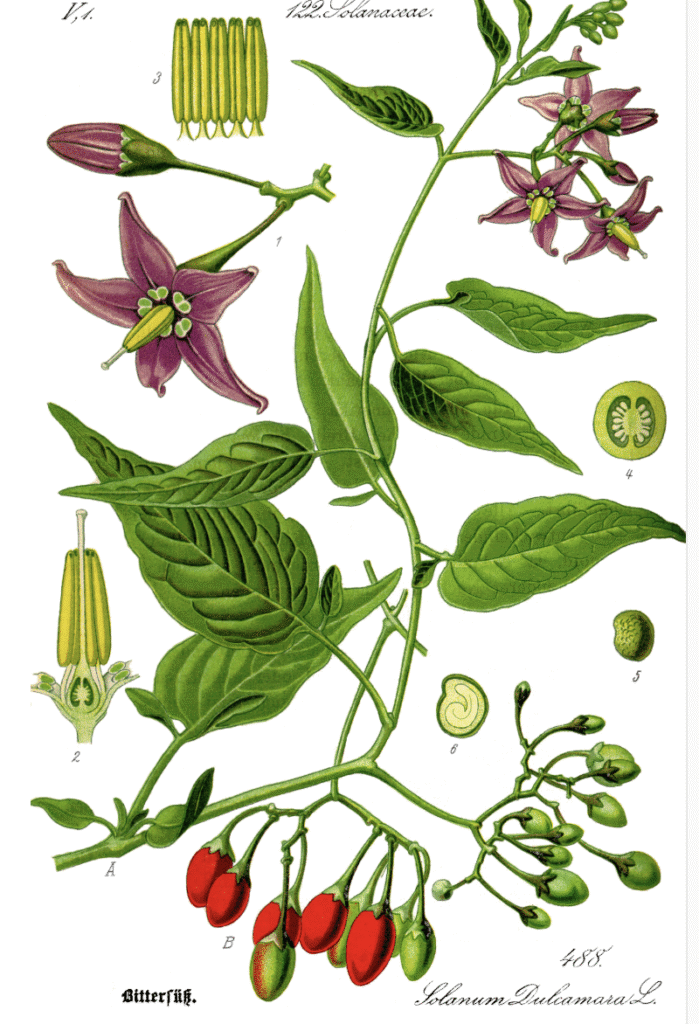
Original book source: Prof. Dr. Otto Wilhelm Thomé Flora von Deutschland, Österreich und der Schweiz 1885, Gera, Germany. From wikipedia, Creative Commons licence.
The nightshade family, Solanaceae, is a family of around 3000 species, known for its important edible species (like Solanum tuberosum, potato, and Solanum lycopersicum, tomato), and infamous for its toxic species (like Atropa belladonna, deadly nightshade, and Hyoscyamus niger, henbane). There aren’t many members of the Solanaceae native to the UK1, and the most widespread of these is Solanum dulcamara, bittersweet or woody nightshade.
S. dulcamara is a scrambling plant that grows up and over other plants, and is found in habitats such as hedgerows, woodland edges, coastal areas and scrubland, often in moist places2. Its green stems are herbaceous, but the base of the plant can be woody, sending out new shoots every year. These shoots can drag several metres in length. The alternate leaves are roughly oval in shape with pointed tips, though they can vary a fair bit, and often possess two leaflets at their base; they may be pubescent and up to 8cm in length.

Leaves with various degrees of lobes. Image: Chris Jeffree
Several varieties of S. dulcamara have been described over the years e.g. var. marinum, var. villosissimum and var. dulcamara, but in her taxonomic treatment of the Dulcamaroid clade of Solanum, Knapp considers the varieties to simply be part of the one, variable, species. This species is native across much of Europe, and Eastern and Central Asia, down to North Africa, and is also found in North America, where it is likely introduced.

Bittersweet flowers from June to September. The small flowers3 appear in loose clusters. The five petals are a deep purple, with two small green spots near the base of each, outlined in white. The petals curve backwards as the flowers open, to become reflexed, and the flowers themselves tend to droop downwards. The stamens are bright yellow and come together to form a cone in the centre of the flower. The anthers of these stamens have pores on their tips through which pollen is released to the right pollinator.

S. dulcamara: clusters of flowers (Images: Heather Forbes from 2021)
Bittersweet flowers are exquisite when viewed at high magnification, as the images below show. They are of course like those of tomatoes and potatoes, although Bittersweet’s colours are more intense.

Flowers, side view. Image: Chris Jeffree.

Front view showing just-open anther tips. Image: Chris Jeffree.

Detail of inflorescence. Image: Chris Jeffree
Like many other members of the Solanaceae, bittersweet is adapted for buzz pollination by bees. Bees grasping the flower use their wing muscles to vibrate at just the right frequency to open the pores on the anthers so that the pollen sprays out. Buzz pollination is fascinating. Watch a video of a bumblebee releasing pollen from the anthers of another species of Solanum below.
Once fertilised, the ovaries ripen into, as the herbalist John Gerard wrote in 1597, ‘faire berries more long than round, at the first green, but very red when they be ripe; of a sweet taste at the first, but after very unpleasant, of a strong savor, growing together in clusters like burnished coral. ‘ The berries ripen from green through orange to red, and all colour stages may be on the plant at once. These bright fruits are eaten by birds, which subsequent disperse the seeds; the plant can also spread via rhizomes.

These berries show varying degrees of ripeness (green, yellow, orange, red). They resemble the fruits of tomatoes, but they are much smaller (8-15 mm). Image: Chris Jeffree.
There seems to be some confusion about the taste of these berries, with some saying they taste sweet to begin with then become bitter, and others saying the opposite: that they taste at first bitter, then sweet. Either way, despite their attractive appearance, you should not try to find out – like many members of the Solanaceae, S. dulcamara is poisonous4, though to a significantly lesser degree than the infamous deadly nightshade, Atropa belladonna.

Unripe berries of bittersweet (left); ripe berries (centre; image by Olli Salmela, (Dacnoh), via Wikimedia Commons, used under CC BY-SA 3.0); the flowers and black berry of Atropa belladonna, deadly nightshade (right; image by pixel2013, pixabay). See also Maria Chamberlain’s article about deadly nightshade here.
Woody nightshade contains the toxic alkaloid compound solanine (also found in Atropa), which has narcotic qualities. In appropriate doses, the extract of S. dulcamara was used to treat skin conditions, respiratory conditions and rheumatic problems. It is still sometimes used for skin conditions. Taking too much of the plant, however, leads to diarrhoea, nausea and slow heartbeat, and a high enough dose can lead to paralysis of the central nervous system (and therefore death), but this seems unlikely to happen.
On the more folkloric side of things, it was said that placing the dried herb under your pillow would help in the healing of a broken heart or in forgetting a lost love (presumably the two are connected). The herbalist Nicholas Culpeper said, ‘It is good to remove witchcraft both in men and beast, and all sudden diseases whatsoever.’ It was hung on the body to protect against and cast off evil influences.

Notes
- Another native species is Solanum nigra, the Black Nightshade. See here.
- Grime et al. (1988) based on their survey in the Sheffield region, and say that S. dulcamara is “primarily a wetland species occurring most consistently in shaded mire” but we have recorded it in many other habitats, especially hedgerows.
- A little more information: plants live for around 20 years, and stems touching the ground form roots; the plant requires rather fertile soils and is absent where the pH is less than 4; berries (diameter 8-15 mm) are eaten by birds and thus widely dispersed in excreta.
- poultry and sheep are known to have died after grazing the plant and children who eat the attractive-looking berries become ill and sometimes die (Minors 1948). All parts of the plant contain poisonous compounds.
References
– Botanical.com, 2021. Nightshade, Woody [online] Available at https://www.botanical.com/botanical/mgmh/n/nighwo06.html
– Brooklyn Botanic Garden, 2017. Weed of the Month: Bittersweet Nightshade [online] https://www.bbg.org/news/weed_of_the_month_bittersweet_nightshade
– CABI, 2021. Symbolism of plants: examples from European-Mediterranean culture presented with biology and history of art: AUGUST: bittersweet, woody nightshade [online] Available at https://www.cabi.org/isc/abstract/20093251708#:~:text=The%20property%20of%20tasting%20first,in%20the%20Christian%20Middle%20Ages.
– Culpeper, N. edited by David Potterton. Culpeper’s Colour Herbal. Foulsham, 1983
– Eflora, 2021. European Bittersweet – Solanum dulcamara var. dulcamara [online] Available at https://eflora.neocities.org/Solanum%20dulcamara.html
– Gerard, J. edited by Marcus Woodward. Gerard’s Herbal. Bracken Books 1985.
– Knapp, S, 2013. A revision of the Dulcamaroid Clade of Solanum L. (Solanaceae), PhytoKeys 22: 1 – 428. Available at: https://doi.org/10.3897/phytokeys.22.4041
– Minors, E. H. (1948) Five cases of belladonna poisoning.British Medical Journal 2, no. 4575 518. Available at https://pmc.ncbi.nlm.nih.gov/articles/PMC2091492/pdf/brmedj03694-0020b.pdf
– NBN, 2021. Solanum dulcamara L. [online] Available at: https://species.nbnatlas.org/species/NBNSYS0000004037
– Online Atlas of the British and Irish Flora, n.d. Solanum dulcamara [online] Available at: https://www.brc.ac.uk/plantatlas/plant/solanum-dulcamara
©Heather Forbes