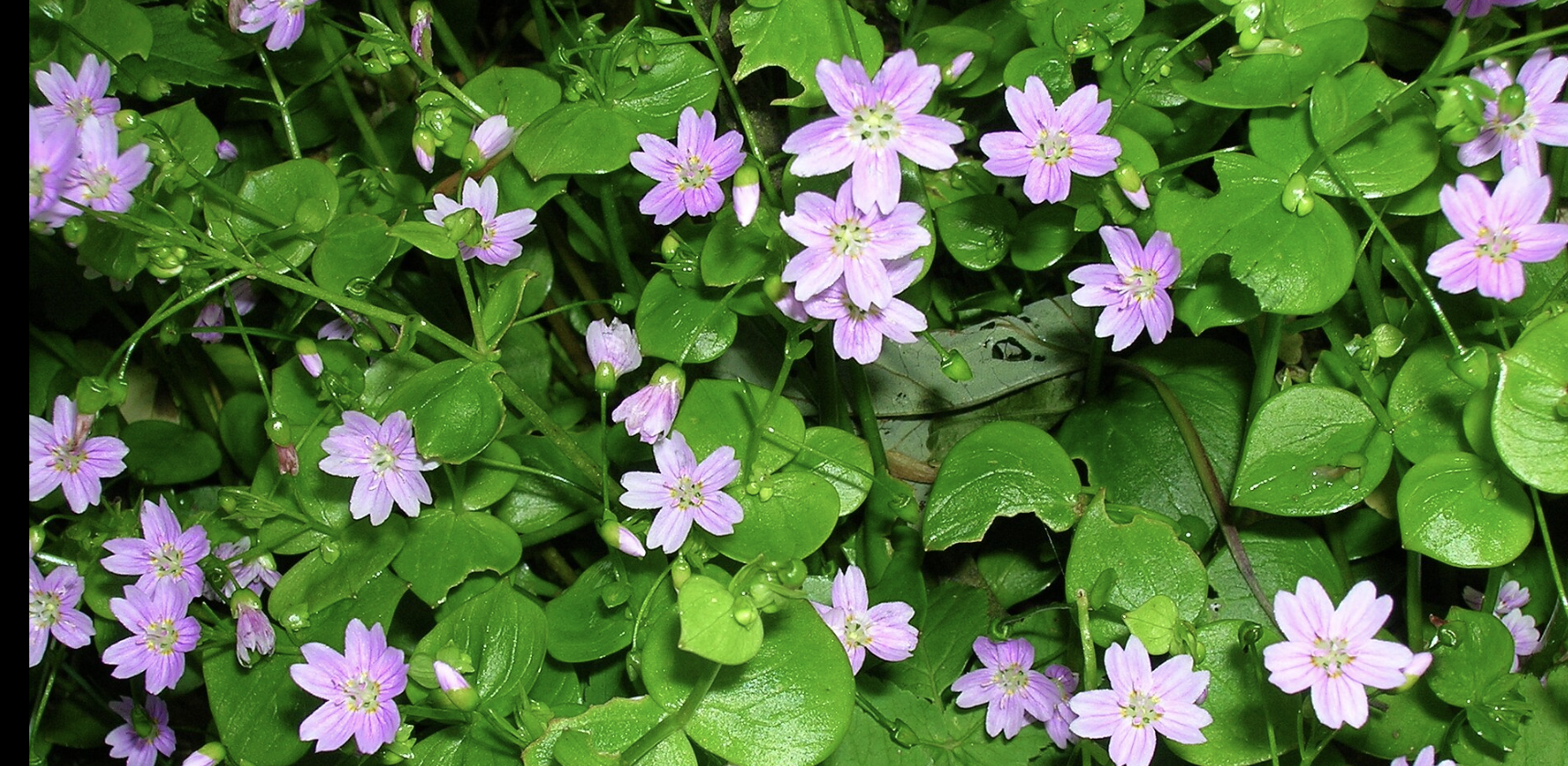
Claytonia sibirica – September 15th 2025 – Pink Purlsane
There is a remote region in the North Pacific Ocean known as Beringia. I’m sure my school geography teacher never mentioned it, despite its importance in Earth history, evolution and geopolitics. During the last Ice Age the region was a vast landmass across which humans from Asia once walked to migrate to North America. When the ice melted, the sea level rose and the land bridge was submerged, leaving just the Aleutian Islands, shrouded in mist, looking like a string of pearls. These volcanic islands are the homeland of Claytonia including our Plant of the Week, Claytonia sibirica.

Flowers are ‘candy-striped’ with notched petals. Image: John Grace.
It is a pretty-looking plant, first cultivated in Britain around 1768 and discovered in the wild in 1837. It prefers damp and somewhat shady areas, and it can quickly colonize woodland. According to the BSBI, it suppresses native vegetation with its lush mass of spring foliage which then flops over nearby plants. I have never seen it doing that – I usually see small patches at the edges of woodlands. It isn’t very common. The first time I saw it was at the Hermitage of Braid, Edinburgh, but it is widespread in Scotland, except in the north-west.

Flowering in August 2025, South Ayrshire. Showing the pale green leaves, borne in pairs with no petiole. Image: John Grace
Now, it can be found throughout Europe and it has even managed to reach the South Island of New Zealand (but not until 2001). It is a short-lived perennial and as might be expected from its northern origin, it is very hardy (on the USA’s scale of hardiness, it can survive -40°C to -17.8°C).
When Linnaeus named the species ‘sibirica’ in 1753, he obviously thought it came from Siberia. I don’t know how he could have been so certain. The strange thing is, the plant has not been reported in the mainland of Siberia. A very thorough survey of Siberia’s flora was made by the Finnish botanist A.K. Cajander in 1901. He found over 800 plant species but no Claytonia sibirica. Of course, Siberia is a very large place and he must have missed many species. The Global Biodiversity Information System (GBIF) shows no records of Claytonia sibirica in Siberia, but many in the Aleutian Islands. Perhaps Linnaeus should have called the plant Claytonia aleutiana? Today, the Islands mostly belong to the USA, but 15 of them known as the Commander (or Komandorski) Islands are Russian. There are many unanswered questions about the origin of the plant – perhaps a visit to London is required to see Linnaeus’s archive.

Claytonia sibirica, distribution of records according the GBIF. Note the native distribution in the north-west of North America and the Aleutian Islands (looking like a string of pearls in the North Pacific). The surface air temperature across the Aleutian Islands ranges from 5 to 10C in summer to nearfreezing temperatures in winter – similar to Shetland.
Once Claytonia sibirica reached Britain and escaped from cultivation it may have spread rather rapidly in some areas. The BSBI have emphasised its rapid spread since the 1930s, especially in Cornwall. Perhaps this is due commercial sale of its seeds. I found a recent research paper on Claytonia sibirica from Bulgaria. The authors state “it can be concluded that it spreads at a low rate, mainly by short and mid-distance distribution. The dispersal vectors are ants, human activity and water courses. ‘Long jumps’ prompted by human activity (forestry, transport, tourism) are also possible”.

Claytonia sibirica, distribution of British and Irish records, from BSBI/Maps
In North-West America, it exists in several forms and researchers refer to the ‘Claytonia sibirica complex’. Miller et al (1984) examined chromosome numbers of populations from the Gulf of Alaska to California and found a high degree of polyploidy: the diploid number (2n) was 12 but many were triploid (24 chromosomes) and tetraploid (36). Octoploids have sometimes been recorded. These different ploidy levels are not obviously linked to habit or morphology: even within the diploids there are differences in climatic adaptations, habitat, shape of basal leaves, and presence or absence of basal bulblets and rhizomes. Variation in British and European populations has not been examined although there is a form with white flowers in North Ayrshire, known as the Stewarton flower. White flowers also occur in the Templeton Woods, Dundee.
In the British flora we have a closely related species Claytonia perfoliata, variously called ‘Spring Beauty’ or ‘Miner’s Lettuce’ which we described in an earlier blog. Claytonia sibirica is often called Siberian Spring Beauty or Siberian Miner’s Lettuce (sometimes Candyflower) but their accepted English names of the two Claytonias are Spring Beauty and Pink Purslane respectively. However, beware of the name ‘Purslane’ which is a common name for several unrelated plants with edible leaves. Since 2009 Claytonia has been placed in the small Family Montiacea, along with the genus Montia. Previously, it belonged to the Portulacaceae (which has been largely dismantled and now only has Portulaca).
References consulted
Bank TP (1953) Ecology of prehistoric Aleutian village sites. Ecology 34, 246-264.
Hämet-Ahti L (1970) AK Cajander’s vascular plant collection from the Lena River, Siberia, with his ecological and floristic notes. In Annales Botanici Fennici (pp. 255-324). Societas Biologica Fennica Vanamo.
O’quinn RL (2005) Phylogeny, biogeography and evolution of perennation structures in montieae (Portulacaceae). PhD dissertation, Washington State University.
Petrova A et al. (2024). On the current distribution and population size of non-native Claytonia sibirica (Montiaceae) in Bulgaria. Phytologia Balcanica, 30(1), 95-102.
Willis J C (1892). The distribution of the seed in Claytonia. Annals of Botany, 4, 382-383.
Wilson H (2001) Plant Record. Claytonia alsinoides – a new naturalised record for New Zealand? New Zealand Botanical Society 17.
internet here for Bugwomanlondon’s blog on Claytonia
Attribution of image
Featured image at the top of the page: Roger Griffith, Public domain, via Wikimedia Commons
©John Grace