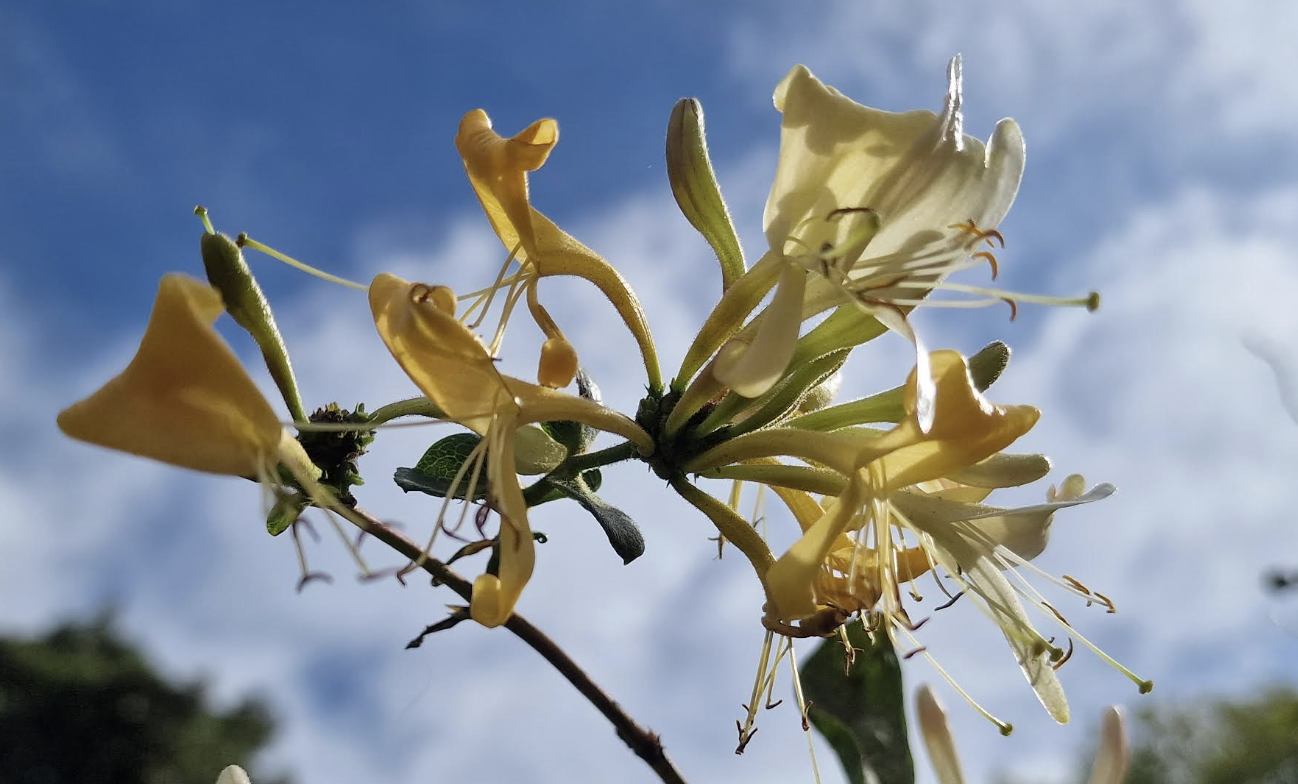
Lonicera periclymenum – September 8th 2025 – Honeysuckle
This week we present a familiar native plant, the scrambling climber Honeysuckle, formerly called Woodbine. The two names evoke contrasting images: ‘Honeysuckle’ refers to the habit of village children of sucking the sweet nectar from the flower; ‘Woodbine’ tells us about the plant’s growth habit, twining around the woody stems of other plants. In folklore and poetry, the plant has been used to symbolise love, fidelity and affection, and its twining habit represents attachment and devotion.

Flowers are in terminal whorls, coloured yellow, often tinged purple or red. Leaves are simple, and in pairs. Image: John Grace.
In 1888 the name ‘woodbine’ was stolen by the cigarette-manufacturer WD & HO Wills and the smokes were promoted with the slogan Light up life with a Woodbine! It’s Britain’s best-selling cigarette! They are still on sale, but no longer in the iconic box bearing the stylised image of Honeysuckle.
Honeysuckle is a shade tolerant plant that can grow rapidly, sometimes reaching a height of over 6 metres. It twines around whatever it can find, binding so tightly that it makes a permanent impression on the surface of its host plant. This mode of growth is uncommon in temperate climates, leading Darwin to remark “Our English twiners, as far as I have seen, never twine round trees, excepting the honeysuckle (Lonicera periclymenum), which I have observed twining up a young beech-tree nearly 4½ inches in diameter”. It twines from right to left (clockwise if viewed from above), as most species do.

The host tree is ‘strangled’ by the Honeysuckle which leaves grooves in the tree. Image: Moinats, CC BY-SA 4.0 https://creativecommons.org/licenses/by-sa/4.0, via Wikimedia Commons.
The other woody climbers in the British flora are strictly not twiners because they deploy different climbing methods: ivy, clematis, dog-rose and woody nightshade. North America has more twiners, and they call them ‘vines’. The humid tropics have many gigantic twiners known as lianas.

Lonicera periclymenum ‘Belgica’, flowers in bud (left) and open (right). Images: John Grace.
Honeysuckle belongs to the Family Caprifoliaceae, a Family that includes Viburnum and Snowberry. In W.J. Bean’s book, Trees and Shrubs Hardy in the British Isles (now quite out-of-date) there are many species of Lonicera that are considered worthwhile for British gardens but these are rarely seen in the wild. Two of them, Lonicera caprifolium and Lonicera etrusca form a hybrid which is widely available to gardeners. The hybrid is called Garden Honeysuckle, sometimes Italian Honeysuckle (Lonicera × italica). This one was known in gardens by 1730 and first recorded from the wild in 1967. It can be found growing wild in the south-east of England; however, it has only rarely been seen wild in Scotland. In contrast, horticultural cultivars of L. periclymenum, especially the one called Lonicera periclymenum ‘Belgica’ has been widely promoted and is now wild in the north of Scotland, especially (and perhaps surprisingly) in Shetland. No wonder, it is so popular: in the words of plantswoman Sarah Raven –
“Like the best William Morris wallpaper, this crimson, ruby and apricot honeysuckle looks and smells utterly delicious from late spring. It’s a hugely abundant and resilient plant which will be in your life and nostrils for ever”.

Honeysuckle growing as a dwarf form on limestone pavement at the Burren, County Clare, Ireland. Image: Chris Jeffree.
The ecology of Honeysuckle is described in detail by Grime et al (1988) based on a thorough survey of the Sheffield region. They found it only in woodlands and hedgerows. However, we have seen it in relatively open sites, including coastal cliffs (Whithorn, Dumfries and Galloway, Scotland) and limestone pavement (the Burren, in Ireland). It is unusual to find it on limestone as it is generally found on somewhat acidic soils (Grime et al 1988).
The flowers are numerous, appearing in early June and sometimes as late as September. They give off a sweet scent, especially at nightfall, and they are pollinated by night-flying moths. Allegedly these moths can detect the scent of honeysuckle flowers up to a quarter of a mile away. Proctor and Yeo (1996) reviewed some elegant earlier experiments with trained and untrained hawkmoths, sometimes using artificial flowers. Once trained, their flight patterns were directional, seeking the smell of Honeysuckle. Out of several natural and artificial scents, only two had any effect on the behaviour of the Elephant Hawk Moth (Deilephila elpenor), and only the scent of honeysuckle would induce feeding. The flowers may also be pollinated in daytime, by bees and hover-flies.

Berries of Honeysuckle, early September 2025, Edinburgh, after a very dry summer. This plant at Inverleith Park had very few berries, evidently the birds had been feasting. The berries are mildly poisonous to humans but not to birds. Image: John Grace.
The red berries are in tight clusters, from mid-August onwards, and are food for Blackbirds, Thrushes and Robins. Smaller birds feed on the seeds of dried-up fruits later in the year. The seeds are therefore widely dispersed in bird-droppings. Seeds germinate in the Spring, following a winter chilling period, and do not survive more than a year in the soil (Grime et al 1988).

Honeysuckle carvings decorating the columns of Iona Abbey. Image: Chris Jeffree.
My interest in twining plants like Lonicera derives from my love of runner beans (Phaseolus vulgaris). The young shoots wave around in a roughly circular motion until they find a vertical support. Then they wrap around it and proceed to climb in helix-fashion. As a child I was told that whether a bean plant coils to the left or right depends on which hemisphere it grows in, suggesting a link to either the apparent motion of the sun in the sky or the Coriolis effect. However, my visits south of the Equator proved this was untrue (likewise the direction of bath-water flowing down the plughole). In plants and animals there seems to be a ’handedness’ like left- and right-handedness in humans, even though plants have no brain. Whilst researching for this blog I came across the work of Edwards et al. (2007). They gathered data from different parts of the world and showed conclusively that there is no hemisphere effect, and that right-handedness in plants far outnumbers left-handedness. We do not know how or why plant display ‘handedness’, but researchers using Thale Cress (Arabidopsis thaliana) are busily looking for the genes that control handedness.

Spiral climbing: Left, Honeysuckle; centre, a Gothic spiral stairway; right, runner bean (Phaseolis vulgaris). Imagine you are the human or insect walker making your way upwards from the arrow. Images of plants, John Grace; stairway image from Wikipedia Commons.
To understand the ‘handedness’ of climbing plants it is useful to think of a spiral staircase. In the gothic staircase pictured above, the human climber is always veering to the right (‘right-handedness’). The runner bean goes in the opposite direction (‘left handedness’) whilst the Honeysuckle is ‘right-handed’. In the picture the Honeysuckle is twining, rope-like, around another honeysuckle stem which looks ‘left handed’ because it is being bent by the stronger ‘right-hander’.
Finally, we may note the frequent appearance of Honeysuckle (Woodbine) in poetry. Shakespeare knew his wild flowers very well, especially the sweet-scented ones. For example, in the Midsummer Night’s Dream (Act IV, Scene 1) Titania’s words to Bottom:
Sleep thou, and I will wind thee in my arms.—
Fairies, begone, and be all ways away.
Fairies exit.
So doth the woodbine the sweet honeysuckle
Gently entwist; the female ivy so
Enrings the barky fingers of the elm.
O, how I love thee! How I dote on thee!

Titania is in love with Bottom the weaver but the mischievous fairy Puck has transformed Bottom’s head into that of a donkey. Attribution: Charles Buchel, CC BY-SA 4.0 https://creativecommons.org/licenses/by-sa/4.0, via Wikimedia Commons.
References consulted
Edwards I, Moles AT, Franks P (2007) The global trend in plant twining direction. Global Ecology and Biogeography 116, 795–800.
Grime JP, Hodgson JG and Hunt R (1988) Comparative Plant Ecology. Unwin Hyman.
Guerra S, Castiello U, Bonato B & Dadda M (2024) Handedness in animals and plants. Biology, 13(7), 502. https://pmc.ncbi.nlm.nih.gov/articles/PMC7616222/pdf/biology-13-00502.pdf
Proctor M, Yeo P and Lack A (1996) The natural history of pollination. Collins.
Sinjushin, AA and Bahadur B (2019) “Chapter 8 Molecular Bases.” Asymmetry in Plants: Biology of Handedness 105. (may be viewed on google books).
©John Grace