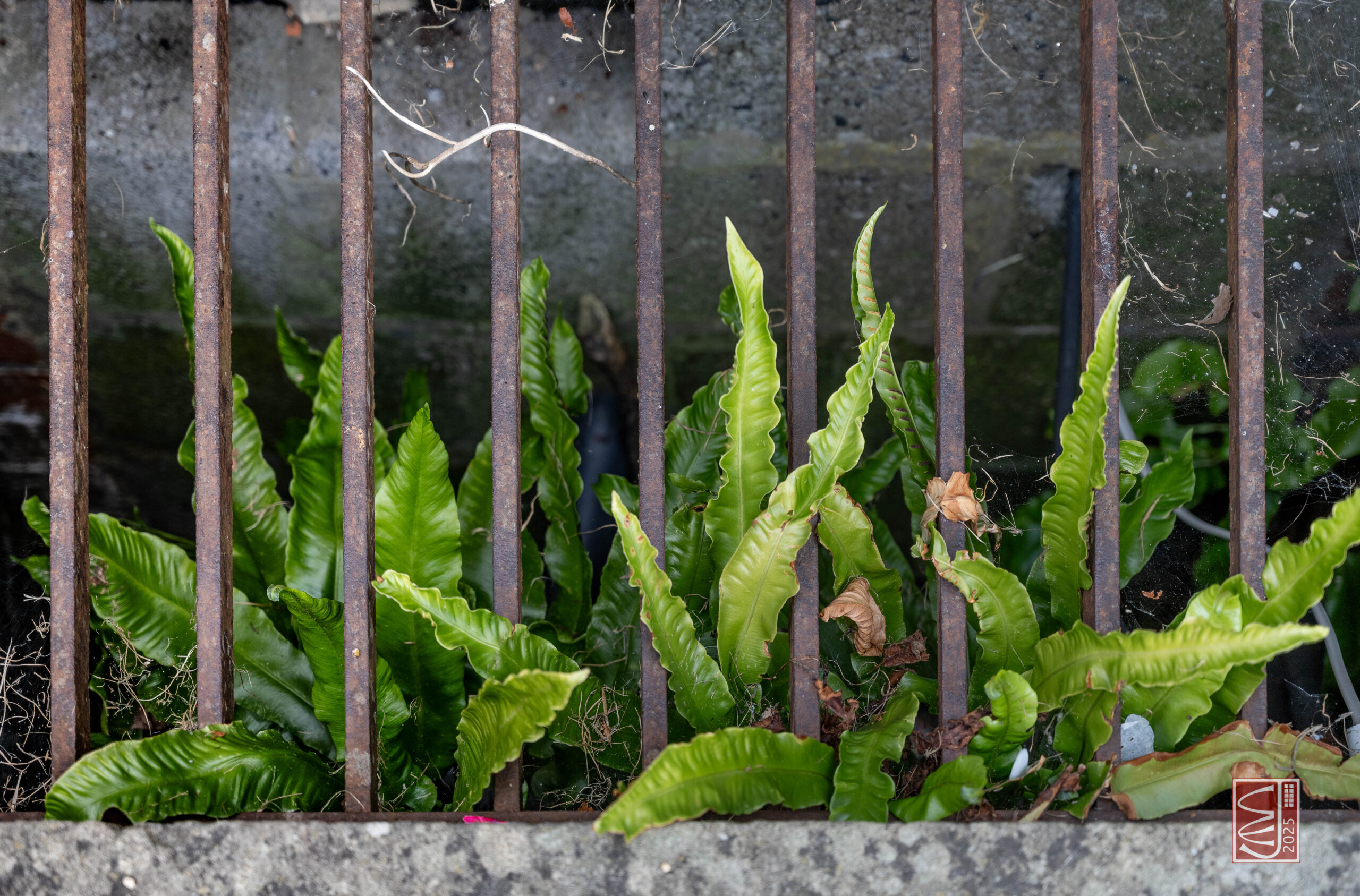
Asplenium scolopendrium – November 10th 2025 – Hart’s Tongue Fern
Hart’s Tongue is the first fern I learnt to recognise back in my schooldays. It’s the easiest to know and one of the most common. It appears on our garden wall and it was growing on a retaining wall at our local bus stop until the Council workers scraped it off.

A woodland population at Merlewood, Grange-over-Sands, Lancashire. Image: Chris Jeffree.
Hart’s Tongue was called Phyllitis scolopendrium until the early 2000s when it reverted to Asplenium scolopendrium, the name Linnaeus gave it in his great work Species Plantarum of 1753.
The plant colonises the mortar of old walls, and any other place where there is a lime-rich substrate including limestone pavement and woodlands on limey soils. It flourishes in the shade, and I’ve seen it deep within a cave. I’ve also seen it growing from a roadside drain1. In bright light it turns yellow and may die. It seems to prefer a high humidity, and it usually stays green over the winter, being able to adjust to temperatures of minus 20 oC.

Asplenium scolopendrium growing on an old wall at Maryhill, Glasgow. Image: Chris Jeffree.
The leaves are strap-like, and when fully expanded I guess they resemble a tongue, hence the name Hart’s Tongue. The leaves of young plants are sterile and short-lived. After a few years, fertile leaves appear and spores are shed. The spore-bearing parts (‘sori’) are on the underside of the leaves, arranged in characteristic parallel lines. Its specific name scolopendrium is from the Greek for centipede as when it was first named someone thought these lines looked like the legs of centipedes.

A limestone community: Asplenium scolopendrium, Teucrium, Geranium sanguineum at Poulsallagh near Lisdoonvarna in County Clare, Ireland. Image: Chris Jeffree.
Most authorities say the fern’s rosette is long-lived, perhaps surviving for several decades. However, the only study I found where a colony has been monitored for many years found “adults lived on average 4.4 years based on plants that completed their whole life cycle during the 34 years of monitoring. The half-life of the whole population was 4.5 years”.
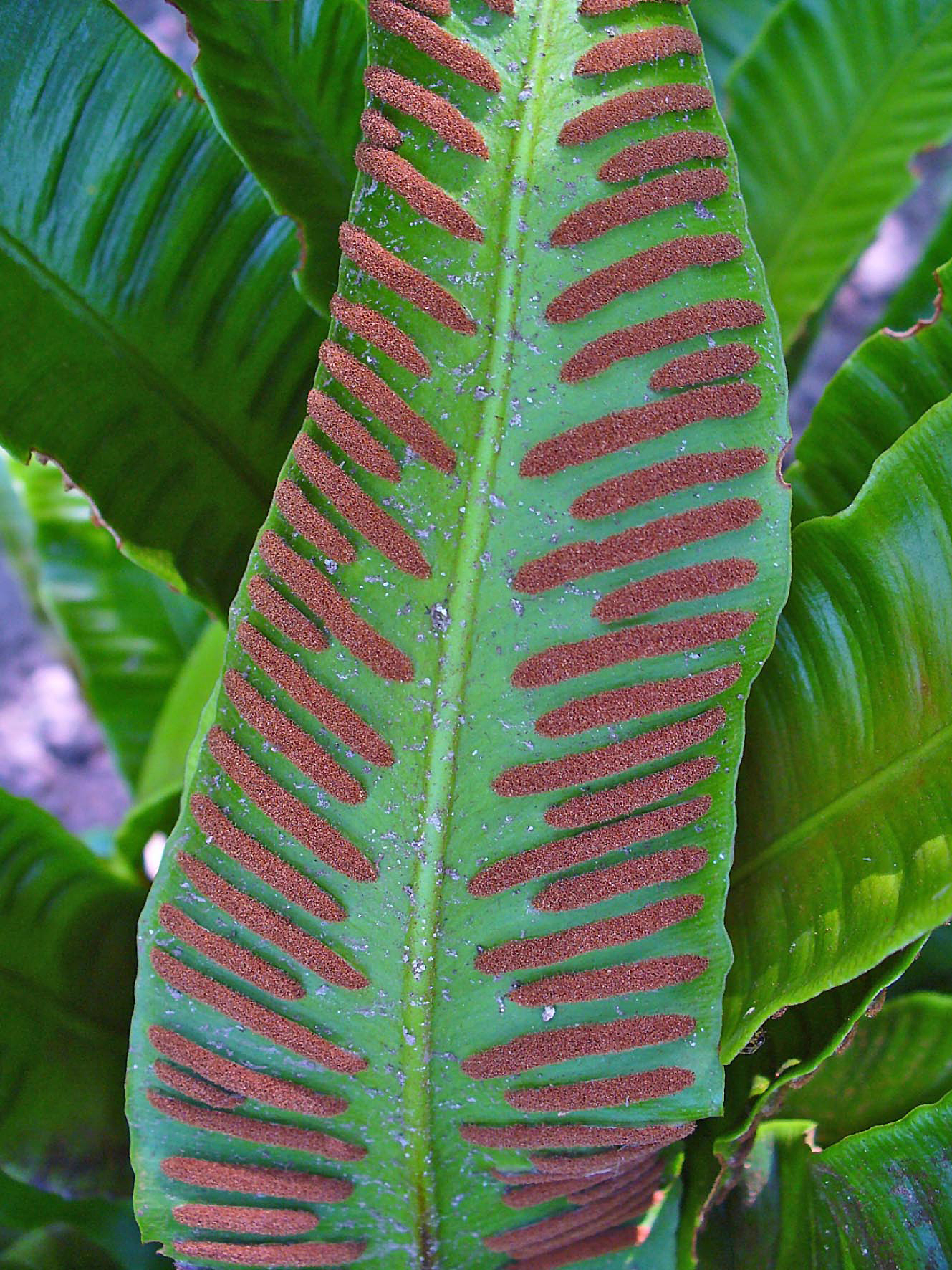
Leaves of ferns are often called ‘fronds’. Leaves in flowering plants are purely concerned with photosynthesis whereas ‘fronds’ have both a photosynthetic function and a reproductive function. The image shows the underside of a mature leaf, with the spore bearing areas organised in parallel lines. Attribution: H. Zell, CC BY-SA 3.0 https://creativecommons.org/licenses/by-sa/3.0, via Wikimedia Commons
The species is very common here in Britain but in some parts of Europe it is rare. In Germany Denmark and Switzerland the distribution of A. scolopendrium has contracted in the last 50 years. It was listed as ‘vulnerable’ in the National Red Lists for Albania in 2014 and Norway in 2010. It is ‘critically threatened and rare’ in the Czech Republic’s Red List and ‘endangered’ in Sweden. I have found no explanation for this scarcity.

Emerging leaves, showing the characteristic feature of many ferns, called ’Circinate vernation’ whereby the delicate growing tips of the leaves are protected within the coiled structure. Image: Chris Jeffree.
Globally there are three population clusters: Europe, North America and East Asia. The European plants have 72 chromosomes whereas the North American and Asian populations have 144. Heo et al. (2022) tried to trace the evolutionary history from analysis of the DNA in chloroplasts. The general conclusions are that the original population was European, but somehow the plant reached North America (in the Early Eocene, 50 million years ago) whereupon it underwent chromosome doubling. The result was a plant that look the same as the European Hart’s Tongue, but somewhat larger. Then, in the early Miocene (about 20 million years ago) this plant spread to East Asia by ‘jumping’ from Alaska to Siberia. The authors point out that the continents were closer together in the Early Eocene, and we need to realise that the spores are very small and easily dispersed either in the wind or on the feathers of migratory birds.

Asplenium scolopendrium showing the coiled leaf-tips (‘circinate vernation’). Image: Chris Jeffree.
In the USA the Hart’s Tongue is rare, and federally listed as a threatened species, whilst in Canada it is a species of ‘special concern’. It fares slightly better in northeastern China and the Korean Peninsula and is relatively abundant on many of Japan’s islands.
Hart’s Tongue was introduced to New Zealand in 1976, where it seems to be flourishing in an urban setting in Auckland, Canterbury, Otago and in the Southland region.

Examples of Asplenium scolopendrium in decorative artwork. Images: Chris Jeffree.
Many ferns are strikingly beautiful, partly accounting for the ‘fern craze’ of the Victorian middle classes (about 1850 – 1890). Ferns were collected from the wild and exhibited in a ‘Wardian case’. One of the delights was to observe the leaves unfolding, with their characteristic ‘circinate vernation’ which is the term to describe the unfolding spiral whereby the delicate tip of the leaf is protected.

Distribution of Asplenium scolopendrium in Britain and Ireland from BSBI/Maps (Left) and in the world as a whole (from GBIF).
Hildegard von Bingen (1098-1179), the Benedictine Abbess from the Rhineland recommended Hart’s Tongue for many illnesses, and gave brief recipes for the nuns to follow. She was a remarkable intellect, known as a healer, an artist and a musician. The earliest herbals known in Britain came much later. The best known herbalist in our land was the Londoner John Gerard. He described the virtues of this fern in his 1597 Herbal:
“ This common Hart’s-Tongue is commended against the lask2 and bloody flux: Dioscorides teacheth, that being drunk in wine it is a remedy against the bitings of serpents. It doth open the hardness and stopping of the spleen and liver, and all other griefs proceeding of oppilations or stoppings whatsoever”.
Others followed. Culpeper’s Complete Herbal (1653) recommends Hart’s Tongue for all manner of complaints including those of the liver (“to strengthen it when weak”) and says “you shall do well to keep it in a syrup all year”. In the 1800s it was a well-established medicinal plant , known especially as a ‘spleen tonic’ (hence an archaic name for the genus, ‘spleenworts’). Today, dried leaf material may be purchased online, to make into a tea. According to one offering, it is good for “kidney disease, intestinal obstruction, liver and biliary diseases, cough, tuberculosis”. So I wonder, what do these ferns contain? Research into phytochemical compounds with biological activity is rare in western countries, but quite frequent in Asia and the Middle East where traditional medicine is strongly valued. In one study, seven types of alkaloids (martensine, almazoline, caulerpin, hordenine, corilagin, colocynthis and isoquinoline) were detected in Asplenium scolopendrium and A. ceterarch (see Alallaq et al. 2023).
Notes
1The image by Chris Jeffree at the top of this article shows the plant growing from a roadside drain in Darlington.
2Lask’ seems to be a very old word for diarrhoea.
References consulted
Alallaq SA et al. (2023). Determination of alkaloids constituents in some ferns by using High Performance Liquid Chromatography technique–Iraq. Iraqi Journal of Science, 4340-4346.
Bremner P and Smit A (2024) Monitoring of a founder population of the Hart’s Tongue Fern (Asplenium scolopendrium) on a former sea-floor (Jagersveld) over 34 years (1985-2018). Fern Gazette 21(8):437-449.
Heo N et al. (2022) Evolutionary history of the Asplenium scolopendrium complex (Aspleniaceae), a relictual fern with a northern pan-temperate disjunct distribution, Biological Journal of the Linnean Society, Volume 137, 183-199. https://doi.org/10.1093/biolinnean/blac080
Fernando DD et al. (2015) Genetic analysis of the threatened American hart’s-tongue fern (Asplenium scolopendrium var. americanum: Insights into its mating system and implications for conservation. Biochemical Systematics and Ecology, 62, 25-35.
Voronkov A and Ivanova T (2022) Asplenium scolopendrium sporophyte adapts to winter conditions by changing its lipid fatty acid composition. In: Prime Archives in Biosciences: 2nd Edition. Hyderabad, India: Vide Leaf.
©John Grace