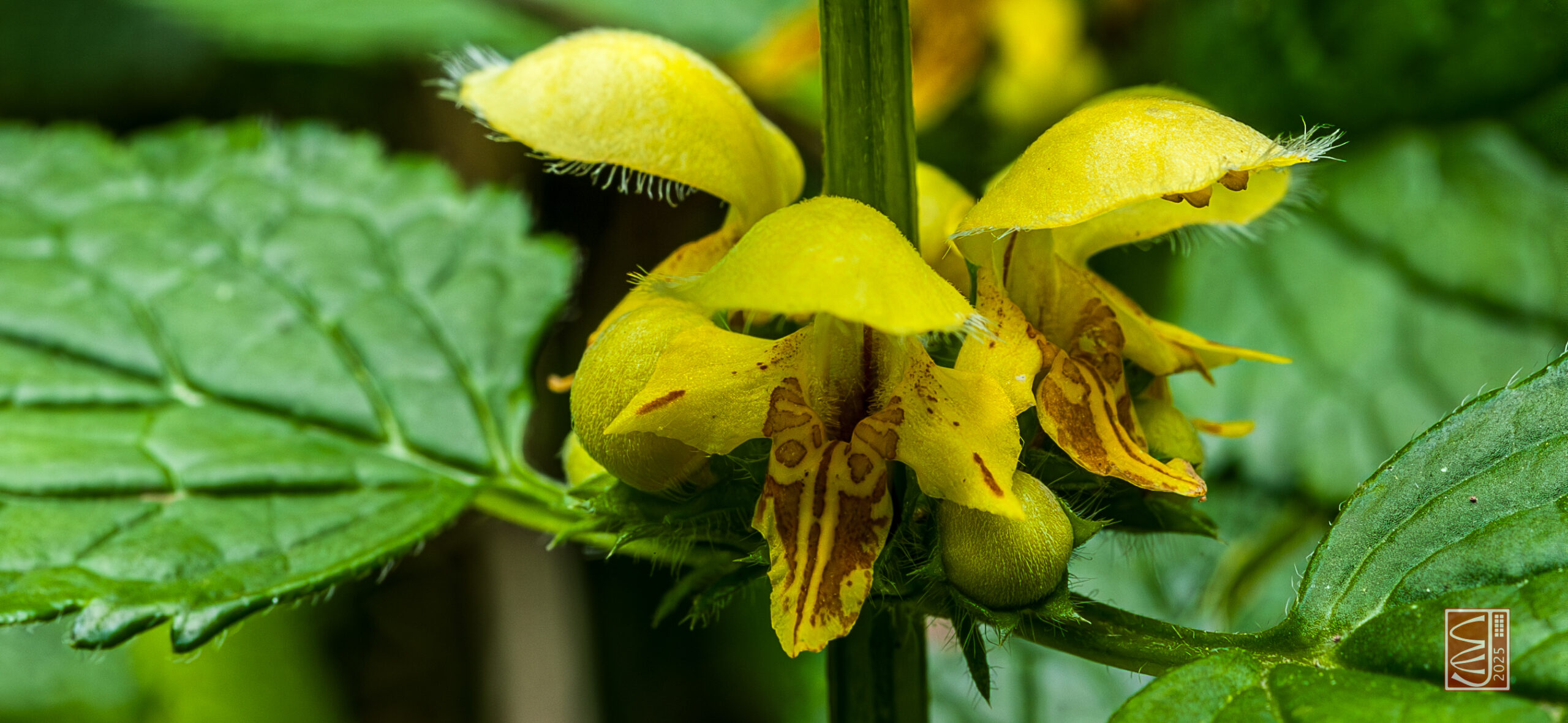
Lamiastrum galeobdolon – November 17th 2025 – Yellow Archangel
Yellow Archangel is the romantic name for a native plant in the Dead-Nettle Family (Lamiaceae), that was well-known to John Gerard, the 16th Century herbalist. He describes it alongside what he calls White Archangel, which is the common plant we now call White Deadnettle, Lamium album. The two dead-nettles are very similar, but the yellow one is rarer.

Yellow Archangel Lamiastrum galeobdolon. The appendage to the right appears to be a stolon. Note also the typical characters of the Lamiaceae (the Mint Family), including the square stems and the opposite leaves as well as the characteristic bilaterally symettrical flowers. Attribution: Johann Georg Sturm (Painter: Jacob Sturm), Public domain, via Wikimedia Commons.
I don’t think John Gerard travelled much. His descriptions of ‘place’ are parochial and mostly pertaining to London and the Home Counties. Here’s what he wrote about Yellow Archangel:
“That with the yellow flower groweth not so common as the others. I have found it under the hedge on the left hand as you go from the village of Hampstead near London to the Church, and in the wood thereby, as also in many other copses about Lee in Essex, near Watford and Bushy in Middlesex, and in the woods belonging to the Lord Cobham in Kent”.

Yellow Archangel Lamiastrum galeobdolon, showing intricate markings on the flower and no variegation of the leaves. Note also that the ‘teeth’ of the leaf margins are pointed. Image: Chris Jeffree.
The Yellow Archangel of my youth (spent south of the Border) is the same as Gerard’s. He called it Lamium luteum, but now we have given it a mouthful of a name: Lamiastrum galeobdolon subspecies montanum. Its Latin name has changed several times and will probably change again, and so we may as well just say ‘Yellow Archangel’. However, there is an important ‘but’ to the name, as follows:
A Czech botanist Miroslav Smejkal (1927-1997) discovered what he claimed to be a new species of dead-nettle that he called Galeobdolon argentatum. It had silvery variegated leaves and long stolons. It is presumed to have been a mutation of Yellow Archangel. In 1975 he described it in Preslia, the journal of the Czech Botanical Society. Nowadays, Preslia is in English but in the Soviet days articles were often in German. If you know German you may like to read it1.

Yellow Archangel at Inveresk (East Lothian). The variegation is variable but the leaves in the lower left of the image show the characteristic pattern of the introduced Lamiastrum galeobdolon subspecies argentatum. Note that the ‘teeth’ on the leaf margins are less pointed than for the native species. Image: Chris Jeffree.
The new species came to Britain; some say in the late 1960s, even before Smejkal had published the description, and the first record in the wild was in 1974 (yes, I agree, the chronology looks impossible). It was widely considered to be a desirable garden plant, thriving in dry shady corners of the garden and covering the ground very efficiently. Sometimes, gardeners found it invasive and chucked it away, whereupon it rooted and spread. Now we call it Lamiastrum galeobdolon subspecies argentatum. It is recognised as an invasive non-native species listed in Schedule 9 of the UK Wildlife & Countryside Act. It is an offence to plant or otherwise cause to grow the species in the wild. You should stop them spreading from your garden, and you should probably ignore the online offers that are clearly argentatum.

Left: the distribution of the native Lamiastrum galeobdolon subspecies montanum. Right: the distribution of the introduced Lamiastrum galeobdolon subspecies argentatum. From BSBI/Maps3.
The subspecies argentatum is now common throughout Britain and Ireland whilst the native montanum is rare in Scotland and northern parts of England. How can you tell the difference? Some of the native montanum plants are variegated too and they can be confused with argentatum. However, Rutherford and Stirling (1987) wrote about ‘Variegated Archangels’ in 1987 and made good drawings of the leaves, emphasising the pattern of the variegation. They showed how the pattern in argentatum is different from other variegations and quite easy to spot. Also the margins of the leaf are less serrated compared to the nettle-like margins of montanum.
I tried to explore the two subspecies by using our Urban Flora data set, the collection of records we have compiled from many Scottish towns and cities over the last ten years2. The native Yellow Archangel is usually recorded as simply Lamiastrum galeobdolon whereas the invasive one is listed as Lamiastrum galeobdolon subsp. argentatum. I found that argentatum had been recorded at 69 locations compared to only 13 for Lamiastrum galeobdolon. The habitat codes in the data set show how argentatum has occupied many habitats, including woodlands, shrublands, car parks, churchyards and public parks. Many of the records are from Glasgow and thereabouts.

Global distribution of the native L.galeobdolon and the introduced L.galeobdolon subsp. argentatum
It seems the native Lamiastrum galeobdolon has always been rare in Scotland. I turned to Lee’s Flora of the Clyde Area published in 1933. The habitat note says “Woods and hedges, rare”. Lee mentions Sauchrie woods, Auchendrane, Neilston, Erskine, Symington. My copy of the book is quite heavily annotated by a previous owner who has written “Bishopton June 44”. I wonder if these are current locations of the species.

This image shows an example of the variegation in Lamiastrum galeobdolon subsp. argentatum. Note also the blunt leaf margins. The red-brown stolons can be seen. Fort William, July 2024. Image: John Grace.
Notes
1Preslia is available to browse online, and has a search facility. Use google to find Preslia’s home page.
2The data set is currently being ‘tidied up’ before been made publicly available. My search for Lamiastrum was on an earlier version, and I plan to repeat the search on the final version soon.
3Apologies to readers in Orkney and Shetland (something went wrong on BSBI/maps). Lamiastrum galeobdolon subsp. argentatum has been recorded in those island but subsp. montanum has not.
References consulted
Rich TCG and Jermy AC (1998) Plant Crib. BSBI.
Rutherford A and Stirling AM (1987) Variegated Archangels. BSBI News 46, 9-11.
Smejkal M (1975) Galeobdolon argentatum sp. nov. ein neuer Vertreter der Kollektivart Galeobdolon luteum (Lamiaceae): Preslia 17, 241-248.
©John Grace