Malva arborea – December 1st 2025 – Tree Mallow
Tree Mallow, Malva arborea, is a native plant associated with coastal habitats, thriving especially at sea-bird roosts, often on cliffs. It tolerates sea-spray and likes soils that are enriched with that all-natural fertilizer ‘guano’ (the accumulated excrement gifted by seabirds). It belongs to the Malvaceae, the Family of Mallows and Hollyhocks. It can grow as an annual or a biennial, but in mild locations, it grows as a perennial plant surviving for several years. Until recently it was called Lavatera arborea.

Malva arborea (Tree Mallow) pictured as a component of coastal vegetation at Prestonpans, East Lothian. Image: Chris Jeffree.
It is not particularly frost-tolerant: plants are killed by severe frost and this may partly explain why it is more or less restricted to the mild micro-climates near the sea. One of its sites in Scotland is the island of Ailsa Craig, some 16 km west of mainland Scotland, currently managed as a bird reserve with huge populations of gannets, guillemots and puffins. Other island sites include those in the east, in the Firth of Forth (van der Wal et al. 2008).

Flowering stem of Malva arborea (Tree Mallow) at the coastal village of Ballantrae, South Ayrshire. Flowering period is March-September. Image: John Grace.
Tree Mallow isn’t really a tree but more of a tall herb (1.5 to 3.0 metres tall) with deep woody tap roots and aerial shoots that are woody at their base but softly herbaceous above. The soft parts usually die back in winter. The plant is highly decorative, well-known in horticulture, and various forms are available to gardeners. There is also a pink-flowered hybrid plant called Garden Tree Mallow (Malva olbia x M. thuringiaca = Malva x clementii). It has escaped from gardens many times in the south of Britain; and in Scotland it has been recorded in the wild in Edinburgh, Glasgow and the north.

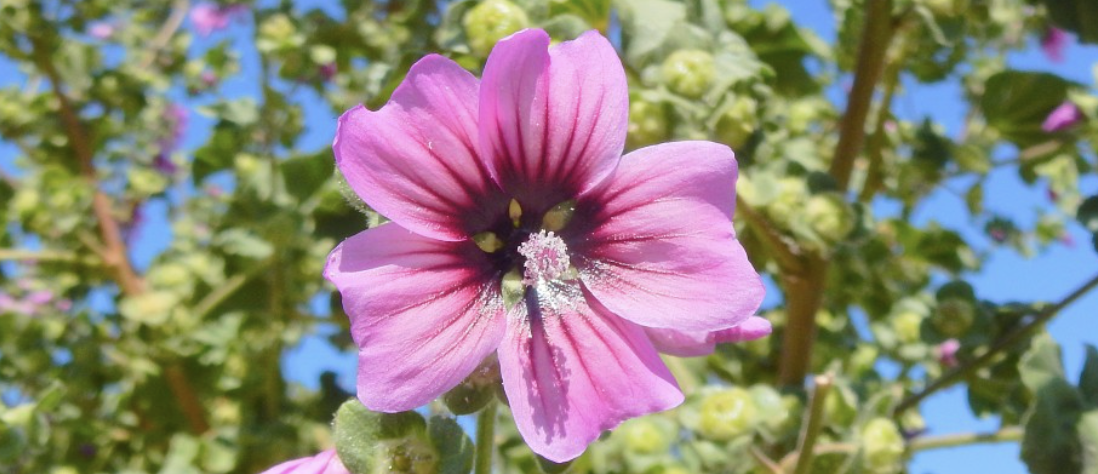
Close-up of flower. Note also how the leaves and stems are softly hairy. For further details click here. Image: John Grace.
Malva arborea is also found on rubbish tips. Many records are inland, far from the sea, and some of these plants may not be the wild type but horticultural forms that have escaped from gardens and spread. In some cases, cuttings may have been taken from wild plants and transferred to gardens and then escaped. It is therefore impossible to say for sure whether the inland plants are native or introduced.

Do not confuse Tree Mallow with the related species Malva sylvestris (Common Mallow) pictured here. This one has petals that do not overlap with each other. Image: Chris Jeffree.
Its tall stems are certain to be drenched with salt spray during storms at the coast. Its tolerance of salt-spray is remarkable as the plant lacks the usual salt-tolerance modifications seen in seaside plants, such as succulent thick leaves and shiny surfaces. It does however have salt-glands from which it can excrete excess salt. Its tolerance of salt and its liking for guano was investigated by Malloch and Okusanya at the University of Lancaster in the 1970s, and later by Okusanya on his return to Nigeria. The conclusion of the experimental work was that maximum growth is achieved with 40% sea water in the rooting medium but only when the supply of phosphorus is very high, as it always is at seabird colonies and as it often is on rubbish tips.

Distribution of Malva arborea in Britain and Ireland, from BSBI Maps.
The species may be invasive in its coastal habitat — in Britain it is claimed that its vigorous growth on small islands restricts access of puffins to their nesting burrows. The evidence for this comes from the small island of Craigleith in the Forth Estuary where Tree Mallow has increased and puffin numbers have declined (van der Wal et al. 2008). The authors attributed the increase in Tree Mallow to two factors i. winters have become milder and the severe frosts (that might kill the plant) are less frequent ii. the grazing pressure has declined (there are fewer rabbits). The study is however somewhat ‘old’ and needs repeating elsewhere. Research in other parts of the world, where Tree Mallow is an alien species, seems to demonstrate the invasive tendency of the species (Hawker and Clark 2010).

Global distribution of Malva arborea, from GBIF. It has travelled far from its native European and Mediterranean range, and occupies several far-flung small islands and coastal habitats .
The question of ‘how does it travel to remote islands?’ has scarcely been addressed by researchers. Each flower produces 6-8 seeds and dispersal may be by birds (through adhesion and ingestion), wind, or flotation in the sea. Seeds are said to remain viable for over 5 years. Much of its intercontinental spread must surely be via the horticultural trade.
References consulted
Bamidele JF and AJC Malloch (2006) Morphological and ultrastructural studies of the salt gland of tree mallow, Lavatera arborea L. (Malvaceae). International Journal of Botany, 2, 313-318.
Battisti C and Giuliano F (2021) Alien-dominated plant communities’ syntopic with seabird’s nests: evidence and possible implication from a Mediterranean insular ecosystem. Ethology Ecology & Evolution 33, 543-552.
Hussein AA et al. (2021) Does seabird guano affect plant physiology in insular ecosystem?. Studia Universitatis” Vasile Goldis” Arad. Seria Stiintele Vietii (Life Sciences Series), 31(1), 11-22.
Hawke DJ and Clark JM (2010). Incorporation of the invasive mallow Lavatera arborea into the food web of an active seabird island. Biological invasions, 12(6), 1805-1814.
Malloch AJC and Okusanya OT (1979). An experimental investigation into the ecology of some maritime cliff species I. Field observations. Journal of Ecology 67,283-292.
Okusanya OT (1979a) An experimental investigation into the ecology of some maritime cliff species II. Germination studies. Journal of Ecology 67, 293–304 doi:10.2307/2259352
Okusanya OT (1979b) An experimental investigation into the ecology of some maritime cliff species III. Effects of water on growth. Journal of Ecology 67, 579–590 doi:10.2307/2259113
Okusanya OT (1979c) An experimental investigation into the ecology of some maritime cliff species IV. Cold sensitivity and competition studies. Journal of Ecology 67, 591–600 doi:10.2307/2259114
Okusanya OT and Fawole T (1985) The possible role of phosphate in the salinity tolerance of Lavatera arborea. The Journal of Ecology 73, 317-322.
©John Grace