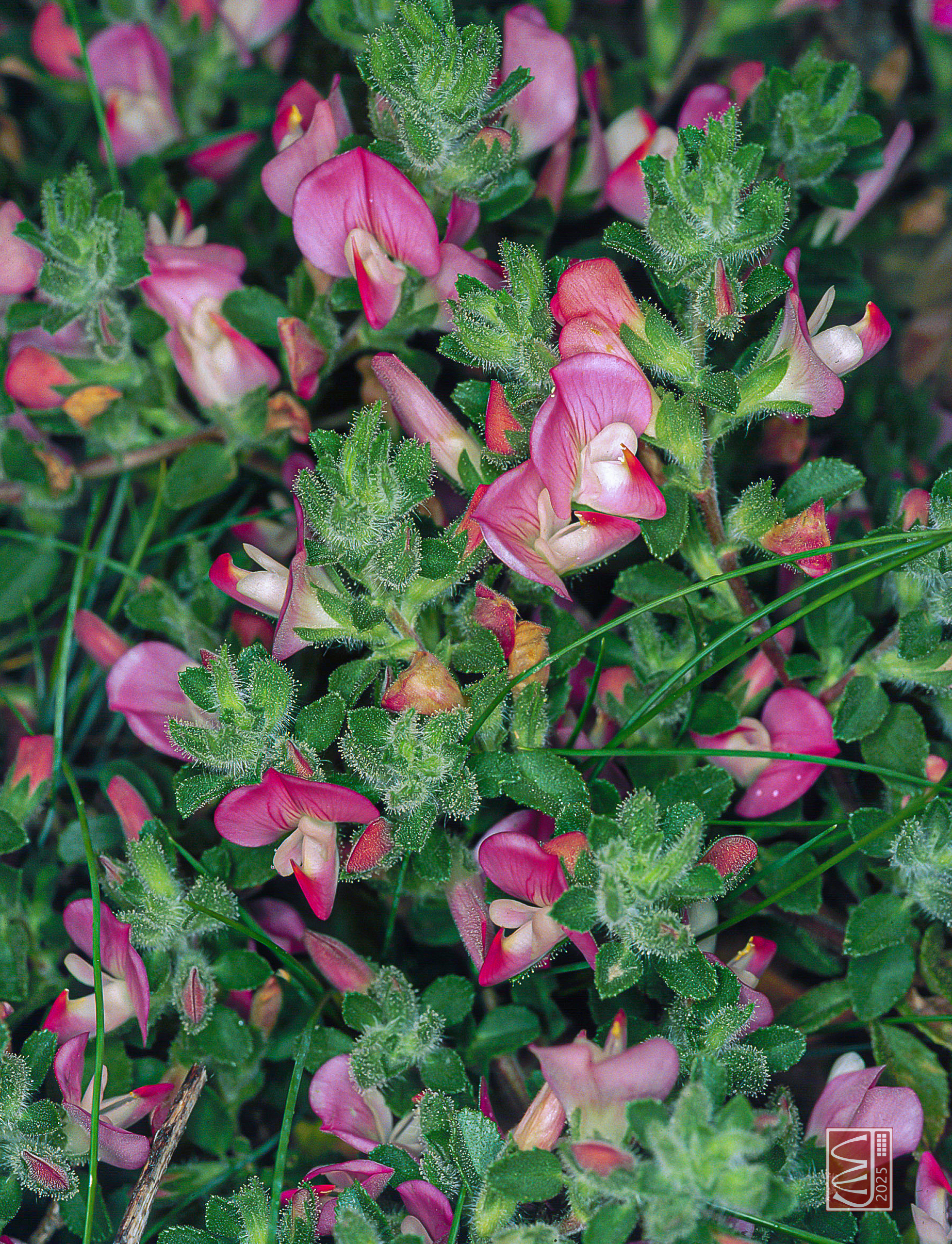
Ononis repens – December 8th 2025 – Common Restharrow
I always look out for this plant when I’m at the coast. These days, that’s where it is generally found. In our urban flora project, it turns up mostly on coastal paths and dunes, although sometimes in derelict industrial sites.

Two species of Ononis by Johann Georg Sturm (Painter: Jacob Sturm), Public domain, via Wikimedia Commons. Note: O . natrix does not occur in the British Isles.
But Ononis repens hasn’t always been a coastal species; it was once an agricultural weed. John Gerard’s Herbal of 1597 states:
Those grow in arable grounds in fertile pastures, and in the borders of fields, in a fat, fruitful, and long-lasting soil: it is sooner found than desired of husbandmen, because the tough and woody roots are cumbersome unto them, for that they stay the plough, and make the oxen stand.
The herbal also says:
the root is long, and runneth far abroad, very tough, and hard to be torn in pieces with the plough, insomuch that the oxen can hardly pass forward, but are constrained to stand still, whereupon it was called Rest-plough, or Rest-Harrow.

Detail of flower. Note also the hairs on the stem and leaves. Image: Chris Jeffree
Evidently it gets the strange name of Restharrow from a time when it was an agricultural weed, hindering the ploughing and tillage of the farmers’ fields. The farmer would need to rest the oxen to untangle the harrow from the plant. But Restharrow is no longer considered a weed. Presumably agricultural technologies including herbicides have banished it from farmland and now it lives by the seaside and on gravelly soil elsewhere.

Flowers arise from the axils of leaves, colours vary but mainly pink and white. Image: Chris Jeffree.
Restharrow is a native perennial in the pea family (Fabaceae). This creeping hairy plant makes roots along its stems and forms long woody rhizomes. Sometimes spines are present. The flowers are pea-like and pink, appearing from June to September, and they are visited and pollinated by bees. It produces pea-like seed pods, but with only one seed. Contrary to what Gerard wrote, it can grow in very poor soils from mildly acid to mildly alkaline, but the soil must be well-drained (whatever did Gerard mean by “fat, fruitful, and long lasting soil’). The plant is seldom found in shade. It does occur inland, often on gravelly road verges and poor grasslands.

An unusual habitat for this species, the edge of a pavement. Image: Chris Jeffree.
Like most members of the pea family, it has root nodules that house nitrogen-fixing bacteria, capable of capturing nitrogen gas from the atmosphere (N2) and turning it into ammonia and other nitrogen compounds that are eventually released into the soil and become available to boost plant growth. Restharrow may not do this on the scale of clover (Trifolium repens) which can supply 100-200 kg of nitrogen (N) per hectare per year to a farmer’s field.

Distribution of O. repens (left) and O. spinosa (right) in Britain and Ireland, suggesting both species are in decline. Some O. repens plants have spines, and may have been recorded erroneously as O. spinosa so the comparison may not show a completely true picture.
There is another Restharrow in the British Flora, Ononis spinosa, which closely resembles O. repens and can be confused with it. Some botanists reckon there is only one species, O. spinosa and that O. repens is merely a subspecies1. In Stace’s New Flora of the British Isles the two species are well separated by simple characters: repens has stems that are hairy all round and leaflets that are less than three times longer than broad whereas spinosa has hairs in one or two rows and leaflets that are more than three times longer than broad. Moreover, O. spinosa is much more likely to have spines and more likely to be upright instead of sprawling. A complication is that hybrids occur, although they are never common and they produce less seed. A recent publication from the Natural History Museum, London, tries to settle the controversy of whether we have one species or two (Skilbeck and Wilcox 2025)2.

Country distribution of O. repens. Green denotes the native range, purple represents regions where the species has been introduced, and orange means ‘uncertain’.
These authors review some of the old literature, which is often highly revealing. For example, when O. spinosa is grown on rich soils with high moisture, it becomes spineless and has the characteristic “goaty” odour of O. repens. It turns out that O. spinosa has 30 chromosomes (= diploid) and O. repens has 60 (= tetraploid). The hybrids have 30 chromosomes not the 45 that might be expected.
Once more, we face the question ‘what is a species’?. The simple answer is that a species as a group of organisms that can interbreed and produce fertile offspring. In the case of the two Restharrows the hybrid seems more or less infertile, and so we may consider repens and spinosa as two separate species (Stace et al. 2015).
Historically, Ononis has been used in tradional medicine, having been used as a diuretic for urinary issues and to treat kidney stones and rheumatoid arthritis. I found that O. spinosa is more often offered by online merchants than O. repens, especially as a tea.
Notes
The image at the head of the article is by Chris Jeffree.
1Kew’s Plants of the World Online does this, and so does Sell & Murrell’s (2009) Flora of Great Britain and Ireland Vol. 3 Mimosaceae – Lentibulariaceae, Cambridge University Press. Ononis repens then becomes known as Ononis spinosa subsp. procurrens.
2This paper is open-access and you can view it by clicking here.
References consulted
Ivimey-Cook RB (1969) Investigation into the phenetic relationships between species of Ononis L. Watsonia 7, 1-23.
Larson, James L. “The species concept of Linnaeus.” Isis 59.3 (1968): 291-299.
Skilbeck CA and Wilcox M (2025) Variation in the Ononis repens group (Fabaceae): implications for species determination and conservation British & Irish Botany 7(2): 98-115.
Stace, C.A., Preston, C.D. & Pearman, D.A. 2015. Hybrid Flora of the British Isles. London: Botanical Society of Britain and Ireland.
©John Grace