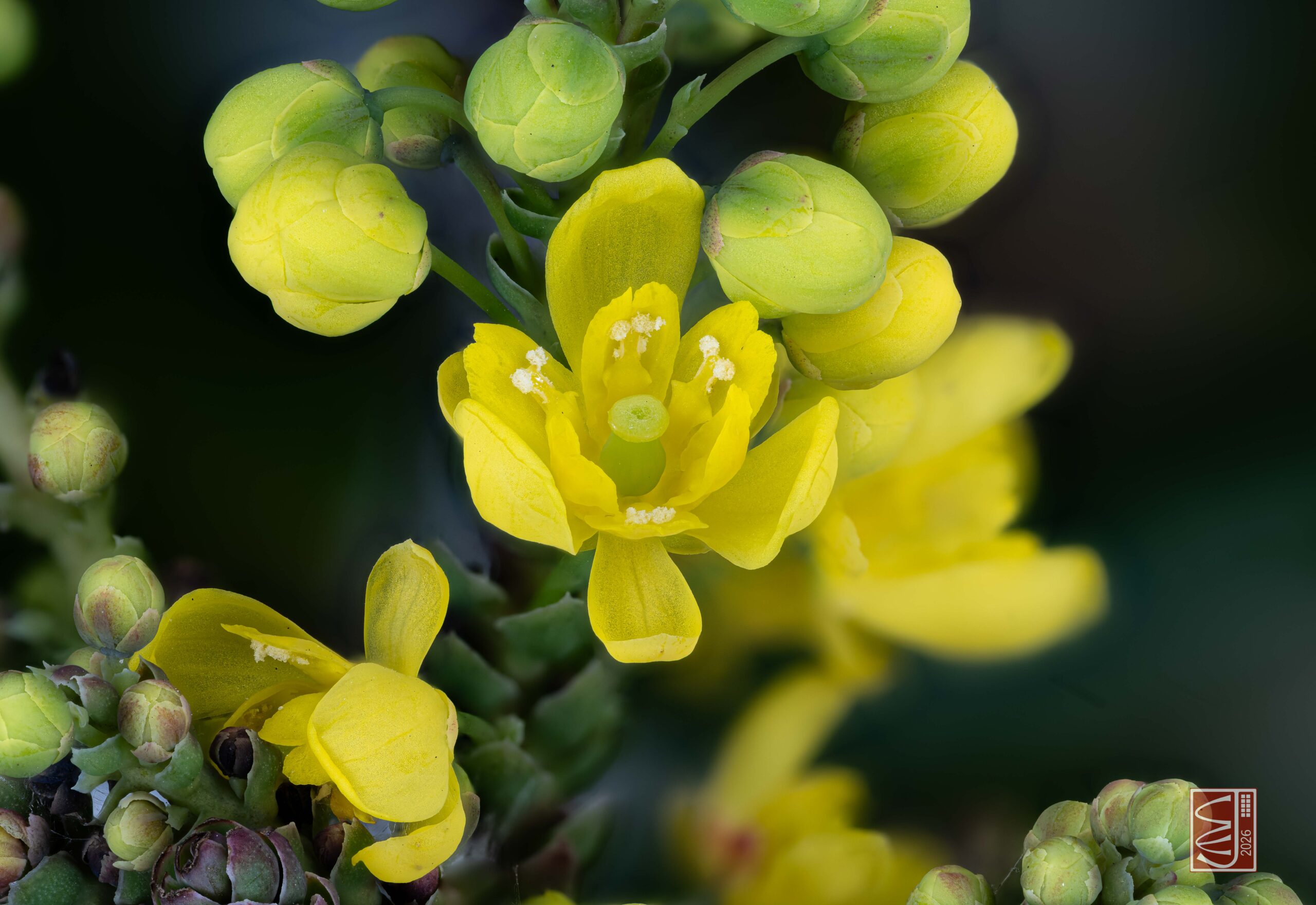
Mahonia aquifolium – March 9th 2026 – Oregon Grape
It’s flowering now, with bunches of lemon-yellow flowers on display in gardens and in the wild. It has prickly leaves and it’s a shrub that grows to about 2 metres. It came to Britain as a garden plant in 1823 from the Pacific coast of North America (British Columbia, Oregon, California and Arizona). Evidently it likes it here, and now it grows and reproduces itself in the wild. It has found its way into many parts of Europe, West Himalaya and Australia.

Mahonia aquifolium, silhouette to show shape of the bush (left) and racemes of flowers (right)
The genus Mahonia is named after Bernard M’Mahon, who emigrated from Ireland to Philadelphia in 1796 and became one of North America’s most celebrated horticulturalists, famous for his book The American Gardener’s Calendar and his association with Thomas Jefferson, the third President of the United States.
There are many Mahonia species in the world, and some have been adopted by European gardeners. Mahonia is a close relative of Berberis, although superficially dissimilar. For example, the leaves of Mahonia are large and pinnate whereas Berberis has small entire leaves; moreover the stems of Berberis are spiny whereas in Mahonia they are not. Some authorities have renamed Mahonia as Berberis, but for this blog we are following Stace’s Flora of 2019 (and the BSBI Atlas 2020) and sticking to Mahonia. Both Berberis and Mahonia belong to the Family Berberidaceae.

Mahonia aquifolium leaf showing general arrangement of leaflets (left) and the extremely sharp spines on the leaf margins (right). Images: John Grace.
Mahonia aquifolium is evergreen, capable of surviving in the harshest of winters, and sprouting readily when cut back. Its leaves are dark green, spiny and leathery, and not attacked by herbivores (as far as I can tell). It also has rhizomes, and so the bush gradually increases in area occupied. In July, it produces abundant fleshy fruits, which are taken by young blackbirds and thrushes, and thus its seeds are spread. With these formidable traits one might expect it to be invasive. Is it?
Indeed, it can be invasive. Auge and Brandl (1997) say it is “an aggressive invader of some forests in central Germany” and Ross (2009) has focussed on Mahonia aquifolium in the German context as a model species to study how plants become invasive. She found, rather surprisingly, that the invasive Mahonia aquifolium was genetically distinct from the original North American native Mahonia aquifolium. It turns out that there are three closely related species in Germany1. Hybrids between them, and several horticultural cultivars of Mahonia occur in central Europe, and in the process of ‘domestication’ there has been inadvertent transfer of pollen and deliberate selection for vigour (selection for being tall, easily established and fast-growing – producing the attractive plants that are finally on the market). It seems the garden version of the species combines the ‘best of all of worlds’. When grown alongside each other, the garden Mahonia showed a strongly increased size compared to the native species. Horticultural breeding and selection has produced cultivars that are ‘fit’ in all habitats and, thus, are ‘Jacks-of-all-trades’. When they escape from gardens, they continue to be vigorous and hence they tend to be invasive.

Flower structure of Mahonia. In the upper image the stamens are fully open. When touched (usually by an insect but in this case by a human) the stamens rapidly close and deposit pollen on the face of the insect (see Li et al. 2022 for a more detailed description). These images are of Mahonia japonica at the Royal Botanic Garden Edinburgh, by Chris Jeffree.
This process may explain why alien species can take more than a hundred years before introduced plants become ‘invasive’. They become invasive because in the process of ‘domestication’ we inadvertently apply selection pressures and so make them different from their wild ancestors. I find this idea very interesting, and I wonder how far it applies to the invasive species of the British Isles, particularly Giant Hogweed, Japanese Knotweed and Himalayan Balsam.

Ripe fruits, resembling grapes in appearance, covered with a blue-grey wax. Attribution: VIEX, CC BY-SA 3.0 https://creativecommons.org/licenses/by-sa/3.0, via Wikimedia Commons
I can find no evidence of it being invasive in Britain. In former times it has been planted on large estates to provide cover for birds. In towns and cities, we find it in gardens, churchyards, at roadsides, in deciduous woodlands and by rivers, but always appearing as a single bush.
One of the old attempts to understand how alien plants became invasive was ‘the rule of ten’ (Williamson and Fitter 1996). The idea supposes four stages towards becoming a pest: 1. Importation 2. Introduction to gardens 3. Escaping to become established in the wild 4. Becoming a pest. The rule of ten states that there is a 10 percent chance of transition from one stage to the next. I like this as an idea because of its simplicity, but it doesn’t really work (Williamson and Fitter 1996 debunk it). However, it does remind us that ‘becoming a pest’ takes time, and part of this process may be an evolutionary change as Ross convincingly showed in the case of Mahonia.
The North American name Oregon Grape reflects the US State where the plant is native, and where it became the state flower in 1899. The flowers have an unusual feature: the six stamens are sensitive to touch, and they move inwards when touched by an insect visitor, thus depositing their pollen on the insect’s body and enhancing cross pollination. Quoting a recent article “Stamens of Berberis and Mahonia are inserted between paired nectar glands and when touched by an insect’s tongue rapidly snap forward so that their valvate anthers press pollen on the insect’s tongue or face”.

Mahonia aquifolium distribution in Britain and Ireland, from BSBI/Maps
Native Americans used the plant to treat skin diseases, and it was introduced into ‘modern’ medicine in 1886 by Parke, Davis & Co., America’s oldest and once the largest drug maker. For an up-to-date review of the medicinal use and the chemical compounds involved, see Andreicut et al. (2018). There are many on-line offers of a psoriasis ointment for treatment of a variety of skin conditions
In common with other Family members, Mahonia aquifolium contains the yellow compound berberine which is used in Chinese medicine to treat a wide range of ailments, but this compound is not available on prescription in Western countries. A recent review (Song et al. 2020) concludes “evidence from clinical investigations is insufficient, and further clinical research should be conducted in the future”.
References
Andreicut AD et al. (2018) Anti-inflammatory and antioxidant effects of Mahonia aquifolium leaves and bark extracts. Farmacia, 66(1).
Li D F et al. (2022) Touch-sensitive stamens enhance pollen dispersal by scaring away visitors. Elife, 11, e81449.
Ross CA (2009) Invasion success by plant breeding: evolutionary changes as a critical factor for the invasion of the ornamental plant Mahonia aquifolium. Wiesbaden: Vieweg+ Teubner.
Ross CA and Auge H (2008) Invasive Mahonia plants outgrow their native relatives. Plant Ecology 199.1, 21-31.
Song D et al. (2020) Biological properties and clinical applications of berberine. Front. Med. 14, 564–582.
Williamson M and Fitter A (1996) The varying success of invaders. Ecology, 77, 1661-1666.
Notes
1In Britain we have hybrids between M. aquifolium and M. repens, called the Newmarket Oregon Grape and possibly also M. aquifolium x M. pinnata. Other Mahonia species are found in Botanic Gardens, and there is always the possibilty of escape into the wild.
©John Grace