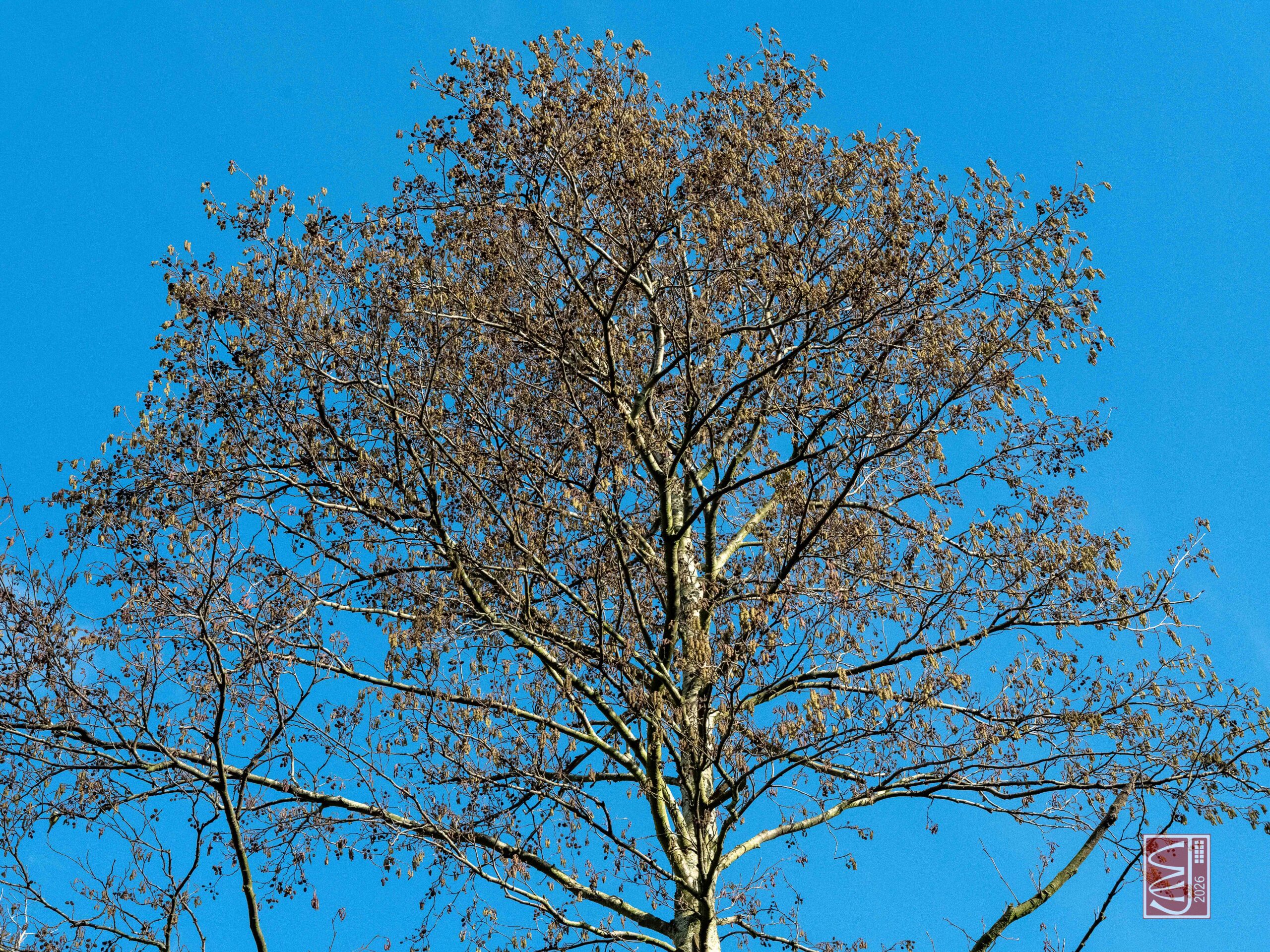
Alnus glutinosa – March 16th 2026 – Alder
Alnus glutinosa is a native tree that can grow up to 30 m tall, found in damp woods and by the sides of streams. It has a few less-common relatives that have been introduced from afar: Italian Alder (A. cordata), Red Alder (A. rubra) and Grey Alder (A. incana). To tell the difference between them, there are useful sketches of leaf shapes in Stace (2019).

Alnus glutinosa, Alder. Painting by Prof. Dr. Otto Wilhelm Thomé in Flora von Deutschland, Österreich und der Schweiz 1885, Gera, Germany, Public domain, via Wikimedia Commons
Alnus glutinosa is very common throughout the British Isles, and Scotland is no exception. It thrives on riverbanks and flushes, but is also found in mixed woodland, including ancient woodland, along spring-lines and flushes and at the edge of forests. It is not fussy about soils but prefers soil with a pH in the range 5.5 – 7.2.

Root nodules formed by Frankia alni on Alnus roots. Photo: Cwmhiraeth, Creative Commons (Wikipedia)
It has the remarkable property of being able to fix atmospheric nitrogen, thanks to a symbiosis with the bacterium Frankia alni, which forms large nodules on the roots. It can therefore live on soils which are low in nitrogen, and over decades it will build soil fertility. Hence it is often planted in reclamation projects, for example on accumulated waste from coal mining. To help it on its way, and especially to obtain phosphorus and other mineral nutrients it has known associations with over 20 species of ectomycorrhizal fungi (Tedersoo et al. 2009). It is also known to tolerate mildly saline conditions.

The pendulous structures are the male ‘catkins’ and the structures at the top of the image are the female ‘cones’. Image: Chris Jeffree.
Its flowers are catkins and cones that appear in early spring, often before leaves, with male and female structures on the same tree. Male catkins are long, pendulous, and reddish-yellow. They produce copious amounts of wind-borne pollen in late winter and early spring, typically February to April. The female structures are smaller, upright, red-to-green and they turn into woody, cone-like, persistent fruits. Reproduction is exclusively by seed: there are no ‘suckers’. Alnus does not fruit every year but the vagaries of weather are sufficient to account for the irregularities of fruiting, which vary from place to place and from year to year.
The seeds are small (about 1.4 mg.), flattened and not adapted for wind dispersal: it is estimated that the typical distance seed is conveyed by wind is only 30-60 m, and seedlings are rarely found more than 20-30 m from the female parent unless carried by water. But seeds are buoyant and waterproof, so that seed that falls into moving water may be carried a long distance, until stranded on the stream bank.

The female inflorescences (generally called cones) onto which pollen is deposited. Image: Chris Jeffree.
In common with several of our trees, Alder suffers from a disease caused by a species of Phytophthora. First discovered in Southern Britain in 1993 and named Phytophthora alni, the disease is now widespread in Europe, and recorded also in North America (Alaska andOregon). In earlier times, Phytophthora was thought to be a fungus, however it is neither a fungus nor a bacterium, but an oomycete, belonging to a rather strange group of organisms that have cellulose cell walls (unlike bacteria and fungi) and self-motile zoospores that swim in water films, as in many algae. It causes the root and base of the stem to rot. Infected trees have small, yellow and sparse leaves. Some trees survive and others die. P. alni is variable in its genetic make-up and virulence; the trees also vary and hence there are some survivors.

‘Cones’ infected by Taphrina alni a pathogenic fungus that causes alder tongue gall. Image: Chris Jeffree.
Recent research at Forest Research (Northern Research Station, Penicuik) shows that P. alni is often present in forest nurseries and presumably it spreads when plant material is exchanged between nurseries (Green et al. 2025).
The history of Alnus glutinosa in the British Isles has been revealed by pollen from bogs and lake sediments. A. glutinosa arrived in what are now the British Isles soon after the last retreat of the ice but it was not common at first. There was, however, a sudden increase of Alder in the Atlantic period, 6200-3800 BCE. Rackham (2015, p.72) remarks of this episode “The Atlantic Period began with a sudden rise of alder, which had previously been present throughout Britain and Ireland, and now became one of the dominant trees. This is something of a mystery: it has been attributed to the climate getting wetter and the ground becoming sodden, but alder is a tree of flushed, not waterlogged, ground, and is not very dependent on high rainfall. Moreover, if this were the explanation, the change should have been most marked in drier regions, which it was not”. Tallantire (1992) and King and Ferris (1998 and 1990) are also interesting on the paleohistory of Alnus glutinosa. A possible explanation is that Britain experienced alternations of drought and flood at this time, which would have favoured alder. It is predicted that current climate change will bring more droughts alternating with more floods, and it may be necessary to reserve sacrificial floodplains upstream of riverside towns, for protection. In which case, we may perhaps see an increase in alder, and we should, therefore, perhaps be looking for more ways to utilise its wood; the traditional uses mentioned below are probably mostly no longer viable!

Alder in an urban setting by the River Tyne, Haddington. Image: Chris Jeffree.
Alder produces one of the most useful kinds of wood. Remarkably, the city of Venice is built on piles made of Alnus (Nakasako 2018). The wood of certain alder species is often used to smoke various food items such as coffee, salmon and other seafood. Alder bark contains the anti-inflammatory salicin, which humans metabolize into salicylic acid, and A. rubra has therefore been traditionally used medicinally by native Americans.

Global distribution of A. glutinosa according to GBIF. Its native range is most of Europe, southwest Asia and part of northern Africa.
Alder wood (A. glutinosa) is durable under water (but not when dry), and has therefore been used to construct boats, sluices, and, in olden times, pipes. In Scotland it was used to make tubs to store butter in bogs. It coppices well and makes excellent charcoal for gunpowder: an A. glutinosa coppice was established near the Royal Gunpowder Factory near Waltham Abbey for just this purpose (Rackham, p.167). It was used to make clogs and charcoal in times past, and had many other uses in mediaeval times for which it has now been replaced by the wood of conifers. The wood is said to be preferred by woodworm and was put in cupboards to attract egg-laying woodworm away from the wood of the cupboard. Alder bark and wood contain tannin and are traditionally used to tan leather. It is used to make the bodies of the best electric guitars (including Fenders), veneers, pulp and plywood. It carves and turns easily, glues well, and looks much like birch. It seems to be under-utilized at present. In favourable conditions the tree grows fast and the wood may become a useful source of bioenergy (Aosaar et al. 2002).
If you are interested in the uses of this tree, and wonder why it is not used more often in Britain, visit this article in Forestry Journal, where it was a Tree of the Month in 2023. https://www.forestryjournal.co.uk/features/23367645.common-alder-forestry-ignore-species-potential/
References Consulted
Aosaar J et al. (2012). Biomass production potential of grey alder (Alnus incana (L.) Moench.) in Scandinavia and Eastern Europe: A review. Biomass and Bioenergy 45 11-26.
Banaev EV and Bažant V (2007). Study of natural hybridization between Alnus incana (L.) Moench. and Alnus glutinosa (L.) Gaertn. Journal of Forest Science 53(2) 66–73.
Bennett D and Birks HJB (1990). Postglacial history of alder (Alnus glutinosa (L.) Gaertn.) in the British Isles. Journal of Quaternary Science, 5(2) 123-133.
Brasier CM et al. (1995). An unusual Phytophthora associated with alder mortality in Britain. Plant Pathology. 44, 999–1007.
Green S et al. (2025). The prevalence of Phytophthora in British plant nurseries; high-risk hosts and substrates and opportunities to implement best practice. Plant Pathology, 74, 696–717.
McVean DN (1955). Ecology of Alnus glutinosa (L.) Gaertn.: I Fruit formation. Journal of Ecology, 43, 46-60.
Nakasako E (2018). A Look at Venice: Past and Present. Illumin. University of Southern California.
Rackham O (2015). Woodlands. William Collins (Harper Collins), London.
Stace C (2019). New Flora of the British Isles, 4th edition. C & M Floristics.
Tallantire PA (1992). The alder [Alnus glutinosa (L.) Gaertn.] problem in the British Isles: a third approach to its palaeohistory. New Phytologist 122(4) 717-731.
Tedersoo L et al. (2009) Revisiting ectomycorrhizal fungi of the genus Alnus: differential host specificity, diversity and determinants of the fungal community. New Phytologist 182, 727-735.
Thiem D et al. (2023). Endophytic microbiota and ectomycorrhizal structure of Alnus glutinosa Gaertn. at saline and nonsaline forest sites. Scientific Reports, 13(1), 22831
Webber J, Gibbs J and Hendry S (2004). Phytophthora disease of Alder. Forestry Commission Information Note (FCIN6).
©John Grace