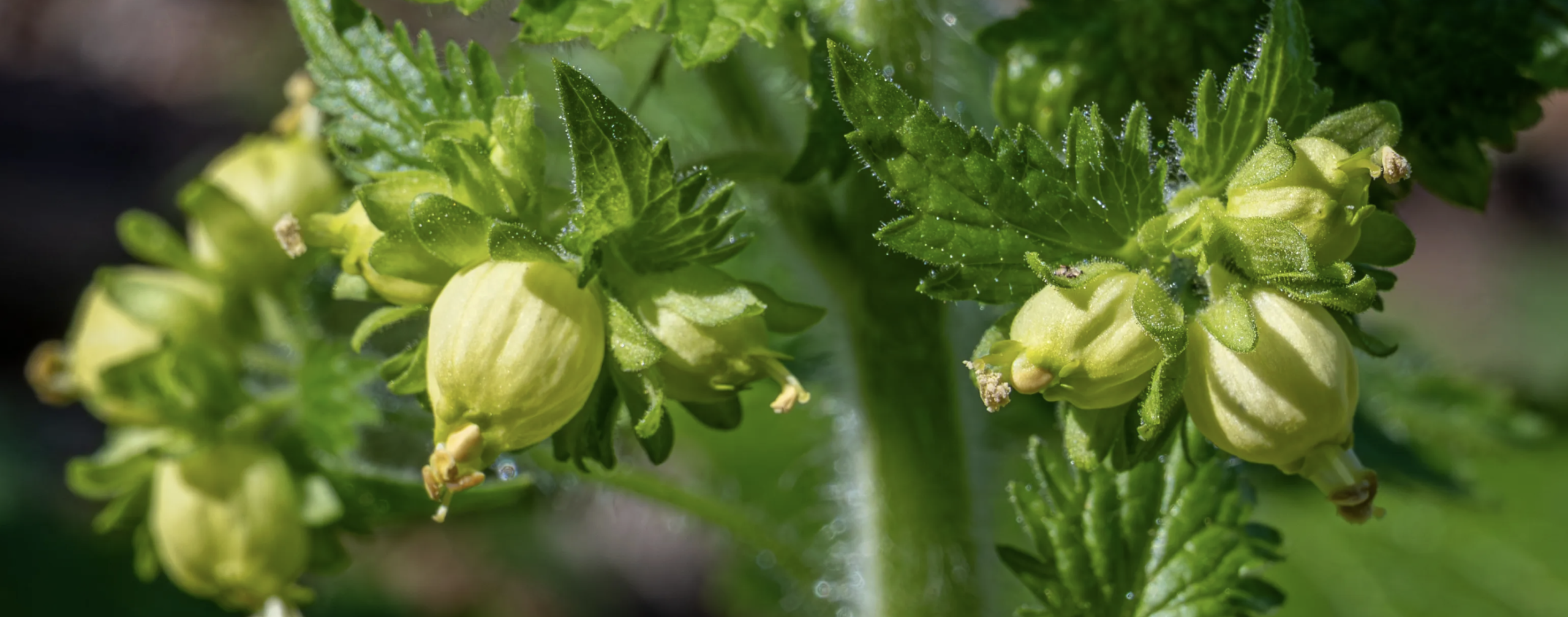
Scrophularia vernalis – March 30th 2026 – Yellow Figwort
How best to celebrate the coming of spring? You may have noticed that we try to mark the awakening of plant life by featuring plants that are spring flowering. The first we covered was a common plant, the Lesser Celandine (Ficaria verna), seen flowering in late December at a roadside in Ayrshire. It’s a familiar friend, in full flower almost everywhere now. This week, in contrast, we present a relatively rare and unfamiliar flower of Spring, the Yellow Figwort (Scrophularia vernalis).

Old painting of Scrophularia vernalis (Johann Georg and Jacob Sturm), Public domain, via Wikimedia Commons. The flower structure is well shown as in all of the Sturm paintings.
Have you noticed that spring flowers are nearly always white or yellow? I think that’s because most insect pollinators can’t see red (except for some butterflies and dragonflies). Insect eyes work well in the ultraviolet, blue and yellow, but they are blind in the red part of the spectrum. The tiny flowers of early-flowering annual species (Common Whitlowgrass, Bittercresses and Thale Cress) are white. They produce no pigment, presumably because pigment is ‘expensive’ for them to produce and they’ve just grown from small seeds that have very little food reserves. Biennial and perennial species with a large flowering effort (such as dandelions and Yellow Figwort) can ‘afford’ to have pigments as they are able to call upon their stored reserves for fuel.

Flowers are bladder-like with protruding stamens and stigma. Image: Chris Jeffree.
Yellow Figwort is a winter-green biennial, but some say it is perennial. It is an unusual plant, largely ignored by researchers, but illustrated and mentioned as a garden plant in the 1633 edition of Gerard’s Herbal. The description is useful even today, though we may occasionally smile at ye olde English:

The author obviously thought it was a perennial plant and the image presented in his book shows a substantial rhizome (as evidence). He wrote that it flowers in May; however, it now flowers in late March and April, a consequence (we presume) of the warmer climate.

Leaves are in opposite pairs and stems are square in cross-section, resembling the (unrelated) members of the dead-nettle Family. Image: Chris Jeffree.
We now know more about the history of this species. It is native of central and southern Europe and the Caucasus, but not especially common anywhere. It is found in several European countries including Britain, Belgium, Denmark, Netherlands, Poland and Sweden, regarded in those territories as an introduced species. When did it come to Britain? The BSBI Atlas says it was grown in gardens “by 1617” and first recorded in the wild in 1762.

Distribution in Europe, showing the clusters in Britain and the Benelux countries. From GBIF.
Its distribution in Britain and Europe is remarkably patchy, and it seems to favour countries where it is considered alien. A glance at the European distribution map shows many records in Belgium and the Netherlands but also in Scotland where it appears in the Lothians and the North-East. Why does it seem to shun England? Most of the records in the southern half of Britain are a few years old, so we can be sure it is declining there, whilst appearing to be spreading in eastern Scotland. Perhaps the English are tougher on weed control.

Distribution of Scrophularia vernalis in Britain and Ireland, from BSBI/Maps.
The BSBI Atlas 2020 describes the habitat preferences as “Occasionally grown in gardens and found naturalized on pavements, road verges and waste ground and in woodland clearings, plantations, hedgebanks and rough waste ground, usually in shade. Lowland”. The database of Henniges et al. (2022) shows it to be tolerant of shade and mildly tolerant of drought, but preferring rather fertile soils.
Its flowers are unusual, with the five petals fused to form a bladder-like structure. The flowers differ markedly from those of related species, such as the more common and familiar Scrophularia nodosa. One difference is that S. vernalis lacks any ‘staminoid’, the peculiar flap of tissue within the flower derived from the fifth stamen, which in some species of Scrophularia plugs the entrance to the flower, preventing rainwater from entering and diluting the nectar.

Flowers of the familiar red-flowered Scrophularia nodosa, which are more open. Image: Chris Jeffree.
The seed capsules contain about 40 seeds, each seed measuring around 1 mm. Edward Salisbury liked to estimate how many seeds any plant can produce (Salisbury 1961). For S. vernalis he reckoned on 47,000 seeds per plant, and said they are mostly wind dispersed with some help from birds.
As for the name of the plant, Scrophularia, it was used to treat scrophula, a form of tuberculosis affecting the cervical lymph nodes in the neck. The specific name vernalis is Latin for ‘of the spring’. The common name in English ‘Figwort’ refers to ‘figs’ an old term for haemorrhoids (piles). We are not sure how it was used for curing piles.
The Figwort Family, Scrophulariaceae, was formerly huge, with 275 genera and over 5,000 species. Molecular genetics demonstrated that unrelated species were mixed in with ‘true Scrophs’ and many have been unceremoniously removed, leaving 58 genera and about 1,830 species.
References consulted
Arnold SEJ (2020) Flowers through insect eyes: the contribution of pollinator vision to the evolution of flower colour. PhD thesis, Queen Mary, University of London.
Glover BJ (2009). The diversity of flower colour: how and why?. Colour in Art, Design Nature 33.
Henniges MC, Powell RF, Mian S, Stace CA, Walker KJ, Gornall RJ, Maarten JM et al. (2022) A taxonomic, genetic and ecological data resource for the vascular plants of Britain and Ireland. Scientific data 9, no. 1 (2022): 1.
Salisbury E (1961) Weeds and Aliens. Collins.
Scrophularia vernalis L. in BSBI Online Plant Atlas 2020, eds P.A. Stroh, T. A. Humphrey, R.J. Burkmar, O.L. Pescott, D.B. Roy, & K.J. Walker. https://plantatlas2020.org/atlas/2cd4p9h.ck4
Uzunhisarcikli ME et al. (2019) Scrophularia vernalis: a new species record for Turkey, and its comparison with S.chrysantha (Scrophulariaceae). Phytotaxa 397, 091–098.
©John Grace