Mibora minima – March 23rd 2026 – Early Sand-grass

Mibora minima, formerly called Chamagrostis minima. Reproduced from Flora Batava, a historical illustrated series detailing Dutch plants. Wikipedia, Creative Commons.
This is a very small annual grass – often claimed to be the smallest grass in the world. It typically grows to 2 or 3 cm, a natural dwarf. Agnes Arber writes about ‘nanism’ in grasses, and the fact that several common grasses can appear tiny, but she explains these are merely ‘starveling forms’ – if grown in good soil these starvelings become taller. But Mibora is a true ‘nana’.

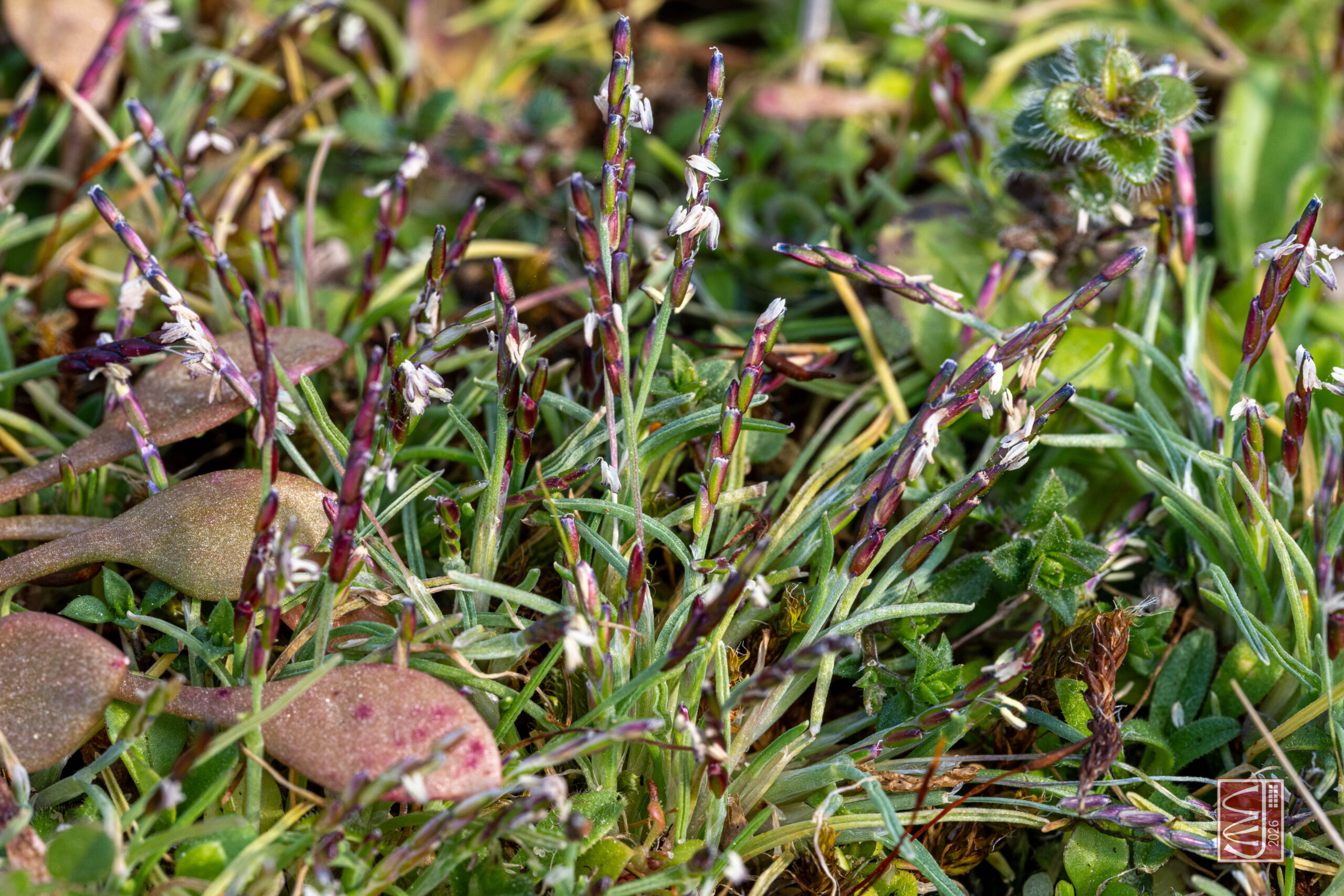
Images from East Lothian were taken in March 2026 at a species-rich rabbit-grazed scrape in dunes near Eyebroughy, a site which by now is well known to local botanists. Image: Chris Jeffree.
I can think of no great advantages of being very small and some serious disadvantages. A small plant is easily overgrown by tall neighbours and may be vulnerable to accidental damage. To avoid competition from taller plants any small plant must live in open conditions or complete its life cycle when other species are dormant. Mibora does both, by living on dunes (some authors found it on rabbit-scrapes around dunes, others saw it at the edges of paths). It’s a ‘winter annual’ germinating in autumn and completing its life cycle very early in spring. One of its old names is Mibora verna (verna=spring), another is Chamagrostis minima.

Mibora minima, Eyebroughy, East Lothian, March 2026. Image: Chris Jeffree
In Britain it is rare. In early books it is mentioned as being a rare native grass in Anglesey and cliff-tops in the Channel Islands. The earliest known record according to Pearman (2017) is from 1762 and was from Wallia (the mediaeval Latin word for Wales). Its name was then Agrostis minima. I searched records to find the earliest herbarium specimen. It’s deep in the Manchester Museum and came from Essex in 1840. As for Scotland, Hooker (1884) wrote that Mibora verna was ‘naturalised’ rather than ‘native’ in Haddington. He may have been thinking of a record by John Hutton Balfour from Gullane Links in 1851 (at that time Balfour was the Regius Keeper of the Royal Botanic Garden, Edinburgh). There is also a specimen in the British Museum, dated 1851, collected from Gosford Links by J.T. Syme. Rare plants on a golf course, really? Were these gentlemen mistaken? More likely the golf courses of those days were unlike the closely mown courses of today, and perhaps these small plants were rooted on disturbed sand of a dune system?

Figures 1, 2, show fully extended spikes with anthers exerted. 1 shows blue-purple rachis and red-pigmented florets. In Fig 3, the spikelet glumes are gaping open to showcaryopsis inside. Images: Chris Jeffree

Figs 4, 5, 6 Show young spikes pushing through the translucent leaf-sheaths. These early spikes show stigmas, but anthers come later. The entire membranous ligules are discernable. Images: Chris Jeffree
I wonder why Hooker thought the Haddington plants to be ‘naturalised’ rather than ‘native’? The usual meaning of that word ‘naturalised’ is that the plant is alien to a region i.e. came directly or indirectly through a human introduction (i.e. maybe someone planted it, or it escaped from a garden, or it came on someone’s boots – it grew, conditions suited it and it made a home there). But how did Hooker know?

Mibora minima habitat, Eyebroughy, East Lothian. Image: Chris Jeffree.
I tried to trace this story of this supposed ‘introduction’. Smith1 et al. (2002) record the plant as “Reputedly abundant along the shore at Gosford Bay, Gullane and Dirleton by the 1850s, and known to have been sown there”. They cite the source as JL Knapp, a botanist in Edinburgh in 1800; I searched online and found a facsimile of Knapp’s wonderful (and illustrated) early book from 1804 called Gramina Britannica. But Mibora isn’t in the index. Nor is the early name, Agrostis minima.

Habitat in Ireland at Bull Island, Dublin Bay. The grass grows on the track. Image: Claire Kenna
In recent times there are records mentioned in the BSBI’s Atlas 2020. They are from Glamorganshire (1964), Dorset (1993) and Lancashire (1996 and 2007). There are Irish records from West Cork (2005) and County Dublin (2019). In Scotland the grass was discovered in 2015 by a group of BSBI botanists visiting the Outer Hebrides, on dunes in the machair. This was an exciting discovery, hailed by some as ‘native’ as the coastal sites of the Outer Hebrides are remote and thus unlikely to have been visited by someone with seeds in his/her pocket or on their boots. Most of the other recent records may have been introductions, but we can never know.

From Bull Island, Dublin Bay. Car keys are shown to demonstrate scale. Image: Claire Kenna
Dune systems and coastal cliffs have attracted the attention of ecologists from early days. Many dunes have been turned into golf courses but plenty remain and they can still have a rich flora. Much research was carried out on plants of the Welsh dunes in the 1970s by staff and students of universities at Bangor and Manchester, and Mibora minima often features. We’ve pasted titles of some of the resulting publications in the reference list below, and here I’ll just mention some of the main conclusions from the Welsh work.
- There are several other small winter annuals that grow alongside Mibora minima, occupying the dryer parts of the dune slacks (damp in winter, very dry in summer).
- The ‘soil’ is extremely sparse in nutrients, especially nitrogen. When nitrogen fertilizer is added they respond strongly forming greater biomass and more seeds.
- When planted in mixtures in a cold frame to test how they interfere with each other, Mibora (although the smallest) holds its own in terms of competitive ability. The ranking in one experiment was Vulpia fasciculata > Phleum arenarium > Mibora > Cerastium atrovirens > Saxifraga tridactylitis.
- Mibora minimum is a wind-pollinated outbreeder. It has small spikelets that contain a single fertile floret with three anthers. The spikelets are protogynous (i.e. female parts mature before the male parts) and this arrangement forces outbreeding, as long as there are other individuals around.
- Geneticists and students of evolutionary theory should read the PhD thesis2 by Colin Ferris (1990) about the meiotic system and also look at what Cope and Gray (2009) have to say on this matter. It seems Mibora minimum does have some peculiarities which may either assist or prevent its adaptation to a changing environment (I have read both and confess I remain confused).

Distribution of Mibora minima in Britain and Ireland. From BSBI/Maps
What does the future hold for this rare grass? It is not so rare in Europe. In Britain it appears to be spreading very slowly, at least in some areas (Smith et al. 2011). It has been introduced into Australia and New Zealand. I was startled to read about its status in North America: “It is an invasive species on both sides of the Canada-United States border from Lake Huron east to Maine”.
Notes
1There are three botanists cited here all with the surname ‘Smith’. PM Smith was an Edinburgh botanist and grass specialist who sadly passed away in 2004, PH Smith is a BSBI member working in Merseyside and PA Smith is the BSBI Recorder for the Outer Hebrides.
2The PhD thesis can be downloaded free of charge if you have a university or research institute affiliation.
References consulted
Arber A (1934) The Gramineae. Cambridge.
Cope T and Gray A (2009) Grasses of the British Isles. BSBI.
Ferris C (1990) The genetic system of grasses with a restricted distribution in Britain. PhD Manchester University.
Hooker JD (1884) The Student’s Flora of the British Islands (third edition). MacMillan, London.
Knapp JL (1804) Gramina Britannica (facsimile, reproduced by google books)
Mack RN and Harper JL (1977) Interference in dune annuals: spatial pattern and neighbourhood effects. The Journal of Ecology .., 345-363.
Smith PA et al. (2015) Mibora minima in the north-west of Scotland, on Baleshare Island, North Uist (vc 110). BSBI News 130, 26-27.
Smith PH et al (2011) Changing status of Mibora minima on the Sefton Coast, Merseyside (vc 59). BSBI News 118, 28-32.
Smith PM et al. (2002) Plant life of Edinburgh and the Lothians. Edinburgh University Press.
Willis AJ (1989). Coastal sand dunes as biological systems. Proceedings of the Royal Society of Edinburgh, Section B: Biological Sciences, 96, 17-36.
©John Grace