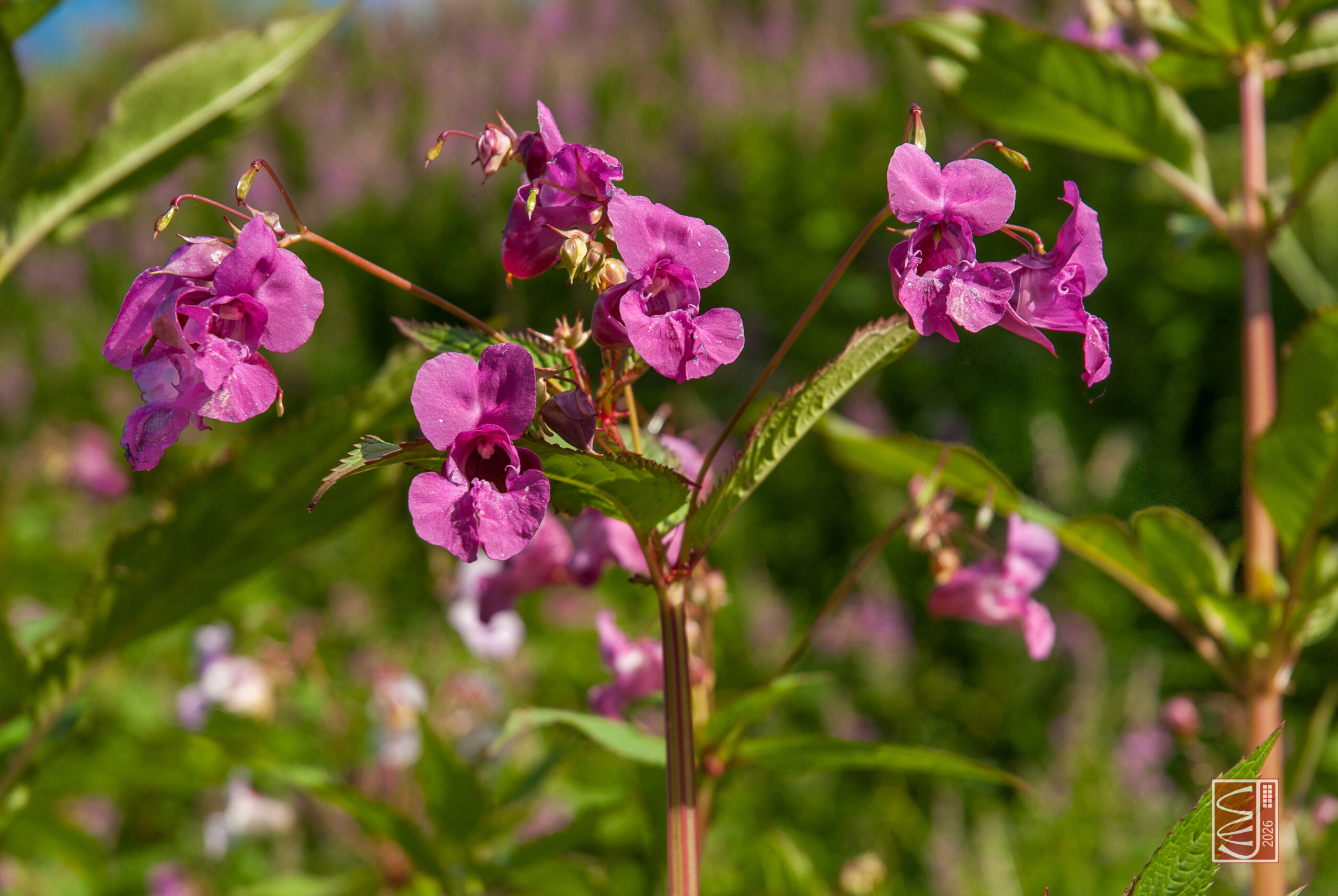
Impatiens glandulifera – July 20th 2026 – himalayan balsam
This week’s plant has the distinction of being the tallest annual species in the British flora – it grows up to 2.5 metres. It is an alien, coming from the Indian Himalayas where it lives in the foothills, ascending to 3000 metres where it takes its place in high altitude meadows. In its native range it also grows in roadside ditches and around field borders. It came to our shores as an ornamental garden plant in 1839, soon becoming a favourite of gardeners, but escaping into the wild shortly after that and becoming extremely invasive. Here, it occupies the banks of rivers, canals and watercourses, and is also recorded in woodland, grasslands, and waste ground.

Impatiens glandulifera. Dense stand beside railway embankment. Image: Chris Jeffree.
It prefers damp ground but is enormously tolerant of soil conditions (from very acid to alkaline, from nutrient poor to rich). It can grow in light shade, as it does at Blackford Hill, Edinburgh.
In British conditions, germination occurs from February to March and the plant grows rapidly after April. Flowering is from July to October, and abundant seeds are formed from mid-July. The seed pods open by a ballistic ‘explosive’ mechanism which you can see in slow-motion here in one of our earlier articles by Heather Forbes. Seeds are flung several meters from their source. There are several hundred seeds per plant.

Wheat field margin with Impatiens glandulifera and Papaver rhoeas, Inveresk. Image: Chris Jeffree.
The plant relies on bumblebees and honeybees for cross pollination, attracting them by producing copious nectar. Bees enter the flower to reach the nectar spur, but in doing so they brush off the anther cap, coating the insect’s back with pollen. When the bee visits another flower, pollen is transferred to the female stigma. As in many species, the flower is protandrous (i.e. pollen is shed before the stigma is receptive, a mechanism to encourage cross pollination), but the bees are likely to visit many flowers on a single sortie, old and young, so cross pollination is the norm.

Impatiens glandulifera flower, side view. Image: Chris Jeffree.
Like most invasive aliens, it is attractive to the human eye. I’ve seen roadside populations in south-west Scotland where the flower colours are sometimes mixed – shades of pink and purplish-pink to a pale pinkish-white, or even pure white, looking (in sunlight) like a painting by Seurat.

Impatiens glandulifera flower, front view. Seed pods in background (left). Image: Chris Jeffree.
Whilst we like to admire its looks and marvel at its biology, we see the harm it does. Growing up to 2.5 meters tall, it quickly shades out smaller native plants and absorbs available soil nutrients. Because it produces a massive amount of nectar, it frequently attracts pollinating insects away from native British wildflowers, which reduces their reproductive success. Its shallow root system fails to bind the soil together, leaving river-banks and canal-banks exposed to the elements, which greatly increases the risk of soil loss and flooding. Its seed dispersal mechanism ensures some seeds are washed downstream in floods, to become stranded on the shore and thus establishing more colonies.

Impatiens glandulifera, flower cut open to reveal androecium. The stamens form a compact group enclosing the stigma. Image: Chris Jeffree.
No wonder Impatiens glandulifera is a prohibited species on the UK Wildlife and Countryside Act 1981, Schedule 9, along with many other plants including Giant Hogweed Heracleum mantegazzianum and Japanese Knotweed Reynoutria japonica. These are the three most prominent and easily-identified invasive plants that attract pubic attention, and are often the target of actions by Local Authorities and groups of concerned citizens.

Seedlings of Impatiens glandulifera (foreground) and emerging leaves of Heracleum mantegazzianum (background) Image: Chris Jeffree.
An important question about this and the other large invasives, is: why do they grow so prolifically in our region? The ‘natural enemies hypothesis’ states that they do well because they find themselves no longer at war with natural enemies, those that have co-evolved with them in an ‘arms race’ in which the plants ‘spends’ carbon to ward off the danger. Enemies may be herbivores large or small, and/or a range of pests and diseases. Several researchers have been able to compare the growth of the plant in its native range with that in Europe (and North America), and broadly the hypothesis is supported. Impatiens glandulifera does tend to grow taller and has fewer enemies when in Europe than when in the Himalayas, although the data are somewhat equivocal (Tanner at al. 2020), and it may not be the whole story. An additional hypothesis that I especially like, is that introduced plants have undergone a degree of evolution in their new homes and so have become well-adapted to the new conditions, and enemies are few. This could apply especially to annual species like Impatiens glandulifera which has lived here for over a hundred generations of selection pressure. Not enough work has been done to test this idea (but see Wyatt et al. 2024 and Nagy et al 2015). The hypothesis is supported by long term records from the Czech Republic and Britain (Pyšek and Prach 1995). In both countries there was a lag in the number of records before exponential population growth began, and we may speculate that the lag phase preceded the point where adequate ‘fitness’ evolved.
Does the plant have value, other than being pretty? Google tells me: “Seeds can be eaten raw or toasted, offering a great crunch for salads or stir-fries. Immature green seeds have a mild flavour, while black seeds are slightly bitter”.

Distribution of Impatiens glandulifera in Britain and Ireland. From BSBI/Maps.
Meanwhile, people struggle to control the spread, usually by pulling them out of the ground. They usually come out easily. But for long-term control, introduction of natural enemies may be desirable. A rust fungus Puccinia komarovii var. glanduliferae, from India and Pakistan infects Impatiens glandulifera, causing seedling mortality, reduced biomass, and lower seed production. Field releases of the fungus have been conducted across numerous catchments and counties, including sites in Yorkshire, Hertfordshire, and Essex. Time will tell whether this works.

Global distribution of Impatiens glandulifera from Kew’s Plants of the World Online. Green shows native range, purple shows introduced range.
For more images and text, see the 2020 blog by Heather Forbes, here. It includes a slow motion movie of seed dispersal.
References
Beerling DJ and Perrins JM (1993). Impatiens glandulifera Royle Journal of Ecology 81,367-382.
Coakley S and Petti C (2021). Impacts of the invasive Impatiens glandulifera: Lessons learned from one of Europe’s top invasive species. Biology, 10(7), 619.
Liu H and Stiling P (2006). Testing the enemy release hypothesis: a review and meta-analysis. Biological invasions, 8, 1535-1545.
Nagy AM and Korpelainen H (2015). Population genetics of Himalayan balsam (Impatiens glandulifera): comparison of native and introduced populations. Plant Ecology & Diversity, 8, 317-321.
Pollard KM et al. (2022). A semi-natural evaluation of the potential of the rust fungus Puccinia komarovii var. glanduliferae as a biocontrol agent of Impatiens glandulifera. Biological Control, 165, 104786.
Pyšek P and Prach K (1995). Invasion dynamics of Impatiens glandulifera—a century of spreading reconstructed. Biological Conservation, 74(1), 41-48.
Ramasubbu R et al. (2026). Floral morphology and pollination biology in impatiens: a comprehensive review. Arthropod-Plant Interactions, 20(1), 14.
Tanner RA and Gange AC (2020). Himalayan balsam, Impatiens glandulifera: its ecology, invasion and management. Weed Research, 60, 4-7.
Tanner RA et al. (2014). An ecological comparison of Impatiens glandulifera Royle in the native and introduced range. Plant Ecology, 215, 833-843.
Wyatt AL et al. (2024). Rapid morphological change in UK populations of Impatiens glandulifera. Sci Rep 14, 19275.
©John Grace