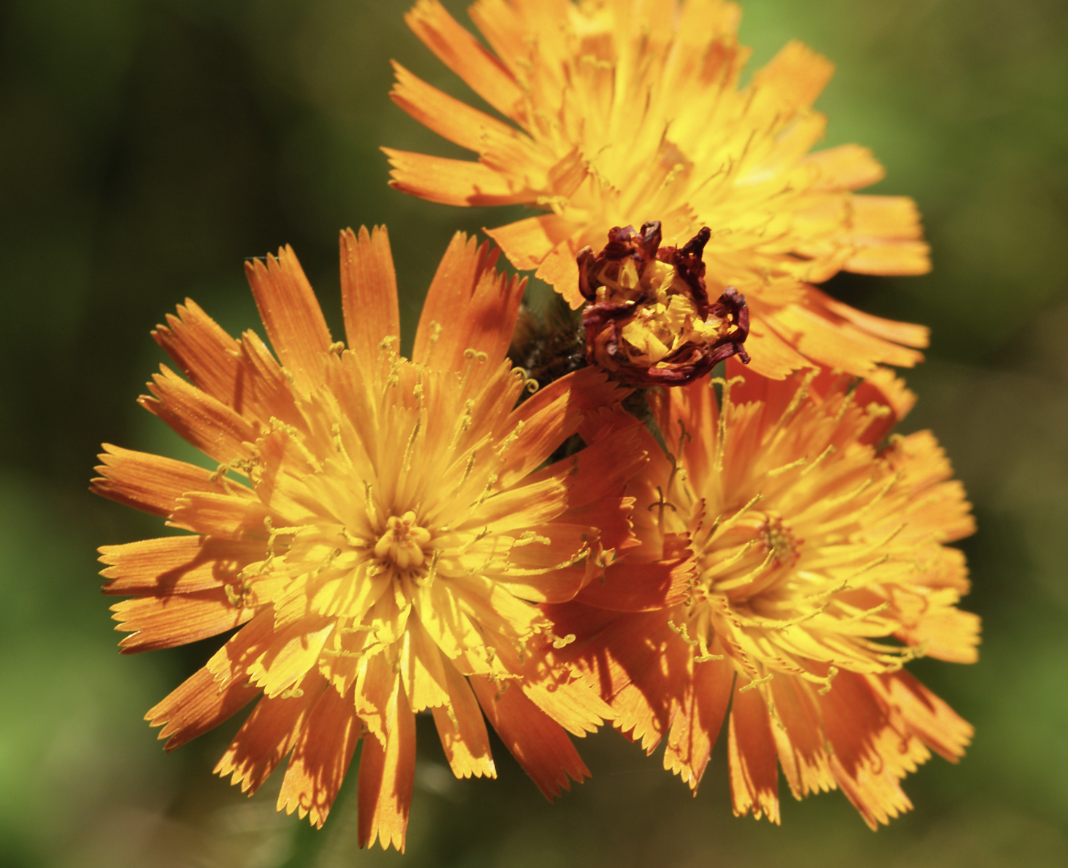
Pilosella aurantiaca – July 27th 2026 – Fox and cubs
A month ago my eye was drawn to a neglected allotment plot in the south of Edinburgh. Over the years, we have been delighted to find several unusual and sometimes rare species growing in good soil that should be feeding cabbages, beans and onions. This plot was mostly grass (Holcus lanatus, Yorkshire Fog) but the sward was dotted with the brick-red flowers of Pilosella aurantiaca (Fox-and-cubs). I realised how little I knew about this colourful species, and decided to learn more and write a blog about it.

Grass sward with Pilosella aurantiaca, on a neglected allotment in late June 2026 (Image: John Grace)
It was introduced as a garden plant from the European mainland around 1629. It escaped over the garden wall by 1793. It is strange that it took so long to escape, as its seeds are tiny and equipped with a ‘pappus of hairs’ . They are swept into the air by the slightest breeze, and no doubt many of them are deposited far away. In fact, when I brought some seeds home to photograph them, the slight draft from an open door (and even my hot breath) disturbed the careful arrangement of seeds on the table.

Flowers and seed heads from the plants shown above. Image: John Grace.
It belongs to the daisy Family (Asteraceae) and it is one of the hawkweeds. Most hawkweeds have yellow flowers and are in the genus Hieracium (the true hawkweeds). Their identification is quite a challenge as differences between species are subtle. Most are in the genus Hieracium, but many years ago some of them were split off from Hieracium and placed in a new genus called Pilosella (the mouse-ear hawkweeds). So Hieracium aurantiaca became Pilosella aurantiaca. The new name was slow to ‘catch on’ and in some parts of the world (especially North America) the old name persists, making my google-searches twice as time-consuming. One difference between Hieracium and Pilosella is that Pilosella has stolons (see the image below) and Hieracium does not. The stolons creep along the ground and produce daughter plantlets every few centimetres, creating a patch of new plants.

Macro-image of flower, showing stigmata protruding from 20-30 florets. Also note the sooty-black appearance af the bracts (‘phyllaries’) and the hiry stem. Image: Chris Jeffree.
Why are Hieracium and Pilosella called ‘hawkweed’? There is an ancient folk belief that hawks use the plant’s sap to sharpen their eyesight. Well, that’s far-fetched although the plants do contain many biologically active compounds and they have been used as a diuretic, an astringent, and a remedy for respiratory and urinary tract conditions. Another theory is that the seeds float around in the air like a hawk searching for prey.

The hairy leaves form a basal rosette, from which the flower stalk arises. This plant has produced three stolons which run along the surface of the soil and bear ‘daughter’ plantlets. Image: John Grace.
The ‘official’ common name for Pilosella aurantiaca in Britain is ‘Fox and cubs’. When the plant begins to produce its brick-red flowers, and with only one flower-head open, the buds surrounding the fox-coloured flower are supposedly the ‘cubs’. There are other names. One is ‘devil’s paintbrush’, another is ‘grim-the-collier’. The paintbrush name is easy to understand, given the vivid colour of the flowers, and ‘grim-the-collier’ is a reference to coal-mining, referring to the sooty-black flower-bracts, but who was ‘Grim’. We may never know. In North America the plant is simply called ‘orange hawkweed’.

Seeds are 2-3 mm long, each equipped with a pappus of hairs. Image: John Grace.
In its native European range, which extends from the Mediterranean to northern Norway, P. aurantiaca is typically found in alpine and subalpine meadows, mountain grasslands, woodland clearings, rocky slopes, and open forests. It thrives in cool climates with well-drained soils and moderate rainfall. In Britain it occupies a somewhat broader range of habitats. It commonly invades roadside verges, railway embankments, derelict areas, abandoned agricultural fields, lawns, churchyards, pastures, forest openings and edges of pavements. It grows successfully in sandy, gravelly, or loamy soils and tolerates both acidic and slightly alkaline conditions. Although it prefers full sunlight, it can survive under partial shade, allowing it to establish in woodland edges and open-canopy forests.

Pilosella aurantiaca was not commonly found as a wild plant before the 1960s2. The maps show how it has become more common: British and Irish distributions before 1970 (left) and currently (right). Drawn from BSBI/Maps.
Its flowers are frequently visited by flying insects (I have seen many bumble bees visiting the flowers in bright sunshine) and sexual reproduction is probably the norm. But some populations reproduce by ‘apomixis’, a form of asexual seed production where seeds develop without fertilisation. Unlike many ‘weeds’ the seeds are not long-lived. They begin to deteriorate after one year, and so there is no appreciable ‘seed-bank’.
Our native Pilosella officinarum (Mouse-ear hawkweed) looks a lot like P. aurantiaca except in the (mostly) yellow colour of its flowers. Hybrids sometimes occur.

Our native Pilosella officinarum (Mouse-ear hawkweed). The flowers are yellow, but note the red-tinge. The leaves are smaller than those of P. aurantiaca. Image: Chris Jeffree.
As mentioned already, this species was introduced to Britain many years ago and therefore has the status of ‘alien’ or neophyte. For me, the surprising feature is that in most of the countries where it has been introduced it is not just an alien but an ‘invasive alien’ to be eradicated. For example, in New Zealand “All Hieracium and Pilosella species, including Pilosella aurantiaca, are strictly prohibited from entry into New Zealand to prevent further spread”. In Britain I hear no complaints from farmers, gardeners or conservationists. Moreover, its seeds (and sometimes plug-plants) can be purchased from highly reputable sources. Are we to suppose that it grows more vigorously in North America than in Britain? If so, why? Are there genetic variants that are more vigorous? Are the British plants all genetically benign? Perhaps it shares common enemies with the closely related native plant P. officinalis, and those enemies serve to keep it under control? Someone should investigate these questions.

Global distribution of Pilosella aurantiaca, from Kew’s Plants of the World Online. Green shows the native distribution and purple shows the introduced range. It is also widespread in New Zealand (unfortunately off the map).
As I was finalising this article, I received images from Chris Jeffree of another species. This is Pilosella praealta (Tall Mouse-ear Hawkweed). It has yellow flowers with many crowded capitulae per stem. It can be up to 64 cm tall. Chris and Julia found it at Leith Sewage Works. It is rare – you may view its distribution on the BSBI web site here.

Pilosella praealta (Tall Mouse-ear Hawkweed). Image: Chris Jeffree.
Notes
1.The image on the front page is from wikipedia: Jörg Hempel, CC BY-SA 3.0 DE https://creativecommons.org/licenses/by-sa/3.0/de/deed.en, via Wikimedia Commons
2. As further evidence for its rarity before the 1960s: the 1965 book The Concise British Flora in Colour by Keble Martin does not illustrate Pilosella aurantiaca. It has Hieracium aurantiaca in the index but the image is missing from the page.
References
Bear JL et al. (2012). The seed ecology of two invasive Hieracium (Asteraceae) species. Australian Journal of Botany, 60(7), 615-624.
De Clerck-Floate RA et al. (2024). Pilosella spp., hawkweeds/piloselles (Asteraceae). Biological Control Programmes in Canada, 2013-2023, 543-558.
French K et al. (2025). Weed invasion increases after large-scale wildfires in remote alpine areas in Eastern Australia: K. French et al. Biological Invasions, 27(9), 209.
Krahulec F et al. (2020). Populations of Pilosella species in ruderal habitats in the city of Prague: consequences of the spread of P. aurantiaca and P. rothiana. Preslia, 92, 167-190.
Ladd D and Ladd D (2023) Another devil comes to town: Pilosella aurantiaca new to Missouri. Missouriensis, 41, 32-36.
Williams NSG and Holland KD (2007). The ecology and invasion history of hawkweeds (Hieracium species) in Australia. Plant Protection Quarterly, 22(2), 76.
©John Grace