Tanacetum vulgare – August 17th 2026 – Tansy
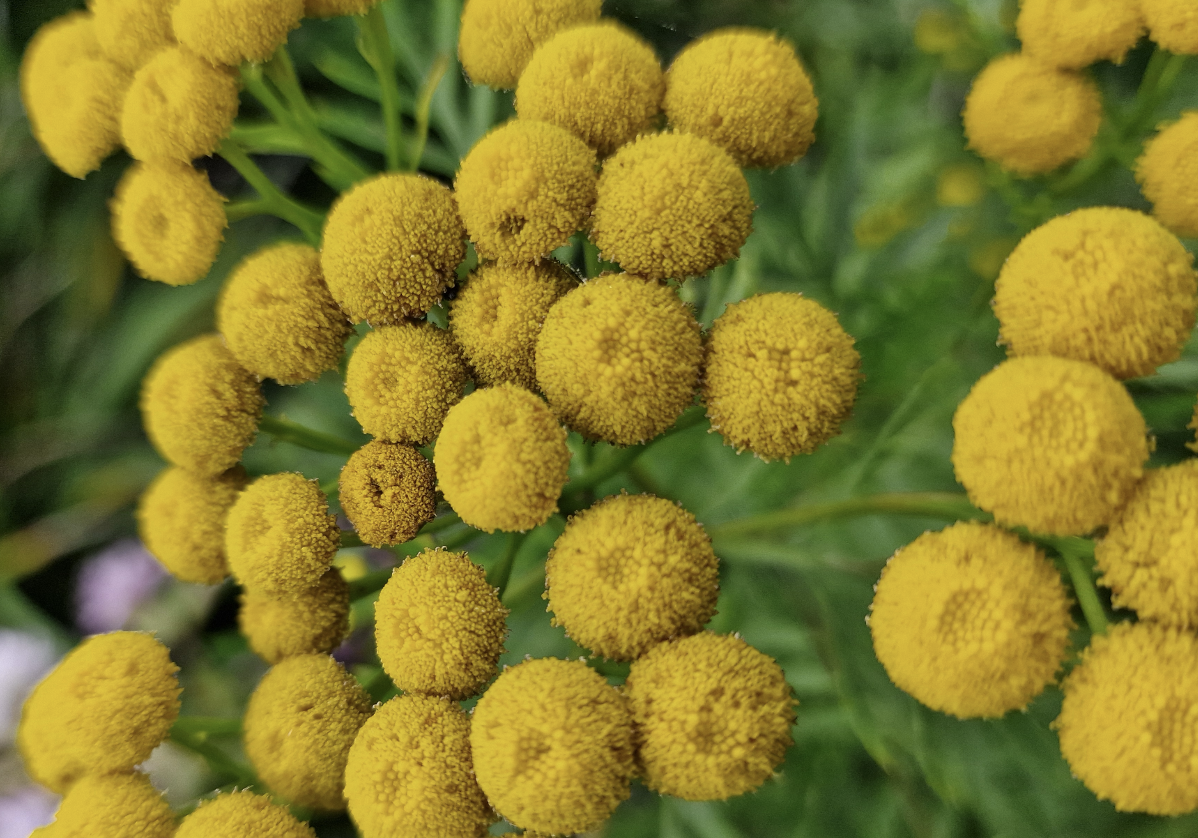
Tansy is flowering now, creating a fine display with its clusters of golden-yellow flower heads, button-like, on tall stalks. The leaves are much-divided, feathery and fern-like, and when crushed between the fingers they release a strong acrid smell, the first clue that this plant ‘packs a punch’.

Tanacetum vulgare, River Esk bank, Musselburgh. Image: Chris Jeffree.
It’s a native plant1 with a long folk history, grown in medieval gardens and used as medicine, insect repellent, and in food preparations. Today, some people still grow Tansy as a garden ornamental, but others frown on it as a persistent weed. It’s a perennial, with tubers and rhizomes, and once established in the flower-bed it can be difficult to eradicate.

Tanacetum vulgare, inflorescence. Image: Chris Jeffree.
It belongs to the Daisy family, the Asteraceae. Each of the button-like flower heads consist of around 50 scented 2tubular florets. Unlike most daisies, there are no ray florets. Instead the buttons are clustered, serving to attract pollinators visually and by scent, and also forming a useful landing stage and resting place for the larger flying insects.

Tanacetum vulgare. Although there are no daisy-like ray florets, there are two types of floret (see note 2 at the foot of this article). Image: Chris Jeffree.
It is most often seen as colonies, usually in disturbed habitats, which include road verges, riverbanks, railway lines, and rough waste ground. It is also known from riparian habitats (riverbanks, lake shores, and stream edges where moist soil and periodic natural disturbance occurs) and field margins. In Ayrshire I often see it at the coast – these populations must surely have some degree of salt-tolerance.
It can also tolerate heavy metal pollution. A group of researchers recently reported on its performance near the Novocherkassk State Power Station (Russia). At this site, the concentrations of Copper, Zinc, Lead and Cadmium in the soil were very high. The plants had elevated concentrations of these elements in their leaves, and electron microscopy showed significant subcellular abnormalities with visible damage, However, the authors state “Despite pronounced ultrastructural damage at the cellular level, T. vulgare maintained remarkable organismal-level stability and high biomass productivity in contaminated soils. Sustained tissue growth and successful population establishment in polluted zones indicate that physiological compensation mechanisms prove sufficient for long-term plant survival” (Alliluev et al., 2026).

Small Tortoiseshell butterfly resting on a Tansy inflorescence. Image: John Grace.
This toughness and tolerance to several kinds of stress lead to its reputation as a ‘noxious weed’ in North America and in other regions where it has been deliberately or accidentally introduced. Canadian researchers tried to control it by applying herbicide and fungicide (Bennett et al., 2025). The fungicide was included because it was thought that Tansy’s growth depended strongly on mycorrhizal associations. However, in some conditions, these applications made the plant grow faster. Another Canadian group have assessed biological control measures using introduced pests (Stutz et al., 2024). They suggested the field release of their three most promising control agents: the shoot-boring weevil Microplontus millefolii, the shoot-boring plume moth Gillmeria ochrodactyla, and the leaf beetle Chrysolina eurina).

Detail of the Tansy leaf. The leaflets are quite thin and probably not suitable for large heavy invertebrates like slugs and snails. Image: John Grace.
The strong-smelling leaves are an indication of high concentrations of defence chemicals. There is a complex mixture of chemicals – primarily monoterpenes, sesquiterpenes, and phenolic compounds, stored in glandular hairs, serving to deter herbivores, insects, and microbial pathogens. Some of these chemicals may have medicinal value as the plant has been used for several hundreds of years to treat headache, rheumatism, diabetes, digestion, respiratory and neurological problems, wounds, and helminth infections. But please do not try it – the plant contains thujone, a poison that can cause convulsions, vomiting and uterine bleeding (Turek et al. 2025). Thujone is a chemical found in several plants including wormwood (Artemisia absinthium). It acts as a toxin in high doses and affects the brain and nerves. It is most famous as an ingredient in the drink absinthe (but modern commercial absinthe contains very little thujone – legally capped at 35 milligrams per litre).

Coastal population of Tansy in Ballantrae, Ayrshire, subject to salt deposition. Image: John Grace.
At Bielefeld University in Germany, researchers tested how Tansy responds to drought and herbivory. The chemical defences against attact by insects and other pests were substantial – they found 54 volatile organic compounds (VOCs) in their plants. Depending on where the plant came from, the VOCs varied. It has long been known that different races of the plant exist, on the basis of their chemical defences – these races are known as ‘chemotypes’. The researchers raised four chemotypes and procured eggs of a moth, Spodoptera exigua. Its caterpillars are voracious, attacking many host plants including Tansy. Drought resulted in lower plant aboveground biomass, as might be expected. But herbivory by the caterpillars increased the VOC emission rates and richness, and had no effect on biomass. This is a clear demonstration of how the plant’s chemical defence are ‘turned on’ when the plant comes undr attack.

Distribution of Tanacetum vulgare in Britain and Ireland. From BSBI/Maps.
The botanical name Tanacetum is from the medieval Latin ‘tanacetum’, which itself is from the Greek ‘athansia’ meaning ‘immortality’, likely referring to the long-lasting flowers or the plant’s historic use in preserving corpses.
Many traditional uses are recorded. High doses were used to induce abortions. It was sometimes used as a face wash, and an insect repellent (especially against Colorado Beetle and mosquitoes) . Also for embalming. Some of the research is recent and evidence-based; for example Pålsson et al (2008) showed that extracts of T. vulgare were good tick repellents.
Notes
1Some people have regarded it as an ancient introduction, not a native. As for many species, it may be native in England but an ancient introduction to Scotland (see Braithwaite 2021)
2One North American internet site gives details as “Each flower is up to 1/3 inch (10 mm) wide, hemispheric base with a depressed top. Although a Composite, there are not any ray florets but instead 2 types of disc florets, all of which have yellow tube shaped corollas. There is an outer ring of about 20 florets that are pistillate only and fertile. These open first. The inner group number 60 to several hundred. These are bisexual and fertile with 4 to 5 tip lobes on the corolla, 5 stamens surrounding a single style.” The site is https://friendsofeloisebutler.org/pages/plants/tansy.html
References consulted
Alliluev I et al. (2026). Integrated Biochemical and Ultrastructural Responses of Tanacetum vulgare L. to Multi-Metal Stress. Plants, 15(7), 1112.
Bennett JA et al. (2025). Fertilizer and fungicide reduce herbicide efficacy and enhance growth of invasive common tansy (Tanacetum vulgare). Plos one, 20(10), e0333818.
Braithwaite ME (2021). Scotland’s heritage of naturalised medicinal plants. British & Irish Botany, 3, 74-89.
Pålsson K et al. (2008). Tick repellent substances in the essential oil of Tanacetum vulgare. Journal of Medical Entomology, 45(1), 88-93.
Stutz S et al. (2024) 9781800623279.0060, CABI Books, doi:10.1079/9781800623279.0060, (569–574), CABI, Tanacetum vulgare L., Common Tansy / Tanaisie commune (Asteraceae).
Ture A. (2025). A Review of Chemical Variability and Metal Contamination of Herbaceous Plants in Terms of Health Safety—A Case Study of Tanacetum vulgare L. Applied Sciences, 15(2), 911.
Xiao X et al. (2025) Plastic Responses to Single and Combined Environmental Stresses in a Highly Chemodiverse Aromatic Plant Species. Physiologia Plantarum 177(6), e70626.
©John Grace