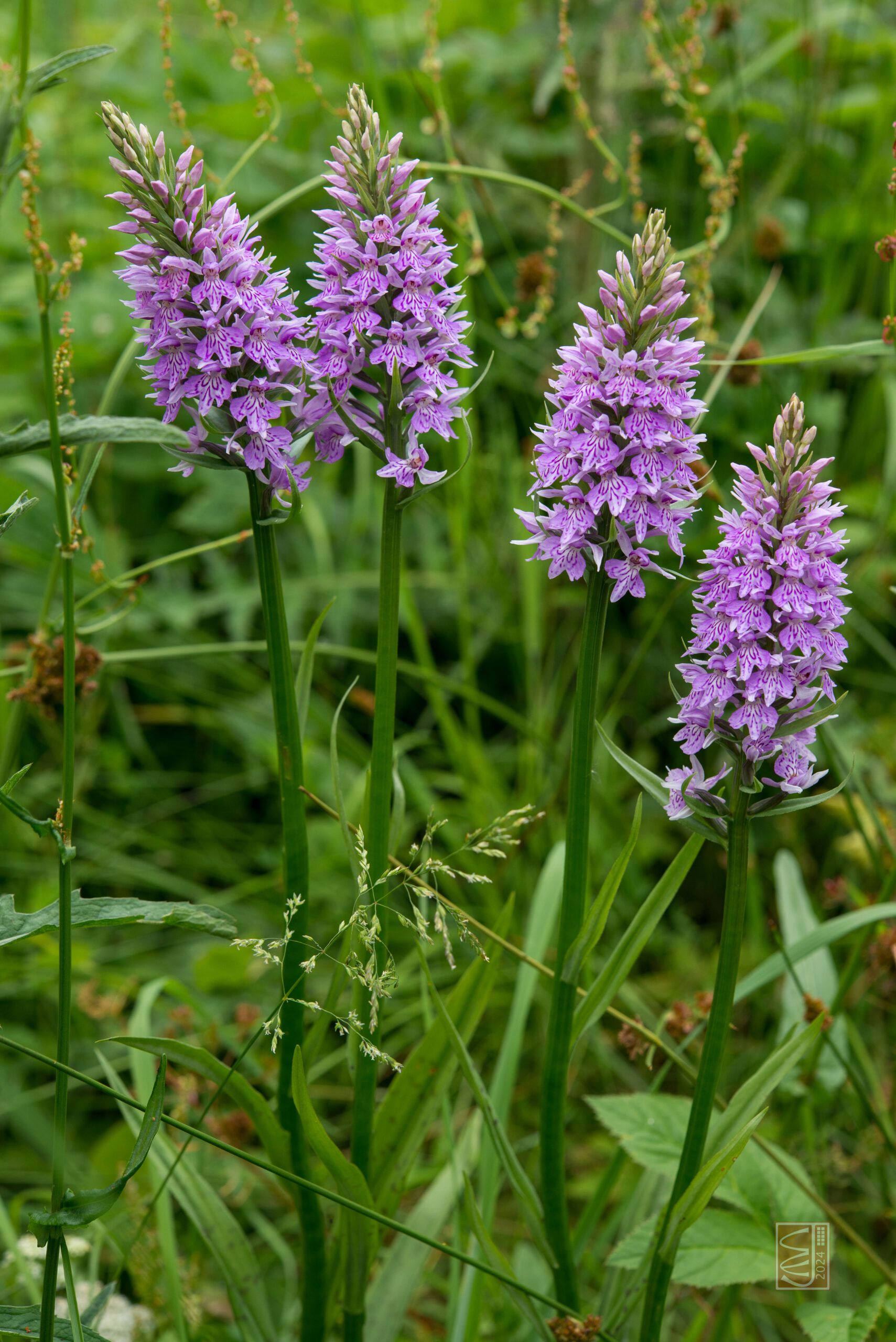
Dactylorhiza fuchsii – July 8th 2024 – (Common Spotted Orchid)
This is the orchid you are most likely to encounter on walks, unless you live around Glasgow where the most common is Broad-leaved Helleborine. More about that one in a future blog.

Colony of Dactylorhiza fuchsii at Dawyck in Peebleshire, South Scotland. Image; Chris Jeffree.
Orchids are alluring subjects for botanists, gardeners and florists alike. I suppose we may call them ‘charismatic’, although how does that allure come about? They are colourful and somewhat mysterious, and they are also capable of deception (attracting pollinators). In this week of Elections in Britain and France, we realise that orchids have much in common with charismatic political figures.
Their mystery (the orchids, that is, not the politicians) lies partly in their reproductive habits (pollen grains aggregated into packages called pollinia, borne on delicate stalks called caudicles), and partly in their complex and still-mysterious below-ground relationship with fungi (their tiny seeds depend on the food provided by diverse fungi).

Early-stage of development, showing the conspicuous leaf markings. Image: Chris Jeffree.
Dactylorhiza is a large and widely distributed genus throughout Europe and Asia, containing the spotted orchids and the marsh orchids. Dactylorhiza fuchsii is a native perennial to be found growing on a wide range of soils, neutral or base rich. We find it in meadows, grasslands, dunes, and deciduous woodlands. We also find it in man-made locations, including derelict land, quarries and railway embankments. It has appeared many times in our survey of Scottish towns – sometimes unexpectedly on suburban lawns and once beside the Edinburgh tram line. It does tend to occur on moist soil and nitrogen-poor soils. It doesn’t like cultivated land: in one experimental study it was found that nitrogen fertilizer reduced its growth (McKendrick 1996).

Flower of Dactylorhiza fuchsii showing the 3-lobed labellum with the large triangular central lobe, and the familiar markings that guide the pollinating insects. Image: Chris Jeffree.
Flowers appear from May to July. They are pollinated by large insects, most commonly by Bumble Bees and Honey Bees (Dafni and Woodell 1986). In the primeval Bialowieża forest of Poland it is pollinated by Longhorn Beetles instead (Gutowski 1990). Where insect pollination fails, there is a back-up mechanism for self-pollination (Tałałaj et al 2019). As in most orchids, the seeds are tiny, said to be ‘dust-like’ and in the soil they germinate with the help of fungi to form unique structures called protocorms, less than 0.5 mm in diameter. New research at the University of Sheffield shows that further development is enabled by nutrient supplies coming via a fungal network from the parent plant, like ‘mother and child’ (Read et al 2024). This remarkable discovery helps to explain why orchid plants are seen in clumps, presumably because they are connected through the fungal network.

Tuberous root with its characteristic fingers. Image: Chris Jeffree.
Dactylorhiza fuchsii is fairly easy to identify. It has a solid stem and the lip of the flower (‘labellum’) has three lobes with the central lobe triangular and exceeding the two laterals. This is nicely shown in Chris Jeffree’s image of a single flower. The plant nearly always has dark spots on its leaves. Flower colour varies quite a lot: lilac-coloured is common but it can be paler, even completely white.
Clapham et al (1987) listed three subspecies of Dactylorhiza fuchsii, the most common being subsp. fuchsii which is “Widespread throughout the British Isles”. Less common are the other two: subsp. hebridensis (found in the Hebrides and also in Cornwall, W. Ireland, N.W. Scotland and Orkney) and subsp. okellyi which grows on limestone pavement in W. Ireland and the Isle of Man, and is known as O’Kelly’s Spotted Orchid after Patrick Bernard O’Kelly, a botanist from the Burren in W. Ireland. O’Kelly’s has white flowers, sometimes faintly tinged pink (not to be confused with the occasional albino mutants that occur in Dactylorhiza).

Developing seed capsules. Images: Chris Jeffree.
However, Stace (2019) disagrees with Clapham; in his New Flora of the British Isles he says it is doubtful whether these should be considered as subspecies. He goes on to list six hybrids which have arisen by natural crosses with closely related species. I confess to have never achieved a working knowledge of the subspecies and hybrids of Orchids. I leave all that to the orchid specialists. The recent BSBI book on Britain’s Orchids points out that most of the Dactylorhiza species of Britain and Ireland are closely related and they can form ‘hybrid swarms’ with a bewildering range of colours, sizes and markings (Cole and Walley 2020).

Seed capsule cut open to reveal abundant small seeds. Images: Chris Jeffree.
Orchids have a long evolutionary history. Pollen has sometimes been found attached to the bodies of pollinating insects that have become trapped in amber. For example, Ramirez et al (2007) found pollinia on the body of an extinct stingless bee, from the late Cretaceous (100 million years ago to 66 million years ago). In contrast, the genus Dactylorhiza is quite a modern branch of the Family. By means of molecular genetics and cladistic analysis it has been possible to construct an evolutionary tree from Dactylorhiza samples collected throughout Europe (Brandrud et al 2020). Their ‘tree’ shows D. fuchsii as a recent offshoot, splitting from two Mediterranean species, D. gervasiana and D saccifera only 1-2 million years ago.

Evolutionary tree of European Dactylorhiza from Brandrud et al (2020). This is an open access publication covered by a Creative Commons Licence. The species abbreviations are: Eux = D. euxina, Fol = D. foliosa, Fuc = D. fuchsii, Ger = D. gervasiana, Ibe = D. iberica, Inc = D. incarnata, Sac = D. saccifera, Sam = D. sambucina, Umb = D. umbrosa, Vir = D. viridis.
We may presume that evolution in this group of Orchids is still in progress. With so many forms, different ploidy levels and a rapidly changing environment, who knows what the future may hold for Dactylorhiza?
The name Dactylorhiza comes from the Greek words for ‘finger’ and ‘root’ and it refers to the finger-like tubers. The specific name fuchsii is given in honour of the German botanist and herbalist Leonhart Fuchs who published De historia stirpium commentarii insignes (translated as Notable commentaries on the history of plants) in 1542. His work is honoured also in the genus Fuchsia.

British and Global distribution of Dactylorhiza fuchsii. Left: from BSBI; Right: from GBIF
References and other articles consulted
Bateman RM (2021) Challenges of applying monophyly in the phylogenetic shallows: taxonomic reappraisal of the Dactylorhiza maculata group. Kew Bulletin 76, 675–704. https://doi.org/10.1007/s12225-021-09971-2. This is an Open Access Publication.
Brandrud MK et al (2020) Phylogenomic Relationships of Diploids and the Origins of Allotetraploids in Dactylorhiza (Orchidaceae), Systematic Biology, 69, 91–109. https://doi.org/10.1093/sysbio/syz035. This is an Open Access Publication.
Clapham AR Tutin TG and Moore DM (1987) Flora of the British Isles, Third Edition. Cambridge University Press.
Cole S and Waller M (2020) Britain’s Orchids. BSBI and Princeton.
Dafni A and Woodell SRJ (1986) Stigmatic Exudate and the Pollination of Dactylorhiza fuchsii (Druce) Soo., Flora,178, 343-350. https://doi.org/10.1016/S0367-2530(17)31521-9.
Gutowski JM (1990) Pollination of the orchid Dactylorhiza fuchsii by longhorn beetles in primeval forests of Northeastern Poland. Biological Conservation 51, 287-297.https://doi.org/10.1016/0006-3207(90)90114-5.
Lang D (1980) Orchids of Britain. Oxford University Press.
McKendrick SL (1996) The effects of fertilizer and root competition on seedlings of Orchis morio and Dactylorhiza fuchsii in chalk and clay soil. New Phytologist 134, 335-342. https://doi.org/10.1111/j.1469-8137.1996.tb04638.x
Read DJ et al (2024) Photosynthate transfer from an autotrophic orchid to conspecific heterotrophic protocorms through a common mycorrhizal network. New Phytologist 243, 398-40. https://doi.org/10.1111/nph.19810. This is an Open Access Publication.
Stace CA New Flora of the British Isles, Forth Edition. C&M Floristics.
Tałałaj I et al (2019) Spontaneous caudicle reconfiguration in Dactylorhiza fuchsii: A new self-pollination mechanism for Orchideae. Plant Systematics an Evolution 305, 269–280. https://link.springer.com/article/10.1007/s00606-019-01570-w
Yeung EC et al (2019) An overview of the life of an orchid protocorm –
a developmental perspective. Acta Horticulturae 1262, 13-22,
https://doi.org/10.17660/ActaHortic.2019.1262.3
©John Grace