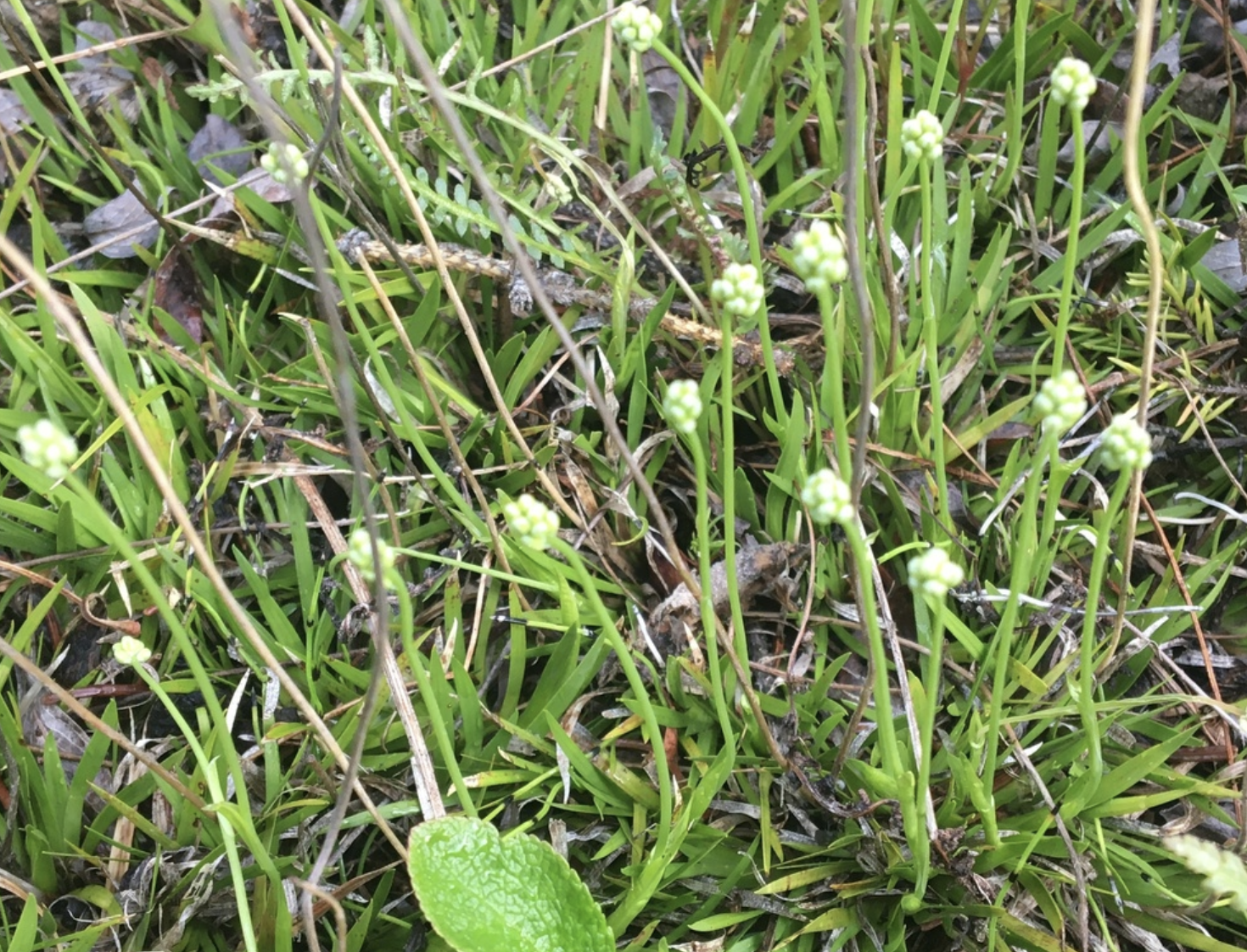
Tofieldia pusilla – February 10th 2025 – Scottish Asphodel
Scottish asphodel looks like a miniature version of last week’s plant (Bog asphodel), but is much smaller, much rarer, and its flowers are whitish not yellow. I have seen it only a few times, always on Ben Lawers. Both plants were once considered to belong to the Lily Family Liliaceae, but they have been taken out and placed in Families of their own (Tofieldiaceae and Nartheciaceae). I’m not sure if this counts as a demotion or a promotion, but they are so similar that surely they should be together. A clue to its small size is its name, Tofieldia pusilla. It was named Tofieldia to honour an 18th century British botanist Thomas Tofield (1730-1779), but the specific name pusilla is from the Latin for ‘very small’, as in the English word pusillanimous meaning ‘small spirited’ or weak.

Tofieldia pusilla, Lurcher’s gulley, Cairngorm. Image: Chris Jeffree.
Scottish asphodel is a native to much of the northern hemisphere, with a circumpolar distribution. In North America they call it Scotch false asphodel. In Britain it was first discovered by parson-naturalist John Ray (1627 – 1705) on a visit to Scotland. He called it Asphodelus palustris Scoticus minumus, and found it near to Berwick. He thought he was in Scotland but he may have still been in England (in North Northumberland, Braithwaite 2004). Another parson-naturalist, John Lightfoot (1735-1788) reported it on the isle of Rum (“upon a mountain call’d Baikevall”) in 1772. This may be the first Scottish record but there are many early records.

The leaves are flattened and form ‘fans’. Attribution via wikipedia: Ellyne Geurts
Like the Bog asphodel, the Scottish asphodel is a perennial plant with rhizomes, and its leaves are roughly sword-shaped, fanning out from a central point. Leaves have been described as iris-like: they are hairless, toothless and stalkless. The flowers are produced between June and September but not all plants produce flowers at the same time. They are carried as spikes on stalks that rise above the leaves. Each flower has 6 tepals, 3 styles, and 6 stamens. The flowers have no nectary and I can find no records of insects visiting them. The stamens point inwards (‘introrse’), not outwards as in Bog asphodel, and this is taken as a sign that it may often be self-pollinated. It does produce flowers and seeds and perhaps these are dispersed short distances when the ‘flush’ of water washes them away.
It grows in open, lime-rich locations that are wet, usually with a steady trickle of water. Its requirement for nutrients is low.

Flowering spikes emerging through other vegetation. It generally does not tolerate competition. Image: Chris Jeffree.
Tofieldia pusilla is one of the species that characterises the flora of Teesdale, an assemblance of rare arctic-alpine species presumed to be a relic population at the southern edge of its range (Bradshaw 2023). Margaret Bradshaw and her many helpers have monitored the Upper Teesdale plants since the 1970s, and she reports a decline in this species (others too!). She says “Some of the declines are attributable to the effects of grazing animals. Plants are sometimes pulled up by sheep eating the fruiting heads and those growing on the edges of streambanks may be destroyed by cattle trampling”. I discovered her book just a few weeks ago – it’s her only book and published when she was 97 years old. Above all, it demonstrates the importance of long-term monitoring for the management of our remaining wild places.

Inflorescence. Attribution: Wolfgang Bacher – some rights reserved (CC BY-NC) https://www.inaturalist.org/taxa/169783/browse_photos
Long-term recording has also been important for conservation of the flora of Ben Lawers in the Breadalbane region of the Scottish Highlands, the mica-schist substrates and the ‘headquarters’ of most of our arctic-alpine species in Scotland (Ross et al 2015). The author stresses the impact of climate change, but I suspect other factors including grazing and atmospheric deposition of pollutants are at least as important. Work at Ben Lawers has shown that at least some sheep grazing is required, as it prevents the faster growing species from smothering the small plants such as Tofieldia pusilla.

An example of a herbarium sheet, showing the structure of the plant including the root system. The older name Tofieldia palustris has been used. The specimens are labelled as 1844 from the herbarium of William Gardiner of Dundee, known as the ‘Dundee poetical botanist’. He was a Scottish umbrella maker, poet, and bryologist. The Botanical Society of Edinburgh employed Gardiner in 1838 to collect Alpine plants in Scotland. The image is from the BSBI website. The ruler has been added later – it is in centimetres. The material in the lower right of the sheet has been enlarged to show the detail.
Bradshaw mentions ‘botanical collecting’ as one of the hazards that rare plants like this one face. I found a way to assess this claim. The BSBI have an on-line library of herbarium specimens. There are many for Tofieldia pusilla, most of them from the 19th century and many from Widdybank Fell in Teesdale. Evidently this was a period of intense collecting, starting in the 1830s and extending for several decades. It was a ‘craze’ rather like egg- and butterfly-collecting. Nowadays it’s illegal and photographs are deemed to be sufficient, but they must be good ones. The herbarium sheets show detail and variations between plants very well, and also provide an archive of plant tissue. Small fragments can be useful in research on climate change (Woodward 1987).

Left: British and Irish distribution of Tofieldia pusilla from BSBI (arrow shows the Teesdale records); right: gloal distribution from GBIF.
Acknowledgement: the image at the head of this article is from inaturalist and the author is Ryan Sealy – the licence is CC BY-NC
References consulted
Bradshaw M (2023) Teesdale’s Special Flora. Princeton University Press
Braithwaite, M.E. (2004) Tofieldia pusilla (Michx.) Pers. at the Scottish border, Watsonia 25, 207-208
Miller, G. R., Geddes, C., & Mardon, D. K. (2010). Effects of excluding sheep from an alpine dwarf-herb community. Plant Ecology & Diversity, 3(1), 87–93. https://doi.org/10.1080/17550871003713726
Ross, L. (2015) Climate change impacts on the vegetation of Ben Lawers. Scottish Natural Heritage Commissioned Report No. 879 Stewart A, Pearman DA and Preston CD (1994) Scarce Plants in Britain. JNCC Peterborough.
Stewart A, Pearman DA and Preston CD (1994) Scarce Plants in Britain. JNCC Peterborough.
Woodward FI. (1987) Stomatal numbers are sensitive to increases in CO2 from pre-industrial levels. Nature 327: 617–618.
©John Grace