Castanea sativa – October 13th 2025 – Sweet Chestnut (also called Spanish Chestnut)

Canopy of a mature Castanea sativa, flowering profusely. Image: Chris Jeffree.
The best general description of this tree might be the one by John Gerrard, the herbalist, written in 1597:
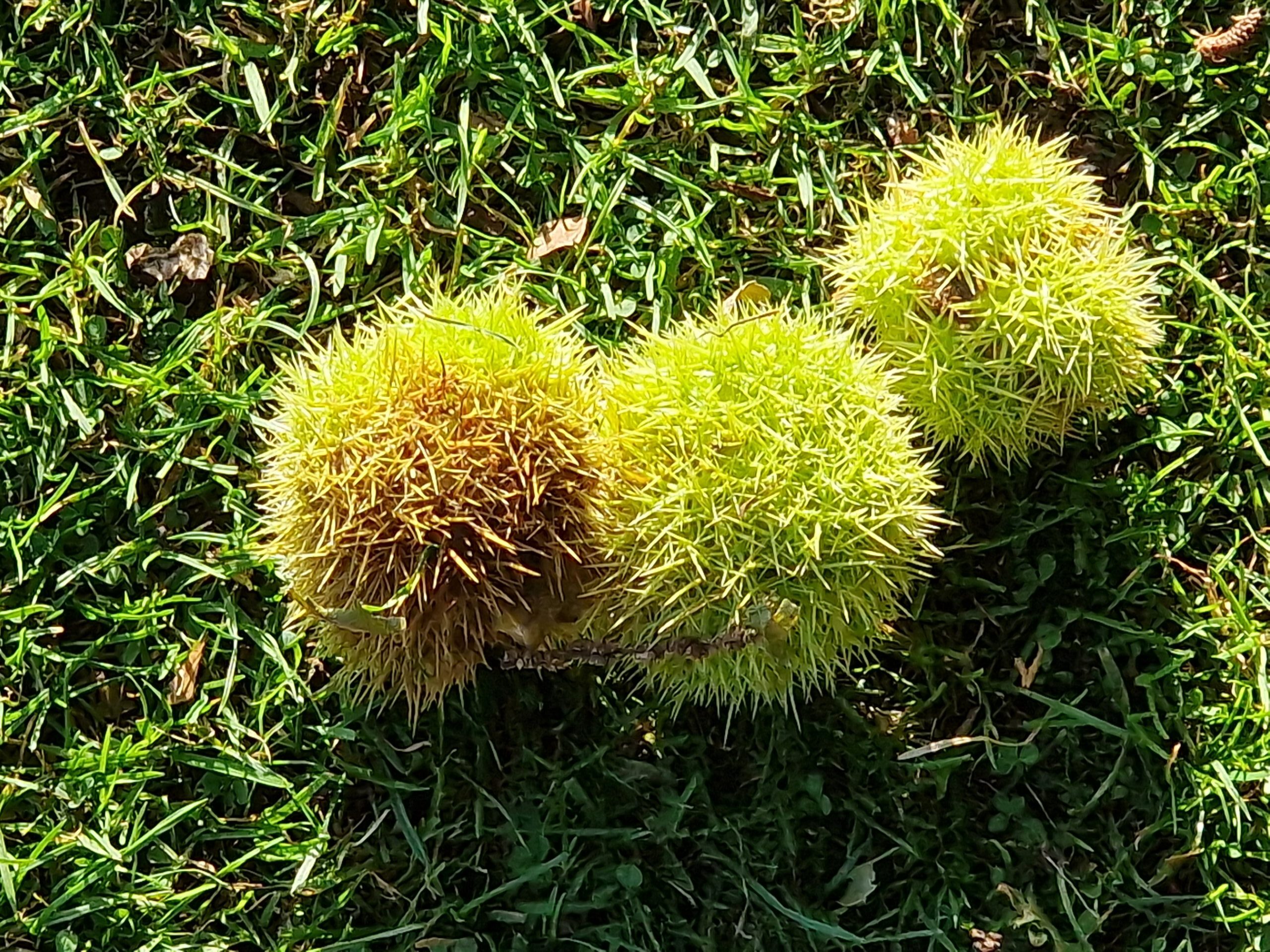
Last week, as soon as Storm Amy departed, we visited the Auld Kirk Burial Ground in Ayr. It is botanically interesting in several ways. As well as ancient gravestones encrusted with lichens and mosses, this graveyard contains an old Sweet Chestnut tree, and we were delighted to find a scattering of its spiny fruits, shaken down by Amy, laying smashed open on a fallen gravestone.

C. sativa in the Auld Kirk Burial Ground in Ayr, with fallen fruits. Image: John Grace.
Castanea sativa is a tree we don’t see very often in Scotland. It is well known to foresters in England, where the extra warmth suits it better and it has long been an important forestry species. Its native range is south-east Europe, and until recently people thought it had arrived in Britain with the Romans, along with many new plants and animals. This belief seems to have gained widespread support from Godwin’s landmark book The History of the British Flora (first published in 1956), then later from Oliver Rackham in his 1980 book Ancient Woodland and henceforth repeated as fact by many others.
However, recent research strongly suggests the tree may have arrived here later. An especially thorough analysis of plant remains from archaeological sites (wood, wooden artefacts, charcoal, nuts, pollen) was conducted by Jarman et al. (2019). These authors conclude:
“The present re-assessment has shown that none of Godwin’s citations of evidence of sweet chestnut being used or being grown in pre-Roman or Roman Britain can be sustained: the original records are either incorrect or cannot be definitively dated”.
And later they say:
“Sweet chestnut was certainly being grown in Britain (for its nuts and wood) by the twelfth century, but the date of its first planting is unknown”.

Male and female flowers of C. sativa. Leaves are 15-30 cm long. Image: Chris Jeffree.
I’m not an archaeologist but my reading of this interesting paper leads me to conclude that, despite a lack of evidence, the tree could well have been brought here by the Romans but perhaps not widely used. The Romans would have found plenty of other sources of wood and nuts, so why bother planting chestnuts when it takes over ten years to produce anything useful?
In Europe, Chestnut was widely cultivated for its nuts, from which a type of porridge was made. In medieval England it was grown in monastic gardens1 and later became appreciated as an ornamental tree. In Scotland it was popularised by Mary Queen of Scots and the oldest Chestnut trees in Scotland date from that era2.

Developing fruits. Image: John Grace.
The tree belongs to the Fagaceae, the Family of Beech and Oak. It is not related to the Horse Chestnut Aesculus hippocastanum even though its fruits strongly resemble those of Horse Chestnut. The tree can thrive on a range of soil types if the site is well-drained, but it is rarely seen on soils rich in lime, in fact it is mostly found on rather acid soils (pH between 4.5 and 6). A mature Chestnut tree is a sight to behold, a deciduous tree that may be 30 metres tall with a girth exceeding 10 metres and a dome-shaped canopy decorated with strangely scented flowers from late June to July. Male flowers are numerous, but females are few. They are organised on a slim, cylindrical flower cluster (‘catkin’), visited and pollinated by bees (and chestnut honey is available online). The nuts ripen in October but in the north of Britain they may not ripen properly.

Chestnuts purchased in an Edinburgh supermarket 8th October 2025. These are some of the earliest to appear on sale. Image: John Grace.
On the matter of nuts, I consulted WJ Bean’s book Trees and Shrubs Hardy in the British Isles. He writes:
“The ordinary C. sativa varies extraordinarily in the size and quality of its nuts. There are numerous trees in Kew Gardens, some of which bear fruit and others that never produce a nut worth eating. The merit of the better forms seems to be due largely to their being able to supress all but one of the three or four nuts which each bur normally encloses. This enables the survivor to develop into a fine nut”.

Demonstration of inferior Scottish nuts. Image, John Grace.
On October 10th I gathered two fruits from the ground around a sweet chestnut tree at the Royal Botanic Garden, Edinburgh, thinking that the ‘hot summer’ of 2025 would produce a decent crop. The opened fruit had three nuts but they were inferior to those imported from Spain (one of the Spanish nuts is shown for comparison). I spied a Grey Squirrel with a fruit in its mouth, but I wasn’t quick enough to record the incident on my camera. Other squirrels were busy searching the canopy for a meal.
In mediterranean countries chestnuts have sometimes been a staple food for country folk. In southern Britain3, good nuts are produced in warm summers. Imported nuts are sometimes sold from braziers as street food, but this trade seems to be dying out. I used to buy imported chestnuts at Christmas from local grocers, to be roasted on an open fire but alas, most batches were rotten, and so I’ve given up. To enjoy chestnuts as food, Italy is the place to be. The next best thing, if you are in Britain, is to buy them vacuum-packed from a local supermarket. Or try chestnut honey, imported from Hungary or Italy and readily available online; the colour is deeper and richer than normal honey and the taste reminds me of fine malt whiskey (presumably it’s the tannins from the whiskey barrel that makes it so).

Left: C. sativa distribution in Britain and Ireland, from BSBI/Maps. Right upper: Native and introduced range according to Kew’s Plants of the World Online (NB it is supposed that the species was introduced to Italy by the Ancient Greeks). Right lower: present world distribution from GBIF.
Sweet Chestnut is widely planted in the southern Counties of England. The wood resembles oak and is good for veneer work, but mature boles suffer from a condition called ‘shake’ (whereby the growth rings become separated) and a fatal disease called ‘ink’ caused by a soil-borne organism (one or more species of Phytophthora). However, plantations provide useful timber for carpentry, joinery and furniture. In the south-east of England the species is grown as coppice, sprouting numerous fine poles from the cut stump, very good for a type of rural fencing (‘paling’).
There is a disease called Sweet Chestnut Blight caused by the ascomycete fungus Cryphonectria parasitica. The disease is common in North America and in parts of Europe. So far, it is rare in Britain. The public are urged to contact Tree Alert whenever a sick tree is seen https://www.forestresearch.gov.uk/tools-and-resources/fthr/tree-alert/
Notes
1Aelfric, Abbot of Eynsham, 955?-1020?
2The oldest is thought to be the one at at Castle Leod, Strathpeffer, said to have been planted in 1550 for Mary Queen of Scots’ mother, Mary of Guise. Another early one was Queen Mary’s Tree in North Lanarkshire reputedly planted by Mary Queen of Scots in 1561 during a visit to Cumbernauld Castle. She planted another when she visited the abbey in 1565 (Balmerino is a small village and former monastic centre in Fife).
3A reader from Bedfordshire has commented as follows: “I am lucky to live near some chestnut trees in Bedfordshire and have just foraged and eaten some this weekend. Most years they have a good crop and this year has been amazing, so I’m basically saying that people round here are still appreciating this great tree and I hope you get to try some decent chestnuts sometime soon”.
References consulted
Bean WJ (1976) Trees and Shrubs Hardy in the British Isles. Vol. 1. John Murray
Everard J and Christie JM (1995) Sweet chestnut: silviculture, timber quality and yield in the Forest of Dean. Forestry 68, (2), 133–144
Jarman R et al. (2019) Sweet chestnut (Castanea sativa Mill.) in Britain: re-assessment of its status as a Roman archaeophyte. Britannia 50, 49-74.
Paganelli, A., & Miola, A. (1991) Chestnut (Castanea sativa Mill.) as an indigenous species in northern Italy. Alpine and Mediterranean Quaternary, 4(1a), 99-106.
©John Grace