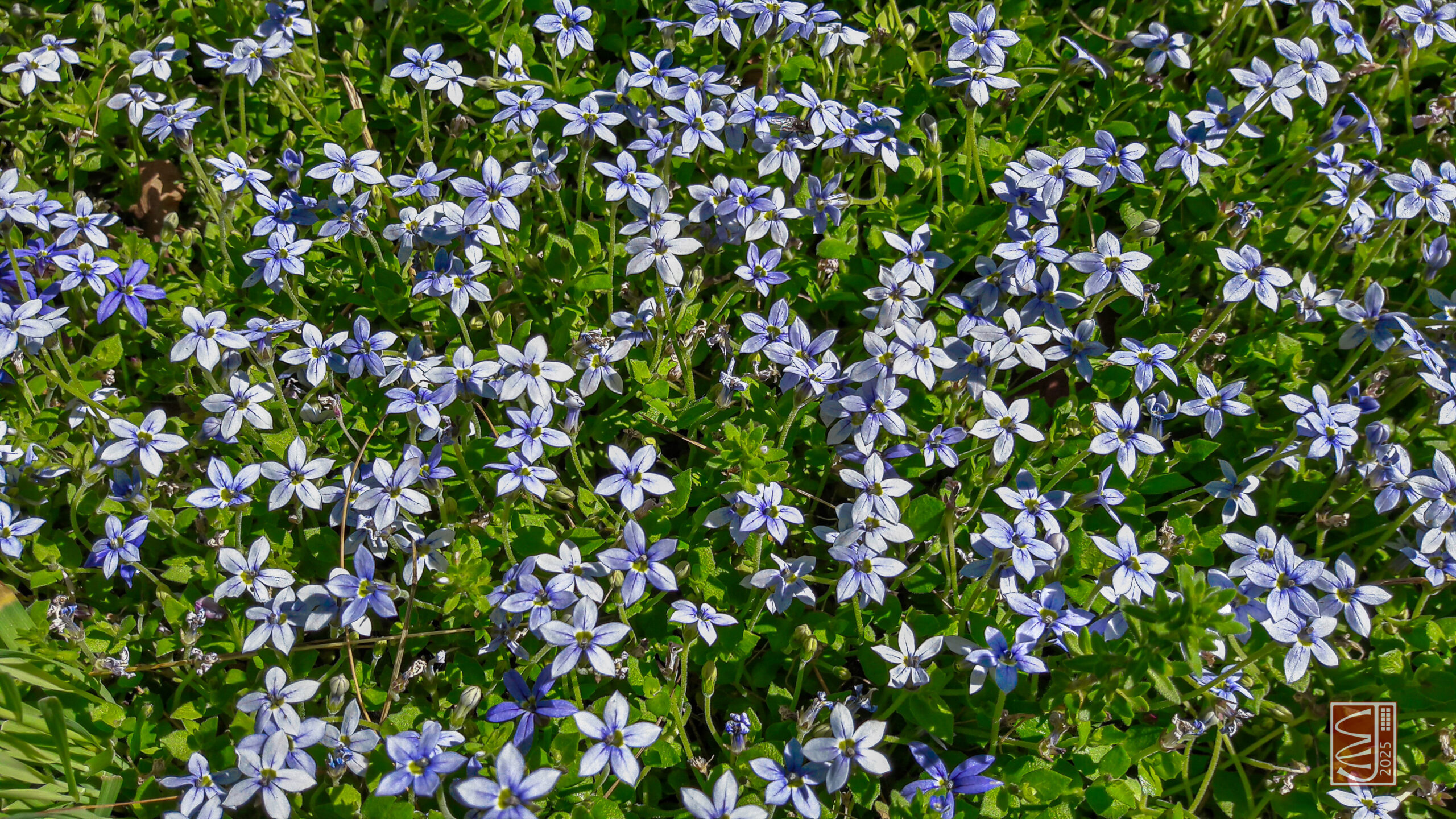
Pratia pedunculata – November 24th 2025 – Blue Lawn-lobelia
Pratia pedunculata is a recent newcomer to our land, arriving from Australia and not recorded in Britain until 2000. You will not find its name in most of your flower books, but it does squeeze into the 4th Edition of Stace’s New Flora of the British Isles published in 2019.
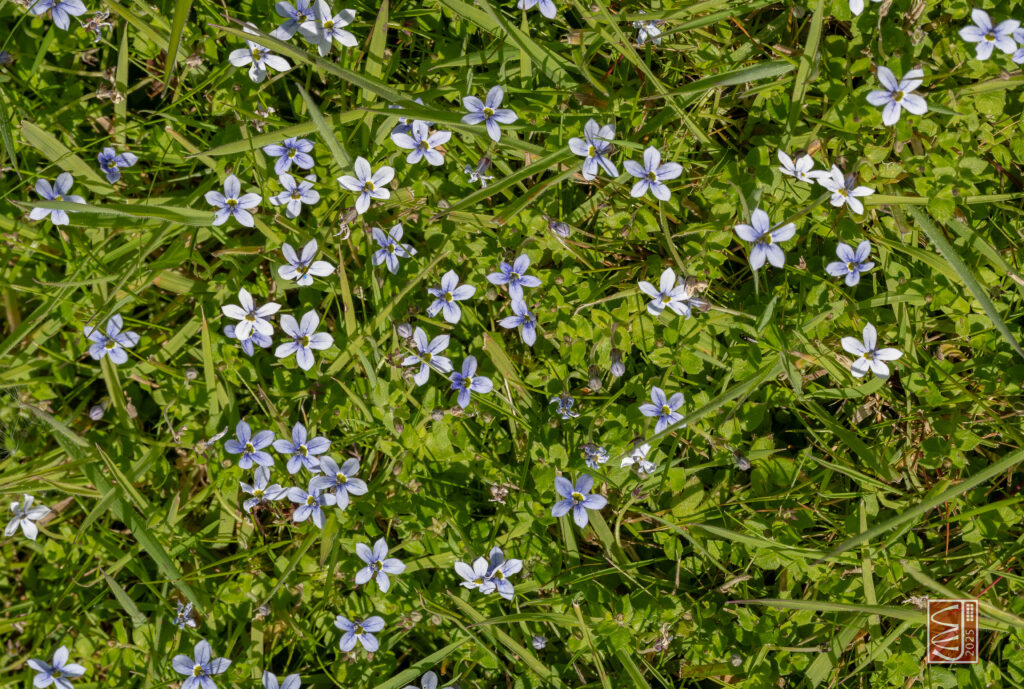
Pratia pedunculata in flower, invading a lawn at Lesmahagow (Lanarkshire). Image: Chris Jeffree.
It’s a creeping mat-forming perennial with pretty blue flowers. It joins a related species, Pratia angulata which hails from New Zealand, appearing in Britain sometime in the 1930s. Together they are called ‘Lawn-lobelias’ and they are placed with other lobelias in the Family Campanulaceae, the Bellflowers. Sometimes the genus is called Lobelia but we are following Stace’s 4th Edition, and so we call it Pratia.
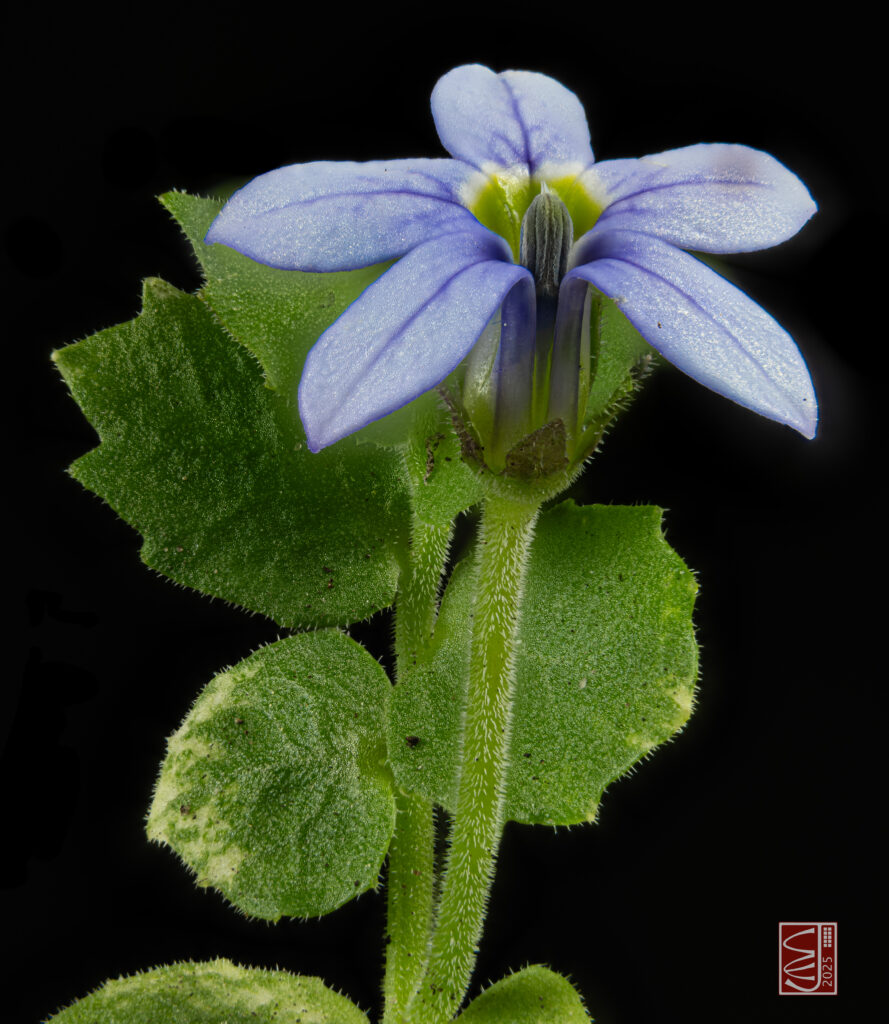
Detail of Pratia pedunculata: note the hairs. This appears to be a male flower (see the note and image on sexuality at the end of this article). Lobelias usually have two-lipped tubular flowers, each with five lobes, but Pratia has lost this character and has almost perfectly symmetrical (‘actinomorphic’) flowers. Image: Chris Jeffree
These two species are found in lawns. Although P. pedunculata came here much later than its New Zealand relative, it has escaped private lawns to outnumber P. angulata at least in southern Britain. In Scotland the first record was 2002 from Galashiels, followed a year later from Jedburgh, and now there are 16 records. As well as lawns, it is known to have spread in garden rockeries.
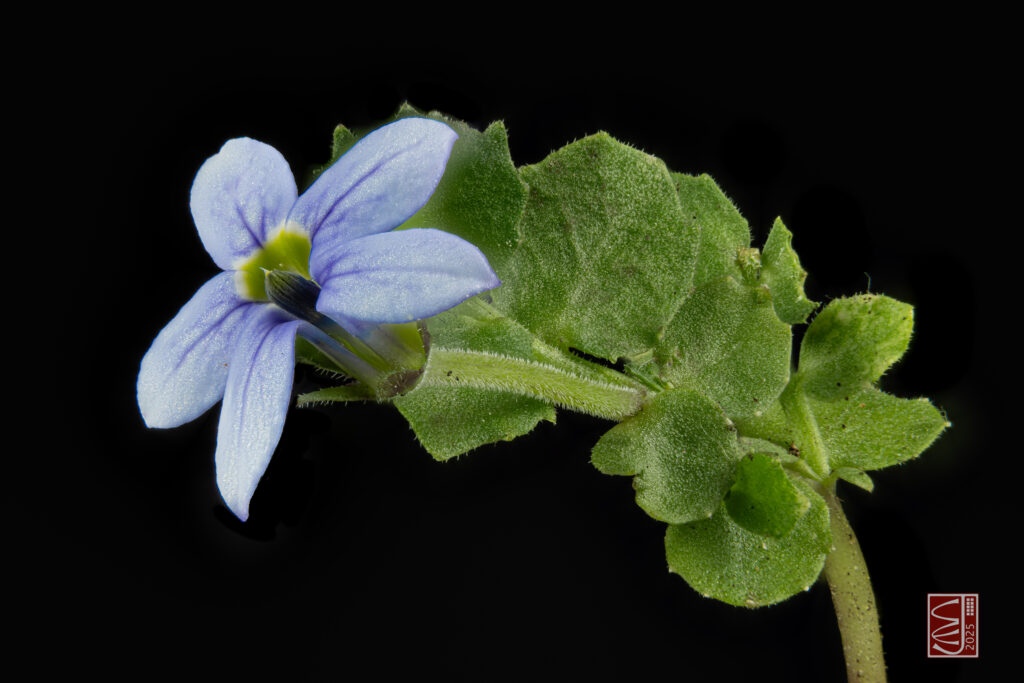
Pratia pedunculata, showing arrangement of the leaves and curvature of the stem. Image: Chris Jeffree.
An early mention of this species in Britain can be found in the 2004 BSBI News (Clement 2004). The author quotes from house-holders: “It has taken over a lawn” and “on a mown area outside a garden, forming a patch 12 x 6ft”.
The species may of course have been overlooked by BSBI recorders who seldom venture onto private land, and who might have confused it with P. angulata. The differences are: ‘leaves hairy’ for P. pedunculata versus ‘leaves hairless’ for P. angulata. Also the flower colour is different: P. pedunculata has blue flowers and P. angulata usually has white.
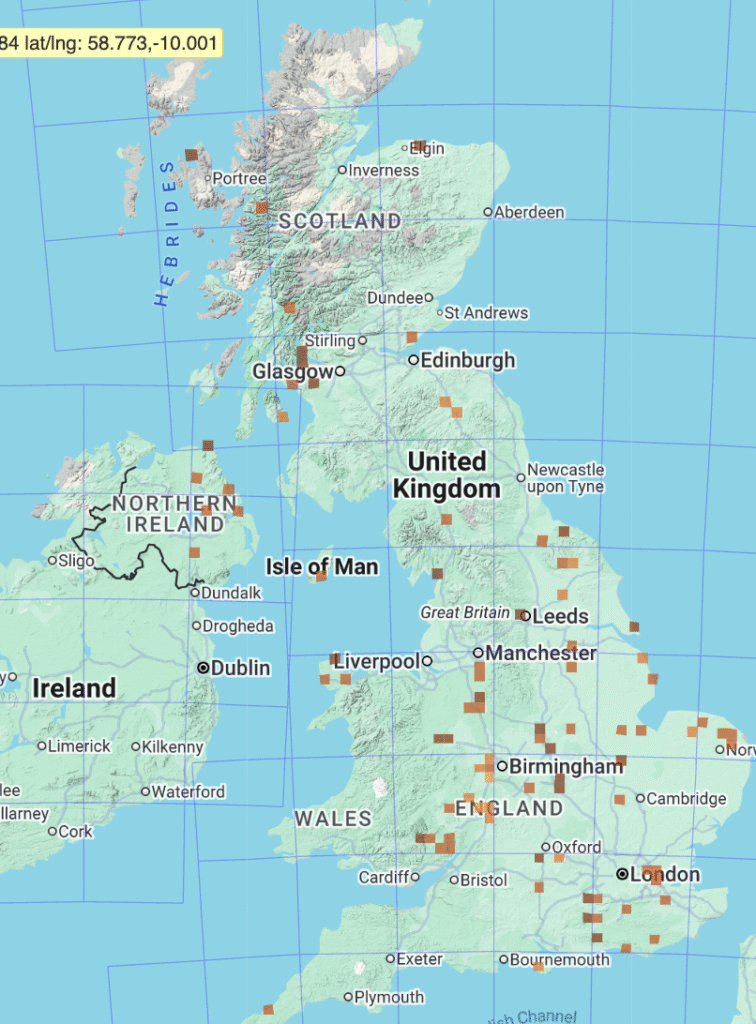
British and Irish distribution of Pratia pedunculata, from BSBI data 2025.
As for habitat, we may learn something from its Australian ecology: “grows in swampy places on damp ground, margins of rivers and lakes and in wet sclerophyll forest, chiefly on the ranges”. There is no mention of lawns. In Britain, parts of the nursery trade has embraced it, and one company, Hardysplants, says “it is one of those plants that every gardener should have in their armoury. Preferring a damp fertile soil in part shade, it will spread to fill and light up a shadier area of the garden but also happily inhabit gaps between paving slabs, softening harsh edges. Perfect for edging a path or the nooks and crannies of a rockery, if it spreads too much, simply dig up the unwelcome sections”. The same trader says “Ankle-high and rather dainty, Lobelia pedunculata spreads across the ground like a gentle fresh green wave studded with tiny starry pale blue flowers in late summer”. This is beautiful and persuasive writing, but I’ll not place my order yet.
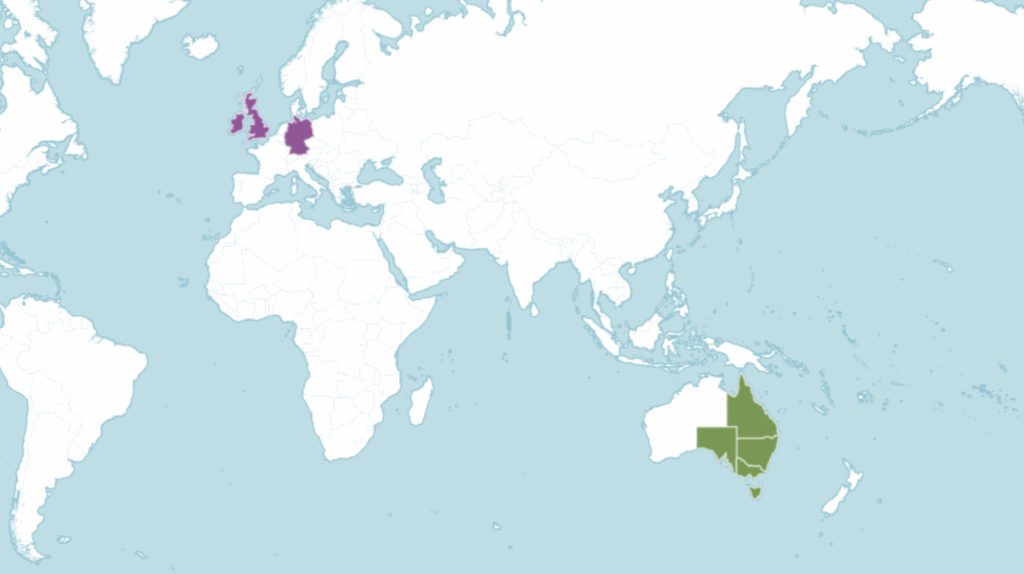
Global distribution according to Plants of the World On-line. Green is the native range and purple is where the plant has been recorded as an alien.
There is however an emerging trend to get rid of grass lawns altogether and to replace them with an assemblage of mat-forming perennials. A green covering of mat-forming perennials both native and alien might provide a labour-saving alternative and be good for the bees and other insects. I found many articles by Lionel Smith (Reading University) pointing out the benefits and arguing the case for what are called ‘tapestry lawns’. Pratia (Lobelia) pedunculatum is one of the species mentioned. There are good images here.
I’m not sure how hard-wearing these lawns would be, nor how long they might last. I suspect some species would decline whilst others would outpace the crowd. Are lawn-lobelias likely to be invasive in our native grasslands? It’s too early to say.
Note
The species is dioecious (separate male and female plants), and currently it is not clear how often the male and female occur together and produce seeds. The image below suggests they do occur together but more observations are required.

The image shows two flowers (bottom left and mid-right) with stigmas, so presumably it’s a female amongst staminate (male) flowers. Image: Chris Jeffree.
References consulted
Clement EJ (2004) Another lawn Lobelia: Pratia pedunculata. BSBI News 95, 46-7. See page 46 of this newsletter at https://archive.bsbi.org/BSBINews95.pdf
Martín-Forés I et al. (2023) The Alien Flora of Australia (AFA), a unified Australian national dataset on plant invasion. Scientific Data 10.1: 834.
Smith LS et al. (2015) Adding ecological value to the urban landscape. Insect abundance and diversity in grass-free lawns. Biodiversity and Conservation 24, 47-62.
Stace CA (2019) New Flora of the British Isles. C&M Floristics.
©John Grace